

Pathologist (My grandfather, ex-USAF intelligence used to say, “Stay away from people.”)
Joined March 2018
- Tweets622
- Following360
- Followers1.2K
- Likes937
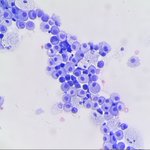




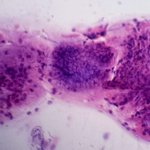

This came to me as negative for malignant cells from the cytotech. These deceptively bland cells are all basically all malignant and BER-EP4 positive. Take a guess about their origin. #boardfodder


The hardest part about being a mom is that the whole family attitude of every day is reflective of my attitude. Wake up sleepy, be grateful, be cheerful.
But really, what right would I have to be dismal?


Kathryn Lindsey retweeted

Nothing is more destined to create deep-seated anxieties in people than the false assumption that life should be free from anxieties
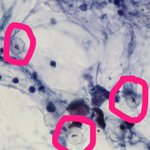
Lung mass, post transplant. FNA. What is this morphologically consistent with?
#Boardfodder


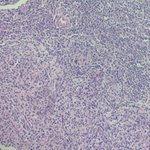
5cm Lung Mass. Which mutation is more likely: EGFR or KRAS?
#Boardfodder

Kathryn Lindsey retweeted

Children who take music lessons develop a larger corpus callosum, the bridge between the two halves of the brain, and the change is permanent. A 2005 review in the Annals of the New York Academy of Sciences found that early music training produces structural brain changes that persist into adulthood, even if the person stops playing.
The review was led by Gottfried Schlaug at Harvard Medical School, one of the leading researchers on music and the brain. He found that children who started instrumental training before age seven had a significantly larger anterior corpus callosum than non-musicians, and the size difference was still visible in adults who had not touched an instrument in years.
The corpus callosum carries signals between the left and right hemispheres. A larger one means faster, richer communication between the two sides, and the effect shows up in tasks that have nothing to do with music: spatial reasoning, verbal memory, and the ability to process multiple streams of information at once. The music built the highway, and the brain uses it for everything.
Schlaug also found that musicians had larger cerebellums, the region involved in timing and motor coordination, and more grey matter in the areas that process sound. The brain had physically reorganised itself around the demands of the instrument, and the reorganisation was visible on a scan.
The age window matters. Children who started before seven showed the largest changes. Children who started after ten showed smaller ones. Adults who took up an instrument for the first time showed the least structural change, though they still showed some. The brain is most willing to be rebuilt by music during the years when most parents are debating whether to sign their child up for lessons. pubmed.ncbi.nlm.nih.gov/1659…


