patients.app (@PatientsApp) header
patients.app (@PatientsApp) profile picture

Health AI should actually work

New York, USA
Joined October 2024
Photo by patients.app (@PatientsApp)Photo by patients.app (@PatientsApp)Photo by patients.app (@PatientsApp)Photo by patients.app (@PatientsApp)
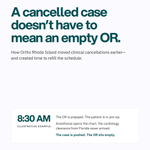
A cancelled case doesn’t have to mean an empty OR. At Ortho Rhode Island, earlier visibility into patient records gave the care team more time to act—and more time to refill the schedule. Here’s what changed. 🧵
1
2
1
3
1,236
Who is that guy 😉
a little intro and trying out twitter video!
1
2
88
We just tried @firecrawl and pretty impressed so far
1
35
the next one is going to show computer use and browser agents taking over healthcare workflows aren’t complicated. the data just lives behind multiple portals and logins that take up the time of too many humans building for niche workflows takes time and effort and i feel like there are going to be lots of companies going for that in various parts of healthcare
Healthcare is now AI’s biggest vertical market. Spend grew 2.5x to $3.7B this year, more than double legal ($1.8B) and more than legal and finance combined. It started in paperwork: scribing and billing. Now it’s moving into drug discovery, patient engagement and clinical decision support. Clinical copilots alone grew 5.5x to $550M. Our 2026 State of AI in Healthcare report from @grgyap, @jpsanday, @CroomBeatty, @hu_j, @derekgxiao and @sabrinarlu: mnlo.vc/2026-healthcare-ai-r…
3
1
22
2,239
❤️ @akiffpremjee inspiring the next generation of super engineer MDs, hopefully like him they will come work with us and do real clinical work
got some good responses to this and working on an advanced version for all the big ballers
1
4
59
can confirm both as a clinician and a product person building tools for providers and practices that no one wants to leave their EMR to log into your app computer use and browser use become even more valuable here. epic is a different beast but many other EMRs being browser based these days unlocks a ton don’t make people go to a different tool!
Health systems I'm chatting with are saying the challenge for them is they'd probably go with a B minus solution from Epic even over an A plus from a vendor. There's basically no point in hearing the pitch if the solution isn't integrated into the Epic workflow.
9
1
62
6,410
"doing 75% of a workflow is less useful than doing none of it"
great take here and very interested in the work being done @joinBunkerhill we are doing similar things in the ASC space and it aligns with my general thesis that doing 75% of a workflow is less useful than doing none of it. you really need to be able to own something end to end (or make it very easy for someone to do the next step)
1
2
354
great take here and very interested in the work being done @joinBunkerhill we are doing similar things in the ASC space and it aligns with my general thesis that doing 75% of a workflow is less useful than doing none of it. you really need to be able to own something end to end (or make it very easy for someone to do the next step)
1
3
1
12
2,105
Replying to @karanbains
yeah health systems are always hard - we’ve found great success doing this at ASCs for pre op clearance @PatientsApp
1
2
92
We won Silver 🥈 in the Ambulatory Surgery Center News (ASCN) Product of the Year (POY) Awards! We are in the Clinical Quality, Patient Safety & Outcomes Technology. A special thank you to Ortho Rhode Island for the nomination. #ASCNPOYAwards
4
94
Dr @akiffpremjee sharing how we think about agents for health care and how we are bringing them to Ambulatory Surgery Centers... 👀
rise of personal agents has been interesting and shift to enterprise use cases is v tempting healthcare is great for this but agree that the model of how to do this in a compliant way is key the second path mentioned in this post is what we are working on at @PatientsApp for the ASC space basically everything before a procedure can be augmented in some way. not all of it means replacing humans (though some tasks like fax triage, referral triage, etc fit in this bucket). clinical clearance is an area where an agent sifting through thousands of pages of records both improves and accelerates clinical teams in healthcare we often seen obstacles that lengthen the process of getting to the care that a patient needs and the ASC space is full of these (referral, clearance, auth, etc) the agent as a user model works better for us because it effectively gives the agent the same tools everyone else works in so that when things do need human input they are in the systems you actually work in and follow the same workflows that the rest of the staff is using
1
67
rise of personal agents has been interesting and shift to enterprise use cases is v tempting healthcare is great for this but agree that the model of how to do this in a compliant way is key the second path mentioned in this post is what we are working on at @PatientsApp for the ASC space basically everything before a procedure can be augmented in some way. not all of it means replacing humans (though some tasks like fax triage, referral triage, etc fit in this bucket). clinical clearance is an area where an agent sifting through thousands of pages of records both improves and accelerates clinical teams in healthcare we often seen obstacles that lengthen the process of getting to the care that a patient needs and the ASC space is full of these (referral, clearance, auth, etc) the agent as a user model works better for us because it effectively gives the agent the same tools everyone else works in so that when things do need human input they are in the systems you actually work in and follow the same workflows that the rest of the staff is using
Company idea - Instinct for healthcare workers It’s clear to me that people are going to try to use personal AI tools like Instinct to do things at their job. Does your job require you to get data from different places and fill out a lot of forms? Or send a lot of follow up emails, etc.? Or make updates to various google docs where you lowkey don’t know where that doc even lives? This tool is EXTREMELY tempting to use for that because it’s excellent at that. However this is also a security and privacy nightmare. These personal AI tools can basically mimic you as they go through your systems which is what makes them useful but also very scary. It even knows to switch to a YouTube short for like 10 seconds before switching back to the task at hand. So any company that touches PHI, or sensitive data has to watch out because these tools will find it and accidentally expose it. But again because it’s such a useful tool for employees you are 100% going to have people trying to use it for work at healthcare companies. So your options are: 1) Do your best to fight it and put in internal security that watches for actions that look bot-ish. However that takes internal resources and will always be an arms race against the personal AI tools that find workarounds. 2) Create compliant paths/tools that work like personal AI tools but have the appropriate security/privacy guardrails. There’s probably opportunity in both of these buckets, but I’m more interested in the second. Something like an agent that gets its own login and virtual desktop on the org’s network instead of impersonating with cached passwords, the brain can be a cloud model under a BAA, memory is maintained locally, etc. Each employee’s agent gets different permissions/requirements of human-in-the-loop depending on their role. There are some seedlings of companies attempting to do this. Contxt is one for regular enterprises, Heidi’s new agent is more healthcare specific. But there is a lot more to be done here and probably could be more specific to different roles in healthcare (e.g. Instinct for clinical research coordinators).
1
2
2
6
957
For the four total-joint surgeons tracked while using patients.app: • 100% of clinical cancellations occurred more than two weeks before surgery. • Every cancelled slot was backfilled. Earlier decisions created time to refill the schedule.
1
38
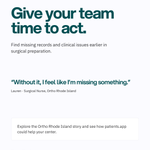
Find the missing records. Surface clinical issues earlier. Give the care team time to act. “Without it, I feel like I’m missing something.” — Lauren, Surgical Nurse, Ortho Rhode Island See how patients.app could help your center: patients.app
29
We are up for the inaugural ASC News Product of the Year Awards, nominated by Orthopedics Rhode Island, one of the ASCs using us every day. Voting closes tonight, over here: poyawards.ascnews.com/nomine…
1
124
one of the lessons we’re learning building agents in healthcare is that automating a full workflow is key lots of agent demos show part of a workflow being completed by an agent. this can look interesting but in practice it’s more work for someone to have part of a workflow be agent native and the other part still requiring human input the right practice here is building an agent that can complete something end to end and only escalate special cases for human review
2
124
the EMRs building for the future are already moving this way and it’s going to be key for automating both clinical and non-clinical workflows ultimately practices and patients will both benefit from agents taking on the tedious parts of healthcare
I'm often surprised by how many SNF / HHA operators complain about the simultaneous lack of APIs from their EHRs as well as those systems of records banning RPA or scraping from authorized vendors. More operators need to become familiar with the the RTMS / PCC info blocking rulings and say: We have a right to our patients’/prospective patients’ EHI; our staff already access and use it to make patient-specific admission/care/payment decisions; we have authorized X vendor to use it on our behalf; your existing API does not expose all of it; therefore permit controlled RPA for the uncovered EHI or provide another complete machine-readable method.
1
324
hello twitter! (yes we just called it twitter)
1
5
1,098