

Many imposters but don’t be fooled. nobody has our proprietary data set and best-in-industry results, increasing profitability of BOTH merchants and processors.
United States
Joined May 2011
- Tweets3.4K
- Following711
- Followers2.1K
- Likes1.3K





Pinned Tweet
😎We are back after a long hiatus and we're trying something new.
🤓Please engage with this post so we can see how many active followers are still with us! Please Paste this into the comments: Welcome Back Payometry!
🧐If you like this subscribe 4 FREE
your-inbox.beehiiv.com/p/jan…

PAYOMETRY | payometry.eth retweeted

“If a bank itself fails, deposits at FDIC-insured banks are protected up to $250,000 per person, per bank.
⚠️ That insurance doesn't cover
money stolen
from a hacked account. ⚠️
But federal rules generally limit what you lose from unauthorized transfers if you report them quickly, so check your accounts often and call your bank right away if anything looks off.”
😬😬😬😬😬😬😬😬😬😬
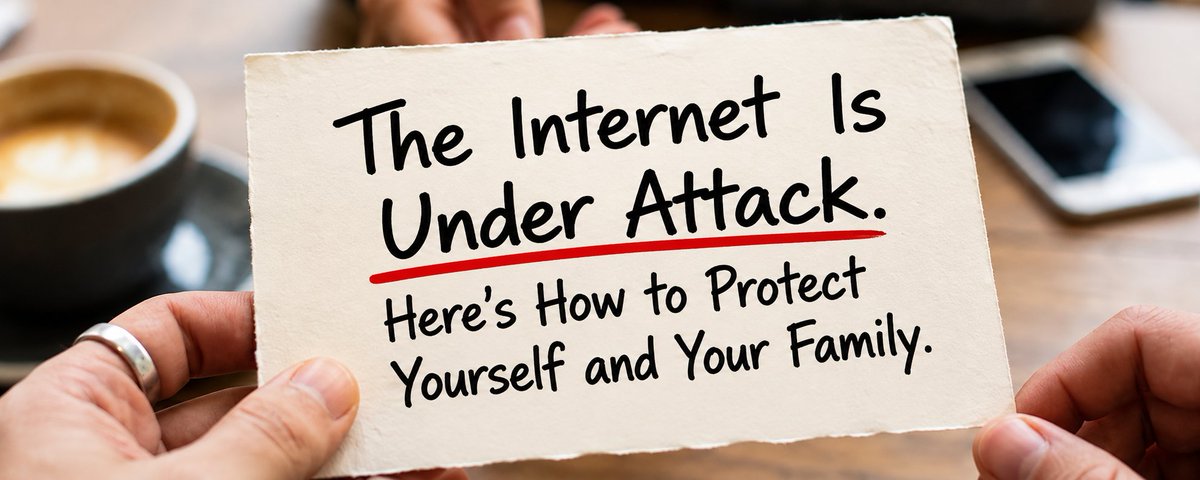
“What to do today:
First, stay off sites you don't know until this blows over. Stick to the big, well-known ones: your bank, Amazon, Google. Small sites are the least likely to have patched, and you can't tell from the outside. For the next few weeks, don't type a password or card number into anything unfamiliar.
Second, update everything: your phone, your computer, your tablet and your web browser. When your phone or computer's own Settings says an update is available, install it. That's your lock. Do the same for your router, and if it's so old it doesn't get updates anymore, replace it. But never install an "update" from a pop-up on a website or a link in a text or email. That's a common scam. Not sure how to do any of this? Here's a simple step-by-step guide.
Third, close the doors you aren't using. Unplug smart gadgets you don't need and delete apps you don't use. Every connected thing is another way in.
Fourth, protect your bank account. If anyone calls, texts or emails you and asks for your password or a code that was just sent to your phone, it's a scam. Every time. Those codes are only for you to type into your bank's own app or website. Treat every call, text or email about your bank as suspicious until you've checked it yourself: don't click their links, and don't call back the number they give you. Hang up and call the number on the back of your card. If it was really your bank, they'll be able to help.
Only type your bank username and password into your bank's own app or website. Don't give them to anyone else, including an AI assistant or another app, no matter how helpful it seems. Chase says not to give them to anyone. Turn on two-step login for your email and your bank (here's how), and stop reusing passwords. A password manager makes that easy, and your iPhone or Android phone already has one built in.
If you want to be extra careful, keep a little cash at home, enough for groceries for a few days, plus some food and water. That's a normal emergency kit, and it's worth having anyway.
What I wouldn't do is pull your money out of the bank. Panic is exactly what scammers count on. If a bank itself fails, deposits at FDIC-insured banks are protected up to $250,000 per person, per bank. That insurance doesn't cover money stolen from a hacked account. But federal rules generally limit what you lose from unauthorized transfers if you report them quickly, so check your accounts often and call your bank right away if anything looks off. Money you're tricked into sending yourself is much harder to get back, which is why the scam calls are the bigger danger.
The next few days are going to be weird. More announcements are coming. My hope is that most things will keep working. Just do the boring stuff today.”
-Matt Shumer

PAYOMETRY | payometry.eth retweeted

Someone hacked my uncles Charles Schwab account and sold 49k of his stocks on Friday. Luckily he caught it on Monday morning and they were able to freeze the funds in time. Charles Schwab is trying to tell him that he must have shared his password or fell for a fishing
scam. Then the thieves tried to transfer the remaining funds to an account in Palm Springs. Looks like Schwab has been breached. And they are blaming their customers.
Visa got the green light to start preparing a domestic business in China — first real crack in a market closed to Western networks for over a decade. Approval to prepare, not to operate yet. Still the news.
Mastercard just completed a ~$1.8B acquisition of BVNK — buying stablecoin infrastructure before the "will stablecoins matter" debate is even settled. That's the tell.
PAYOMETRY | payometry.eth retweeted

Stablecoin payments provider Noah has secured both a MiCA crypto-asset service provider licence and a PSD2 payment institution licence, giving it a regulated framework to offer stablecoin and fiat payment services across all 27 EU member states paymentsindustryintelligence…

$1.21B. Third-largest fine in Treasury's history. Not a scandal story — a speed story: transaction volume outrunning the systems built to watch it.


The Truth About AI Access to Your Money youtu.be/nbech22fbY0?si=muEU… via @YouTube
PAYOMETRY | payometry.eth retweeted

I have remote opportunities!
I’m hiring for a YC backed AI company in SF that just raised a $28.5M Series A and is building autonomous companies, where AI agents can operate real businesses end to end.
They’re looking for:
Founding Product Engineers who want to build AI agents, infrastructure, and products from 0 to 1.
Founding Growth Engineers who can take technical AI products to market, own growth experiments, launch strategy, technical content, acquisition, and activation.
Remote | $150K to $300K+
If you’re exploring your next move or know someone who would be a strong fit, DM me :)
PAYOMETRY | payometry.eth retweeted

Stripe to Expand Stablecoin Cards to Over 100 Countries by the End of the Year
coindesk.com/business/2026/1…
#Payments

60 days, 5 pillars, one thesis: cards give merchants timing optionality instant rails can't match. That's what this whole series has been about: payometry.zoholandingpage.co…
PAYOMETRY | payometry.eth retweeted
Digital Payments Linked to £88 Billion in Additional Sales for UK Businesses, Visa Report Finds
visa.co.uk/about-visa/newsro…
#Payments
PAYOMETRY | payometry.eth retweeted

The National Science Foundation (NSF) has issued a 10-page memo signaling a retreat from its traditional role of giving grants to individual researchers to pursue their best ideas and to train the next generation of scientists.
Instead, the memo makes clear, NSF will devote the bulk of its resources to addressing the research priorities of President Donald Trump and his administration, many of them technology focused. scim.ag/4ipE1kY

Your AI fraud tool blocks bad transactions before they happen. It does nothing for the chargeback that already happened. Two different problems, two different fixes: payometry.zoholandingpage.co…
PAYOMETRY | payometry.eth retweeted

The 9/11 Memorial "Tear Drop" sit's directly across from NYC, in Bayonne New Jersey, just the other side of the Statue of Liberty, yet we hear nothing about it.
This beautiful, 100 ft tall monument was gifted to the people of the United States by the people of Russia in 2006, in memory of all those who lost their lives on that fateful day, September 11, 2001.
The breaking in the cracked façade forms the shape of the two towers.
The giant suspended tear drop signifies the tears of the entire world that day.
Maybe it's something that needs to be known, starting today.
PAYOMETRY | payometry.eth retweeted

One month after September 11, workers clearing the rubble at Ground Zero found something alive.
A tree.
Eight feet of blackened stump. Roots snapped. Every branch broken but one.
They could have thrown it away with the rest. Nobody would have noticed.
They did not.
It was a Callery pear. Nobody had ever paid attention to it. It had been planted in the 1970s in the plaza between Buildings 4 and 5 of the World Trade Center, one of dozens of ornamental trees the Port Authority put in to make the concrete feel less like concrete. Office workers ate lunch under it. Tourists walked past it on their way to the observation deck.
On the morning of September 11, a hundred and ten stories fell on it. Twice.
In October, on the pile, someone saw a single living branch sticking out of the wreckage. Green. Still trying.
A decision was made on the spot. They dug it out.
The city's Parks Department took the stump to a nursery in Van Cortlandt Park in the Bronx. The horticulturists there looked at it and were not optimistic. The trunk was charred. The root system was mostly gone. Trees in that condition do not usually come back.
They went to work anyway. They cleaned the burns. They trimmed the dead wood. They set it in good soil. They watered it. And they waited.
That first spring, in 2002, against everything the experts expected, the stump put out blossoms.
Small white flowers, on a tree that had been under the World Trade Center six months earlier.
It stayed in the Bronx for nine years. Relearning how to be a tree. Growing new branches out of the old scarred wood. Getting taller. Filling out.
In 2010, weeks before it was finally scheduled to go home, a storm tore through the nursery and ripped it out of the ground.
The people who had been nursing it for nine years came out the next morning and found it on its side, roots exposed again.
They stood it back up. They repacked the soil. It survived that too.
On December 22, 2010, it was replanted at the 9/11 Memorial in lower Manhattan, a few steps from where the South Tower had stood. Where it had been found.
The eight-foot stump is now more than thirty feet tall.
Walk up to it and look at the trunk. There is a line on it. Below the line, the bark is dark and gnarled and twisted. That is the wood from 2001. Above the line, the bark is smooth and pale and new. That is everything that grew after.
The tree does not hide the line. It does not cover it over. The scar is right there, and the whole rest of the tree grows up and out of it.
People tie tags to the railing around it. Prayers. Names. Messages to the dead.
Every spring it is the first thing on the entire plaza to bloom. It goes white before the other trees have even leafed.
In 2013, the Memorial started a program. They gathered seedlings from the Survivor Tree, and every year they sent them to a community that had just had its own worst day.
Newtown, Connecticut, after Sandy Hook. Orlando, after Pulse. Puerto Rico, after Maria. Paris. Manchester. London.
A small tree from the rubble of the World Trade Center, planted in the ground of the next place that thought it would never grow anything again.
Twenty-five years ago this month, a hundred and ten stories of steel came down on a pear tree and someone on the pile saw one green branch and said, not that one.
Not that one.
The last living thing pulled out of Ground Zero has children now, growing all over the world.
It did not survive by being untouched.
It survived by growing out of the wound. 🌸
PAYOMETRY | payometry.eth retweeted
After September 11, more than a million tons of the World Trade Center was loaded onto barges and shipped to a garbage dump on Staten Island.
Then hundreds of men and women stood at conveyor belts for ten months and picked through every ounce of it by hand.
They were looking for people.
The place is called Fresh Kills. For fifty years it was the largest landfill in the world. It took its last barge of household trash on March 22, 2001, and shut down for good. New York was finally done with it.
Five and a half months later, at two o'clock in the morning on September 12, the landfill's director got a phone call at home. He had just walked in the door.
Two trucks were at the gate. They were carrying pieces of the World Trade Center.
He drove back.
The man who ran the dump would later say, without any drama, that if Fresh Kills had not been closed, this could never have happened. There would have been no room. The garbage would have been in the way.
The site was empty. So that is where the towers went.
Here is how it worked.
At Ground Zero, cranes and grapplers lifted the debris into dump trucks. The trucks drove to a pier on the Hudson. There, the load went onto barges, six hundred tons at a time. The barges were towed down the harbor, past the Statue of Liberty, to Staten Island. More than fifteen hundred barges made the trip.
At Fresh Kills, sanitation workers unloaded them onto a hill.
And then the sorting began.
The debris was mechanically screened into three sizes. Chunks bigger than eight inches. Two to eight inches. A quarter inch to two inches. Anything smaller than a quarter of an inch, the size of a fingernail, fell through the last sieve.
Everything above that size went onto a conveyor belt.
And along the belts stood the detectives.
NYPD. FBI. Port Authority police. Medical examiners. Dressed head to toe in white Tyvek suits, in masks, in gloves, on a hill that stank of jet fuel and pulverized concrete and things nobody wanted to name. Looking down at the belt, hour after hour, as the towers rolled past them a fist-sized chunk at a time.
When they saw something, they reached in and took it, and placed it in a white bucket at their feet.
A wedding ring. A photo ID. A set of keys. A shoe.
A piece of a person.
The white buckets went to a tent that served as a morgue.
The volume was beyond comprehension. In mid-September the operation was processing 1,750 tons of debris a day. By mid-October, 17,500 tons a day. Ten times more. Round the clock. The 200-acre hill was declared a federal crime scene and stayed one for ten months.
A retired NYPD detective later wrote down what a shift looked like, because almost nobody outside knew it existed.
You wake at 3 a.m. You get a giant coffee. You drive two hours in the dark from Orange County, through New Jersey, to Staten Island. You park at the bottom of a hill that looks like the end of the world. You put on the white suit. You go to your belt. You stand there. You look.
Then you drive two hours home and do it again tomorrow.
Sanitation workers pulled sixteen-hour shifts, seven days a week. One of them, a supervisor named Barry Asnes, said afterward what kept him there. We were attacked on our own soil, in the city where I was born. This was personal.
The operation did not stop for weather. It did not stop for Christmas. It ran until July 2002. Ten months.
By the end, the men and women on that hill had recovered thousands of human remains. Tens of thousands of personal effects. Wallets, badges, wedding bands, photographs, all cleaned and catalogued and returned to families who had nothing else to bury.
When they were finished, the remaining material was placed in a 48-acre section of the landfill, a mound two hundred and twenty-five feet high, and covered.
It is a park now.
Many of the men and women who stood on that hill have lung disease. Asthma. Cancer. PTSD. The air they were breathing, eight and ten and sixteen hours a day, was full of the towers. Some of them have died of it.
Almost nobody knows their names. Almost nobody knows the place.
Mention Fresh Kills and 9/11 in the same sentence, the retired detective wrote, and most people will have no idea what you are talking about.
Here is what you should know.
Two thousand seven hundred and fifty-three people were murdered in those towers. Only about six in ten have ever been identified.
Every one of those identifications came out of a white bucket.
Every wedding ring returned to a widow. Every badge returned to a firehouse. Every fragment of bone matched to a name and buried with a headstone instead of a question mark.
Somebody in a white suit, standing at a belt on a garbage dump at four in the morning, reached into the World Trade Center as it rolled past, and picked that person up, and put them in a bucket, and sent them home.
They did that for ten months.
Nobody applauded on the hill. There was nobody to watch.
They did it anyway. 🇺🇸
PAYOMETRY | payometry.eth retweeted

If you'e never read The Falling Man, you should do so. I post this on September 11th every year, and I find time to read it on this day every year. Still, in my eyes, the greatest piece of journalism I have ever read. esquire.com/news-politics/a4…
