Permanent Equity stewards companies that care what happens next. We invest with no intention of selling in family-owned companies throughout North America.

Columbia, MO
Joined February 2011
At Permanent Equity, we’ve long said that we buy boring businesses, but the reality is that’s not the full story of what we value and what we do. When we invest, we steward companies that care what happens next. Read about the journey here: permanentequity.com/writings…
6
5
4
76
Permanent Equity retweeted
If you're headed to @MainStSummit this week, a few thoughts: 1) Please join me for praying for safe travels and lightened burdens. 2) It'll be hot. Bring shorts and tennis shoes. You'll be more stylish than me (not hard). 3) Come more excited to make friends than do deals.
4
4
1
39
5,128
Permanent Equity retweeted
Countdown for @MainStSummit has begun! Safe travels into town. And apologies in advance for the I-70 construction…
1
3
9
756
New pieces from our Director of Health are live, all about making the right outcome the default (rather than relying on spotty effort). Willpower is finite, structure is renewable, and health is solved by engineering fewer decisions. Three angles at permanentequity.com/health-a…
2
594
. @timhanso is taking an extra-long break from Unqualified Opinions. But before he hands the keyboard over to the rest of the PE team for Qualified Facts (yes, that's the new newsletter), he has a final gift: All the F-Bombs, in one place. permanentequity.com/content/…
1
1
842
Permanent Equity retweeted
This might be the last installment. Available at @MainStSummit !
2
5
636
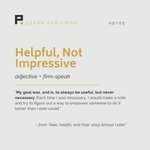
The last word in our firm vocab is the one we hold ourselves to: helpful, not impressive. It's how we try to show up at the companies we back – genuinely useful, never load-bearing, and definitely not flashy. The goal is to add something real and still be the kind of partner the business would be fine without. @BrentBeshore has described his own aim as "useful, but never necessary.” In other words, whenever he finds himself necessary, he treats it as a problem to solve and finds a way to empower someone to do it better than he can. That's the whole posture. Put the knowledge in the open, the decision in their hands, the credit on their side of the table. It runs against every instinct that says your value is in being needed, and it's the only kind of help that doesn't quietly trap the people you're helping.
4
1
658
You'd think a firm with 30-year funds and "permanent" in its name would be the patient, sit-back-and-wait type. Not quite. Waiting, on its own, is just decay. When we say patience, we mean something active (i.e., the stillness is still work). The upshot is that the way you earn a good long term is to be relentless about the few right things in front of you, every single day. Or, as we say it, the long term is a series of short terms. Think in decades. Be rigorous about today.
2
2
1
622
The instinct, when you take over a business, is to walk in and start improving things. Our first move is almost nothing. We call it Do No Harm. It's our Rule #1. It sounds like passivity, but it takes real confidence to assume the people already running the business know things you don't (hello, Chesterton’s fence). The clunky system, the vendor nobody would pick today, the spreadsheet column that looks pointless until the one week a year it saves you: there's usually a reason. So we spend a long time understanding before we touch anything. And the flip side of not breaking what works is letting great be great.
2
2
521