

Author of the novel, The Phantammeron | All writing is 100% AI-free! | Freedom of Speech Constitutionalist 🇺🇸 | Related to Thomas Jefferson | Bitcoin Nation
United States
Joined April 2011
- Tweets14.2K
- Following7.5K
- Followers3.3K
- Likes65.8K



Pinned Tweet
"He who does not imagine in stronger and better light than his perishing and mortal eye can see, does not imagine at all"
— William Blake
Writing Without Artificial Intelligence ✅
Life is about personal experience and the artistic expression that comes from it. Once you realize that, why use AI for anything beyond a paycheck at an employer? Why have a machine create anything for you? Why even use AI to edit your writing when it’s not part of you, when you realize it’s random patterns from a machine?
I am asking all serious writers to make a vow to avoid using AI in any of their writing, going forward.
But why?
AI has a place in the world creating efficiency, cheap consumption, even entertainment. But AI can never replace you. It cannot replace real Art and the experience of creating it.
Humans want to read what real humans think and feel, not a pattern of tokens that feel right on the page. Once the world is full of powerful, perfected AI books, none of it will have value or meaning. The human mind will suddenly see AI writing is an empty mirror of themselves, rather than a connection to a living person on the other end that actually felt something.
The horror of realizing all art is polluted by automated thought will mean that nothing truly matters in the digital world. If we are all creating empty art and words and images of ourselves in our homes, ones only we will ever connect to, suddenly the disconnection is real. It is like the last man on earth reading books about himself in a huge library no other human being but him will ever experience.
AI art is leading us down a hall of mirrors, rather than a connection to other people, a connection to life and sharing its joy with others. The machine wont care…
As Ive said before, we should not create books for money or even for others to enjoy. Creating anything is a separate joy in itself that must be honored. That is my second defense of avoiding AI in your writing.
The the third defense is the irony of how human art will be valued in the AI world that is coming. I believe income will return in human-only Art once the value proposition of a super-saturated, meaningless AI movie, book, and animation world takes hold. When 99% of all we enjoy in the arts is artifice, people will come questioning what is left of human expression. And suddenly people will return to owning the novelty of owning human-only Art. People will pay for the experience of 100% AI-free art!
The money will then come pouring back to the rare people with any skills left to create beautiful art. The novelty and power of human art will return as a rare, non-fungible commodity people will gladly pay to own or experience.
This means AI actually puts more value on human art coming up, not less. So my advice is to separate your art from AI, now!
Begin to write in notebooks (in crude pencil or pen) so you avoid the digital recapture and rewriting AI tools will start to do in damaging and polluting your works and your words. This creates a purity test.
Start relearning grammar and perfecting your writing skills the old fashioned way with reading, discipline, and perfection.
Start collecting old movies, paintings and books, the last evidence of real works from human beings still left in the AI planet.
Avoid digital spell checkers. Force yourself to edit your own writing and spelling so you alone master the art of high quality literature and learn from your mistakes.
Take advantage of the fact human error in writing is now an advantage, and ironically a sign your books are not AI word perfection but flawed with human blunders, flaws, and expression.
Start publishing your work with labels like “AI Free Book!”, “Human-only Writing!” as a defiant badge on all your works. Once organizations create AI writing detection, or you can provide proof through hand-written notebooks your work is real, your claims will have real validity and value.
After all that, you will find your work stands apart from the AI-infected writing crowd. You can watch your books enrich the world and stand apart from the mass adoption of the doomed AI world of art. 🙏

178
Celtic Springs
The Iron Age Celts across Europe and Britain saw springs of water as sources of magic and religious meaning. They were divine places of worship, of life-giving waters, and gateways to the Other World.
Often a Goddess controlled the springs, which granted powers to kings and warriors alike in battle, and granted women fertility and a good childbirth.
The Druids held power over these places and the Goddess of these fountains. For he was wed to the Earth Mother from whose womb these waters spilled forth. Her waters were for all, not just the worthy.
The Druids knew that the Earth Mother was the embodiment of life and death. And so they coveted these springs as a sacred source of all life on Earth. Should the wells dry up, then it was a sign the Virgin was no more and the Witch had come forth to take back the living - the end times.
And so these springs could not be fouled or destroyed, as they were religious places to the Celts, much like Christian Churches are today. When the Romans or Saxons in Britain game to destroy them, the Celtic people defended these places above all others.
This is why the springs at places like Glastonbury Tor have such special meaning. These are very old religious gathering places, gateways to the underworld of Faerie and the matriarchal magic of the Earth Mother and her yearly cycle of life and death mirrored in the seasons and their traditions.

47
I have 100% support for this War on Beauty manifesto.
Even though it could lead to some free speech cancellation of modern art projects, the culture is decadent enough today that it would benefit from a cleansing of woke agendas in the arts today and the biased prioritization of Works of Beauty free of all social ideologies.
My novel, the Phantammeron, is about Beauty. In the book I go into detail about the glory of the Gardens of Abrea and the White Tree of Celebreava that formed a central source of light, purity, and beauty to all living things around it. Its destruction was the goal of evil. The extinction of its living light meant the Death of Beauty, as it did all life in Phantaia. But in the story, it is reborn…
There is no sex in my book. But there is Love.
There is no vulgarity in my book. But there is poetic prose.
I am in fact a fan of Beauty. All of my writing strives for it on multiple levels. I live for it in my writing, as I did for years as an artist and an engineer. I never surrendered to those telling me it is not needed or a waste of time and money.
Beauty matters in every profession. The perfection of Beauty must be the eternal goal.
Artists in 2026 can choose to depict ugliness, violence, woke identity, judgement, laziness, and crudity. But why not choose Beauty.l? I still believe Truth is Beauty and Beauty, Truth. The two are inseparable, it seems to me on some higher level that still matters in 2026.
For these higher qualities of the Human Soul can lead to who we truly are, something beyond the lower forms we choose to cling to in the present culture we are born into.
Beauty in Art is but one of many paths to higher things…

1
153
Enya - Caribbean Blue (1991)
Remembering Enya’s beautiful, transformative music. ❤️
youtu.be/Jl8iYAo90pE?is=o64X…
2
102
Please get Don Bluth’s documentary on Amazon Prime!!
He is the famous Disney and independent animator behind all our childhood classics. His talent and influence are second to none in children’s entertainment, animation, and fantasy film! Thank you Don for your beautiful art and bringing such joy and wonder to my childhood with your film. 🙏❤️
Early Disney Era (Animator & Director)
•Sleeping Beauty (1959) (in-between artist)
•The Sword in the Stone (1963)
•Robin Hood (1973)
•Winnie the Pooh and Tigger Too (1974)
•The Many Adventures of Winnie the Pooh (1977)
•The Rescuers (1977)
•Pete's Dragon (1977)
•The Small One (1978) (short film)
•The Fox and the Hound (1981)
Independent & Fox Feature Films
•Banjo the Woodpile Cat (1979)
•Xanadu (1980)
•The Secret of NIMH (1982)
•An American Tail (1986)
•The Land Before Time (1988)
•All Dogs Go to Heaven (1989)
•Rock-a-Doodle (1991)
•Thumbelina (1994)
•A Troll in Central Park (1994)
•The Pebble and the Penguin (1995)
•Anastasia (1997)
•Bartok the Magnificent (1999)
•Titan A.E. (2000)
Video & Arcade Games
•Dragon's Lair (1983)
•Space Ace (1984)
•Dragon's Lair II: Time Warp (1991)
•Dragon's Lair 3D: Return to the Lair (2002)
•I-Ninja (2003)

Don Bluth: Somewhere Out There is now available on Amazon! traditionalanimation.com/202…

4
172
Yes, all great art is tied to the will of the artist, who suffers alone in defiance of the rotten culture and their plight within it.

REMINDER that Van Gogh painted "The Starry Night" in a mental asylum, Dostoevsky wrote "The Gambler" to pay off gambling debts, and Dickens wrote "The Christmas Carol" when he was broke and his wife on their 5th child. Stress has produced more art than "slow saturdays" ever will
60
Harryhausen’s monster movies were like no other. His film had a huge impact on me as a child in the 1970’s. I am still inspired by his magical movies and rewatch them all the time. He explored the universal boyhood desire for adventure.🙏❤️

Exclusive BBC News coverage of the Ray Harryhausen: Myths in Motion exhibition at The Arc, Winchester. Trustee Vanessa Harryhausen and Collections Manager @ConnorHeaney86 explain how the Foundation’s work allows for exhibitions of Ray’s original creations to take place.
This fantastic show is open until 16 February 2027:
arcwinchester.org.uk/event/r…
(As seen on the 19/10/2026 edition of BBC South Today News)
40
My analysis of Tolkien as relates to Mythopoeia
youtu.be/_tT0aQpR2Wg?is=qeT8…
80
The Texas Comanche
This piece of Texas history is one I enjoyed researching, years ago. I love the beautiful Comanche people and their history. The Comanche were once a powerful nation, feared by all. But they were also a brutal culture, at war with many enemies, including the Apache out west, the Mexican military on the despoblado, and the innocent American families moving into Texas.
Once New Spain made a claim to parts of Texas in the 18th century, the Comanche quickly became a road block to their ambitions. For 200 years, the Spanish feared the Comanche. So their two main trails into Texas - the two Camino Reals - twisted west into New Mexico and south through San Antonio to avoid them.
As soon as the Spanish settled San Antonio with missions, the Comanche regularly began raiding them, brazenly firing their guns in the main plaza and stealing dry goods and ammunition. At one point the Spanish King set up a fortress in central Texas to tame the Comanche - Presidio de San Saba (1757). Years ago I visited this fort with my Dad. Its basically a tiny rocky presidio off a creek in the middle of nowhere. The jesuit priests then set up a small wooden church miles away to invite the Comanches. But the Indians refused the invite and sacked the church. They then attacked the fort for days. It was then abandoned by the Spanish. And never again would they seek to tame the Comanche.
These brilliant horse raiders had a tradition called counting coup, where young braves gained power and reputation by their acts of bravery in battle, including the number of scalps they could take in courageous situations. The cutting of the hair off of the enemy was the game. These skin and hair trophies were then hung from a spear as a measure of pride in the tribe. But each hairpiece that was taken while on horseback granted the young buck extra valor. For every victory on the battlefield was verified by witnesses then long remembered.
This was patriarchal horse culture at its highest, a warrior cult like no other. For such was the same in Europe when the Scythians and other horse cultures raided Europe off the Pontic Steppes thousands of years ago. Horse Culture creates warriors.
But we also forget, none of this power was truly theirs. It came from the Spanish horses they acquired and domesticated 200 years prior after Conquistadores looking for El Dorado in the 16th century left them on the plains of North America. Those horses did not exist. And so the Comanche were but poor, primitive nomad traders dwelling on the plains, until the Spanish empowered them with European mustangs after 1540.
It seems the Spanish created the Comanche, created their own worst nightmare…
For a hundred years after the pullback from Texas by Mexico, on the September moon, Comanche braves would raid and pillage deep into Mexico from Texas, capturing Mexican women and children, killing soldiers, and stealing thousands of horses each fall. One year they made it all the way to Mexico City and assaulted the cities defenses. So the Comanche for a brief time in the late 18th century, ruled a wide swath of Mexico and North America. Nothing could stop them.
That is why, by 1820, Mexico was desperate for a defense…
This was why Santa Ana brought in Europeans to settle the Texas frontier. He had no defense against them but to settle Texas by selling it as some paradise to innocent families of foreigners. But the Comanche saw the newcomers as just more opportunity.

1
1
168
I have old books with narratives I have read, where early European colonists near the Nueces River were capture by the Comanche, brought upon a hill. Their babies were thrown high into the sky by Indian braves until they fell upon the rocks and died. All the men and fathers were then killed. The children and women where then marched through the Texas desert through cactus barefoot without water for days. Many died.
But if they survived they would become full members of the tribe. For these were tests of strength, of survival. It was not just cruelty. For the Comanche knew to survive on the desert plains of Texas, one had to endure. And so much of who and what they did was for survival. Many whites who were captured later talked about their love of the Comanche despite the cruelty, and their desire to return upon capture by Americans and return to living with the Comanche.
After so much violence, the Texas militia rose up in Texas to stop the depredations. Sam Houston tried to make agreements with the Comanche. But Texans would come to power to defeat both Mexico and the Comanche. After the invention of the Samuel Colt revolver, which the Texas Rangers first used against the Comanche in the 1850’s, the game had changed. The flintlock rifles of the Comanche was no match for the Ranger’s superior technology.
After the Civil War, military garrisons were set up across the middle of Texas to protect travelers. Ive visited many of these stone ruins in West Texas. My Dad and I visited Fort Lancaster out in the middle of nowhere. It shows how soldiers living in the vast spaces of Texas with very little. They had to spend weeks patrolling the vast plains of Texas on horseback. Not an easy life. This US military garrison rarely fought Indians. But it was the military presence that kept the Comanche from invading Texas.
But the Mexico invasions continued out west near Presidio, Texas, and for decades after. They and the Apache continued to cross over the Rio Grande and pillage northern Mexico, until around 1877 when the Texas rangers and US military teamed up with Mexican troops to trap them. Only the great Apache, Geronimo, continued raiding Mexico until his capture in 1886.
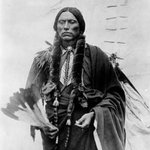
The Golden Era of the Comanche was nearing its end. But history is filled with irony and beauty. It was a brave new leader that finally stood up to the US military, gathering the last tribes of the Comanche Nation to defy the Texans for many years. It was this leader, Quanah Parker (photo), that would become the last great Comanche Chief.
But he wasn’t one of them. He was in fact a half white, half Indian child, born after his mother was captured by the Comanche during a raid of Fort Parker new Groesbeck, Texas in 1836. He rose to power in the tribe and led the Comanche in their last fight against the US Military, until their final surrender in Palo Duro Canyon. The US military had to do a multi-pronged invasian of the last Comanche strongholds to stop their endless raids. In 1874, during a brutal winter, they finally cornered the Comanche in Palo Duro Canyon on the high plains Texas. But the Comanche refused to surrender, until the military was forced to shoot thousands of their horses. Without the source of their military might, they quickly surrendered. They were then marched to Fort Sill, Oklahoma. And this was the end of the wild and free Comanche.
But Comanche story proves history is not black and white, but filled with beautiful shades of grey, where people mix, lives merge, and where history is not always good vs evil. With power and might comes many forces to oppose you. History repeats. But the irony of history forces us all to rethink false stereotypes, old assumptions, and condemnation of others. And once you realize it was always about the people beyond the labels, History suddenly comes alive with joy and tears, and respect for both sides of a brutal war of many cultures and faces.
151

The Trickster in Storytelling
Jack Sparrow never chased gold, girls, or glory. He sought only his beloved ship, one that meant Freedom.
I love these movies and the acting in Disney’s Pirates of the Caribbean. But Jack is my favorite. He is a classic figure found in old storytelling, a being some call the Trickster or Naif. You will see this same being in Loki of Viking Myth, in Don Quixote, in Native American Coyote tales, in Forrest Gump, and many others. We just repeat the same ancient stories, guys. Nothing is truly original.
These special male protagonists escape judgement and war. They dance between worlds so they can curse and doom the fates of Gods and Men alike. They care not for the world, yet always set it aright, in the end. They fearlessly face death, and easily resurrect themselves to chance fate, again and again. In the end, they laugh at the greedy and the foibles of love. They trip up kings and heroes alike, but have pity on the weakest and smallest of creatures. They defy all characterization, so confuse and yet charm us on the big screen. Even young children instantly get the Trickster in story.
But they all share a universal love of Freedom. They cherish the experience of living over what rewards come in life. And you see that in Jack in these Pirates of the Caribbean movies. When he holds his compass, it spins. It is designed to point to the one thing the heart loves most. For all other pirates it leads out to sea to some lost treasure or doomed romance. But it spins in Jack’s hand, because his ship is his true love. It is freedom.
The actor Johnny Depp does a great job of creating this strange pirate figure. And the brilliant screenwriting captures his true motivations, which is always to get his ship back.
He talks about “horizons” in the movies…the idea of sailing beyond it, beyond the last waves to some place where he is free from his destiny in this world, of all worlds, where he can only sail on forever into infinite horizons. And audiences love that kind of thing, especially Americans because we are made of the stuff of freedom. We are the last freedom-loving people left on Earth, it seems. Many great men have died for it.
So Jack Sparrow is truly one of us. 🇺🇸
We need the Trickster. We need the great disrupter of life, the being that reminds us of the experience and joy of life, of its irrationality and absurdity at times. The rational mind needs the illogical mind. The Trickster is part of our emotional self. For the Trickster comes from the heart more than the mind.
As writers Im always amazed at how often we need the characters that break us down, show us our flaws. And this is precisely what Tricksters in story are. Mirrors of the soul, of its beauty and flaws.
But they also are reminders of the spiritual journey of life, the mystery of it all. For what seas in the Great Beyond will we bravely sail with the Creator at the helm?
Only the Trickster knows…

192
The Dead Sea Scrolls
The Dead Sea Scrolls reveal a strange primeval battle between the forces of Light and Dark, Good and Evil in the world. It seems we have always written stories of Good vs Evil.
In the Dead Sea Scrolls, the battle between light and darkness is not just a poetic metaphor. The Essenes likely wrote and hid the scrolls in ancient times. We know Jesus was an Essene, a rebellious Jewish monk who lived near the Dead Sea. This we know from Roman and other historical documents. They were living in the Qumran community, the authors of the scrolls.
They viewed the Light vs Dark concept as both an ongoing spiritual battle inside every human heart as well as a literal one in the universe.
They saw two ruling spirits. God had created humanity and placed two opposing spirits within the world to govern human choices until the end of time: The Spirit of Truth and the Spirit of Perversity. But it was a choice. Mankind was not governed by either. He became part of one of the two armies by the life he led. For at the end of time, he would be called back as a great warrior to fight for one side.
It seems Good and Evil was always a line in the sand.
One could become a disciple of the Prince of Light on Earth. if they chose good works and let their hearts follow God’s word. All righteous people were called the "Sons of Light," and were governed by an Angel of Light - the archangel Michael. He guided them toward humility, wisdom, purity, and truth.
But one could follow the Angel of Darkness, instead. All wicked people, were called the "Sons of Darkness," and ruled by the Angel of Darkness (or Belial, a chief demonic figure). The taking of life and selfishness guided the lives of evil people.
The two battled in the Human heart, though none are native qualities. Freewill says you must choose. Being good or evil is an act. It seems the Dead Sea Scrolls saw life choices the same way Christians today see them.
But the scrolls also describe a physical war on Earth between these spiritual forces, a Final Apocalypse at the end where the sons of Light and Dark would do battle in 7 stages, until at the end God would intervene and obliterate Belial the false god and banish him from Earth forever. Then a new age of man would begin.
The scrolls describe priests or holy men in the front lines of these battles with Holy Angels of Light joining them in the war. No woman or children with any physical or ritual impurities were allowed as the presence of the angelic armies required strict holiness in the midst of God’s mightiest holy men.
This was a spiritual and physical war based purely on morality and ideals. These are very prophetic words and ideas, not to be ignored or discredited. It seems our ancestors valued holy men and those who lived a good, if not pure, life.
I love history as it reflects modern man’s struggles and confusion, and often clarifies our own spiritual need to follow better paths and be better Human beings. 🙏

1
100

Yes! This is what happens when you do not remove the mask of the Wizard of Oz and let viewers remain enthralled by the unknown. Great old film does that by withholding information then letting the audience fill in the rest.
Ive been trying to explain this for 40 years after seeing Alien in 1979 at the theater. The unknown in Alien is what made it so terrifying. As soon as Scott made the backstory it obliterated the movie magic.
I never liked Prometheus or Covenant. Just dead stories to me.
I prefer to go back and watch Alien and relive the horror and shock of seeing the alien ship and its space jockey. It remains a prescient and powerful shock to the system; a brutal Man vs Nature moment when the brain is reminded of danger in the horrific and cruel unknowns of space.
Not knowing, not comprehending the vast terrors out there matters. Having a bit of it thrown in front of you in a frightening film and reacting to it is what Mankind evolved to confront in the raw, untamed wilderness of Earth long ago.

What I always found to be the one of many master strokes in Alien is the utter lack of context to the Space Jockey. It's an alien, and something horribly happened to it. The end. The rest is on the audience.
H.R. Giger's original intent for the Space Jockey was that it was physically grown into and inseparable from its chair. Both literally functioning as singular unit and a part of the ship's control systems. But you can only guess that while only watching the movie.
The biggest bone head move Ridley Scott did was attempt to explain away one of the best pieces of cryptic flavor and set designs ever put on screen with Prometheus. A movie I refuse to believe is canon.
Alien (1979) | Ridley Scott
Agree. To win the “war on beauty” we need to create beauty and disconnect from the decadent time and culture in which we live. 🙏
72
The Wizard
The old wizard has known the bliss of heaven and the blasphemy of hell. He has battled dragons of the olden days and beasts of the netherworld. He has climbed the towering heights of necromancy and yet crawled through the mud of mankind.
He has watched great lords rise in power, to then watch their vast armies perish in a final tragic ending. He has seen the hubris of the fallen Gods finish them off, the vanity of kings end bloodlines, the folly and futility of youth waste away, the golden glow of the weary rich grow tarnished and fade, the futility of love and lovers sacrifice it all for the one. He has watched the flowers bloom and wither, the skies darken in the dust of timeless ages, hope become lost along treacherous paths of temptation, the glory of many wondrous worlds wrecked upon the rocks of some unforeseen tragedy. He has seen the timeless cycle of life’s renewal finally broken, then time itself march on through the silent shadows alone without them…
But as he hides away in his rain-wrapped castle, far from the world, he stumbles upon strange words written in letters of gold upon the pages of some forgotten tome, tucked away in the darkest of his dungeons. It describes the lost tale of an earlier world, a time when Man was True, living in a perfect paradise that the Gods had made and promised would never be broken.
He then begins his search in earnest for the secret knowledge, the rare enchantments that will return him to that place, that Golden Age when all of life was once treasured, when faith was held strong across the countless generations, when hope was ever-present, and hearts were true, when children sang as one, and the glades were green and pleasant with life renewed.
For he seeks not paradise, but only the answer to why…

67