

Exploring physics beyond Earth 🌌 Black holes, galaxies & the secrets of the universe. https://xitter.cf/t.co/4qT3CNb6Gw?
Joined June 2018
- Tweets13.3K
- Following5.6K
- Followers154K
- Likes968




🪐 Imagine Looking Up and Seeing Several Moons in the Sky!
On Earth, we're used to seeing just one Moon. But elsewhere in our solar system, the night sky could look dramatically different.
Saturn has hundreds of known moons, from tiny irregular objects to enormous Titan, which is even larger than the planet Mercury.
Imagine standing on the surface of one of Saturn's moons, watching the giant ringed planet dominate the sky while other moons move across the distance.
The exact view would depend on where you stood, and the scene shown here is an artistic illustration rather than a real photograph.
Somewhere in our solar system, a single moon in the sky is far from the only possibility. Would you want to witness a view like this? 🌌✨
#Saturn #Astronomy #SolarSystem #Space

🌍 Somewhere in the Universe, Another Earth Might Exist!
Imagine a distant world with vast oceans, towering mountains, and an atmosphere that could support life.
It sounds like science fiction, but astronomers are discovering planets that bring this possibility closer to scientific investigation.
Some exoplanets orbit within their stars' habitable zones, where temperatures might allow liquid water to exist under the right conditions.
But there's an important mystery: being in the habitable zone doesn't guarantee oceans, an atmosphere, or life. Scientists are still searching for convincing evidence of a truly Earth-like world.
With billions of planets in our galaxy, could another living world be waiting for us to discover it? 🌌✨
#Exoplanets #Astronomy #Space #Science

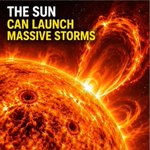
☀️ The Sun Can Unleash Storms Powerful Enough to Disrupt Earth!
What happens when our closest star releases billions of tons of charged particles into space?
The Sun can produce enormous eruptions called coronal mass ejections (CMEs), sending clouds of magnetized plasma racing through the solar system.
When a powerful CME reaches Earth, it can trigger a geomagnetic storm, creating spectacular auroras while potentially disrupting satellites, GPS signals, and power grids.
One of the most powerful recorded solar storms, the Carrington Event of 1859, caused auroras to appear unusually far from the poles and disrupted telegraph systems.
The Sun is 150 million kilometers away, yet its magnetic storms can still affect our technology here on Earth. Imagine what a Carrington-level storm could mean for our connected world today! ⚡🌍
#SolarStorm #Astronomy #SpaceWeather #Science

🪐 Uranus: The Planet Where Winter Can Last 21 Years!
Imagine a world so cold that temperatures can plunge to −224°C (−371°F) — where the Sun barely lights the sky and the planet spins almost on its side.
Welcome to Uranus, one of the strangest planets in our solar system.
Unlike Earth, Uranus has an axial tilt of about 98 degrees, causing extreme seasons. Each season lasts roughly 21 Earth years!
Its blue-green atmosphere contains methane, and powerful winds sweep through its icy clouds.
Even more fascinating, scientists believe its deep interior may contain exotic forms of water and other materials under enormous pressure.
A planet that rolls around the Sun, experiences decades-long seasons, and hides mysteries beneath its clouds. What else could Uranus be hiding? 🌌✨
#Uranus #Astronomy #SolarSystem #SpaceScience

☄️ A Mysterious Visitor From Another Star System!
Imagine an object traveling through the darkness between stars for millions of years — only to pass through our solar system.
Astronomers have identified rare interstellar objects that originated beyond our Sun's gravitational family.
The first confirmed visitor, ‘Oumuamua, was discovered in 2017. Since then, astronomers have detected other interstellar travelers, including comet 2I/Borisov and 3I/ATLAS.
Unlike ordinary asteroids and comets born in our solar system, these objects carry clues about the formation of distant planetary systems.
A tiny visitor from another star could reveal secrets about worlds we've never seen. How many more are passing through space unnoticed? 🌌✨
#Astronomy #InterstellarObject #Space #Science

🌌 This Is Where New Worlds Are Born!
Imagine watching an entire planetary system take shape — billions of miles from Earth.
Around young stars, enormous disks of gas and dust slowly transform into something extraordinary: new planets.
Scientists call these structures protoplanetary disks. Within them, tiny dust particles can gradually combine, forming larger bodies that may eventually grow into planets.
Astronomers have even observed gaps and rings in these disks, offering fascinating clues about planets forming around distant stars.
Our own Earth began its journey in a disk like this about 4.6 billion years ago. Somewhere in the universe, another world may be taking its first steps right now. ✨
#Astronomy #PlanetFormation #Space #Science

🌍✨ Another Earth? Scientists Are Discovering Worlds Beyond Our Solar System!
Somewhere in the vast darkness of space, planets roughly the size of Earth orbit distant stars. And each discovery brings us closer to answering one of humanity's greatest questions: Are we alone in the universe?
Astronomers have already confirmed thousands of exoplanets, including fascinating Earth-sized worlds. Some orbit within their stars' habitable zones, where temperatures might allow liquid water to exist under the right atmospheric conditions.
But here's the mystery: An Earth-sized planet isn't necessarily an Earth-like planet.
It could be a frozen wilderness, a scorching rocky desert, or something entirely unlike anything we've imagined.
With powerful instruments such as the James Webb Space Telescope, scientists are investigating the atmospheres of distant worlds, searching for clues about their environments and potential habitability.
🌌 Imagine looking up at an alien sky from another Earth-sized planet. What do you think you'd see?
Note: The image is an artistic illustration; the specific planet and discovery date are not identified.
#Exoplanets #Astronomy #SpaceDiscovery #Science

ALIEN OCEANS ARE HIDING BENEATH THE ICE — COULD LIFE EXIST THERE? 🌊🪐🤯
Far from the warmth of the Sun, entire oceans may be hiding beneath the frozen surfaces of distant moons.
Jupiter's moon Europa is believed to contain a vast global ocean beneath its icy crust, while Saturn's moon Enceladus has been observed spraying water-rich plumes into space. 🔭✨
But here's where the mystery gets even more fascinating.
Scientists have detected organic compounds and phosphorus in material associated with Enceladus's ocean — ingredients that make this distant moon one of the most intriguing places to search for extraterrestrial life.
The mind-blowing part? These hidden oceans can remain liquid even without much sunlight, thanks to heat generated inside the moons, including tidal heating.
Some of the most promising places to search for life beyond Earth might not be planets at all. They could be frozen moons hiding enormous oceans beneath their surfaces. 🌌
If life exists beneath that ice, what do you think it might look like? 👀
Image: Artistic illustration of an icy moon's subsurface ocean.
#Europa #Enceladus #Astrobiology #SpaceDiscovery

A VISITOR FROM ANOTHER STAR SYSTEM IS PASSING THROUGH OUR COSMIC NEIGHBORHOOD! ☄️🌌🤯
Imagine a comet traveling through the darkness between stars for millions — perhaps billions — of years before entering our solar system!
Meet 3I/ATLAS, the third confirmed interstellar object ever discovered passing through our solar system. Unlike ordinary comets that orbit our Sun, this extraordinary visitor came from beyond our planetary neighborhood.
Discovered in July 2025, its unusual trajectory revealed that it originated outside our solar system. 🔭✨
The mind-blowing part? This comet carries material formed around another star, offering scientists a rare opportunity to study the chemistry of a completely different planetary system.
And after its journey through our solar system, it will continue into interstellar space — never to return. 🚀
How many mysterious visitors from distant stars have passed through our solar system without us ever noticing?
Image: Artistic illustration of an interstellar comet.
#3IATLAS #InterstellarComet #Astronomy #SpaceDiscovery

A Spaceship Designed to Carry 2,400 Humans to Another Star! 🚀🌌
What if the first humans to reach another star were never meant to return to Earth?
Meet Chrysalis, an ambitious concept for a massive interstellar spacecraft designed to transport up to 2,400 people toward Alpha Centauri, the nearest star system to our own.
Located approximately 4.37 light-years away, Alpha Centauri is so distant that even our fastest spacecraft would take thousands of years to reach it.
The Chrysalis concept imagines a self-sustaining generation ship where people could live, raise families, grow food, and build an entirely new society during a journey lasting centuries.
The most extraordinary part? The people who arrive might be descendants of those who originally left Earth.
Chrysalis remains a conceptual design, not a spacecraft under construction. But it raises one of humanity's most fascinating questions:
Would you board a spaceship knowing you would never see Earth again, but your descendants might reach another star? ✨
Artist's concept of a future interstellar spacecraft.
#InterstellarTravel #AlphaCentauri #SpaceExploration #FutureTechnology

Somewhere in This Vast Universe, You're Worrying About Tomorrow. 🌌✨
Look at this galaxy. Billions of stars, countless worlds, and a cosmic story stretching across unimaginable distances.
This is Andromeda, our nearest large galactic neighbor, located approximately 2.5 million light-years from Earth.
The light reaching us from Andromeda tonight began its journey long before modern humans existed.
And here's something even more astonishing: while we spend our days worrying about deadlines, bills, and tomorrow's problems, two enormous galaxies are slowly moving toward each other.
Our Milky Way and Andromeda are expected to interact and eventually merge billions of years from now.
Somewhere in all that cosmic immensity, there's a tiny planet where we fall in love, chase dreams, make mistakes, and occasionally cry over a Monday morning.
The universe is unimaginably enormous. But that doesn't make your little life insignificant. It makes the fact that you're here to experience it extraordinary. ❤️
Does looking at the universe make your problems feel smaller, or your existence feel more meaningful?
Artistic visualization of the Andromeda Galaxy.
#Andromeda #Astronomy #Universe #CosmicPerspective

The Moon Will Be Full on October 26… But Here's Something Most People Don't Know! 🌕✨
A glowing Moon above silent mountains. Golden reflections dancing across a peaceful lake. A night that feels almost too beautiful to be real.
On October 26, 2026, the Hunter's Moon will reach its full phase, offering skywatchers a wonderful reason to look up.
But here's the fascinating part.
You don't have to wait for the exact moment of the full Moon to enjoy it.
The Moon will appear nearly full on the nights before and after October 26, giving you more than one opportunity to admire its beauty.
And when it rises near the horizon, it may take on a warm golden or orange glow.
That's because moonlight travels through more of Earth's atmosphere at low angles, scattering shorter wavelengths of light and allowing warmer colors to become more noticeable.
The Hunter's Moon takes its name from an old seasonal tradition associated with autumn hunting and preparing for winter.
For centuries, people have watched this same Moon rise above forests, mountains, and quiet waters.
Different generations. Different landscapes. The same celestial companion. 🌌
So, whether you're watching from a busy city or beside a peaceful lake, take a moment to look up.
Will you be watching the Hunter's Moon this October 26? 🌕
Artistic visualization. The Moon's apparent size is exaggerated for visual effect.
#HuntersMoon #FullMoon #Astronomy #NightSky

JWST detected variable water clouds for the first time on which nearby object?
A) A hot Jupiter exoplanet
B) The cold brown dwarf WISE 0855
C) Saturn’s moon Titan
Reply with A, B, or C.
The Great Pyramid Has Lost More Than 8 Metres of Its Original Height! 🌙🏛️
For more than 4,500 years, the Great Pyramid of Giza has stood against the desert sky. But the monument we see today is not quite the one the ancient Egyptians completed.
When it was built for Pharaoh Khufu around 2560 BCE, the pyramid rose approximately 146.6 metres (481 feet) above the Giza Plateau.
Today, it stands about 138.5 metres (454 feet) tall.
More than 8 metres of its original height have disappeared.
Its original summit is missing, and much of the smooth white limestone casing that once covered its exterior was removed over the centuries, with some of the stone reused in buildings around Cairo.
And here's the fascinating part: the pyramid wasn't originally the rough, stepped-looking monument we recognize today.
Its polished limestone exterior would have reflected the brilliant Egyptian sunlight, creating a sight dramatically different from the weathered stone structure that survives.
Now picture that ancient wonder beneath a golden full Moon, as a caravan crosses the silent desert below.
The pyramid has lost part of its height, but not its power to inspire wonder.
If you could travel back 4,500 years, would you rather see the Great Pyramid newly completed or witness the ancient Egyptians building it? ✨
Artistic reconstruction. The oversized Moon and its apparent alignment with the pyramids are imaginative, not a documented astronomical event.
#GreatPyramid #AncientEgypt #Giza #Astronomy

WASP-17b is classified as what type of exoplanet?
A) A rocky Earth-like planet
B) A hot Jupiter
C) A cold ice giant
Reply with A, B, or C.
The supernova AT 2026abck is described as extremely bright. At its peak it was roughly how bright compared to the Sun?
A) 1 million times brighter
B) About 8 billion times brighter
C) 100 times brighter
Reply with A, B, or C.
Why Science Teachers Should Never Be Left Alone With a Swing Set! 😂⚛️
Other teachers see a playground.
A physics teacher sees a laboratory full of pendulums, gravity, momentum, and potential energy!
Every swing is a little physics experiment. At its highest point, gravitational potential energy is greatest. As it moves downward, that energy transforms into kinetic energy, reaching its maximum near the bottom.
And the best part? The children are experiencing the laws of motion without even realizing they're learning science.
Because physics doesn't stop at the classroom door. It's everywhere — even in the playground!
Give a physics teacher a swing, and suddenly recess becomes a lesson in Newton's laws! 😂
Would you trust your physics teacher to supervise the playground?
#PhysicsHumor #ScienceIsFun #PhysicsEverywhere #ScienceTeachers

A Telescope Built to Uncover Dark Matter Has Spotted Something Unexpected! ☄️🔭
A spacecraft designed to investigate the invisible universe has turned up an unexpected visitor from our own Solar System.
The European Space Agency's Euclid space telescope was built to study billions of galaxies and help scientists understand two of the universe's greatest mysteries: dark matter and dark energy.
But while observing the distant cosmos, Euclid has also detected comets and asteroids moving across its field of view.
It's a fascinating contrast.
A telescope looking billions of light-years into space can also reveal small, icy objects traveling through our own cosmic neighborhood.
Comets are ancient leftovers from the formation of the Solar System, around 4.6 billion years ago. As they approach the Sun, their frozen materials can release gas and dust, creating glowing comas and spectacular tails.
Sometimes, the most surprising discoveries happen while scientists are searching for something entirely different.
What else might Euclid uncover while mapping the hidden universe? 🌌
Artistic illustration, not an actual Euclid telescope photograph.
#EuclidTelescope #ESA #Comets #SpaceDiscovery

A Beautiful Celestial Encounter: The Moon, Saturn and Neptune! 🌕🪐
Three worlds. One night sky. And a beautiful reminder of how much there is to discover beyond Earth.
Around October 25, 2026, the Moon will appear in the same region of the sky as Saturn and distant Neptune, creating an interesting opportunity for skywatchers.
Saturn, famous for its magnificent rings, can be spotted without a telescope under suitable conditions. Neptune, nearly 4.5 billion kilometers from the Sun, is far too faint to see with the naked eye and requires optical equipment.
But here's the fascinating part: although these celestial objects may appear relatively close together from Earth, they are separated by enormous distances in space.
The Moon is our nearest celestial neighbor. Saturn and Neptune are distant giants, each following its own orbit around the Sun.
Would you step outside to see three very different worlds sharing the same stretch of sky? ✨
Artistic illustration. The apparent sizes, spacing and visibility of the planets are not realistic.
#Astronomy #Saturn #Neptune #NightSky

Scientists Found Possible Clues to Life on a Planet 124 Light-Years Away! 🌍✨
A mysterious world, more than twice the size of Earth, may be hiding one of the biggest secrets in the universe.
Meet K2-18b, an exoplanet located approximately 124 light-years away, where observations from NASA's James Webb Space Telescope have revealed intriguing atmospheric chemistry.
Scientists have detected methane and carbon dioxide in its atmosphere. In 2025, researchers also reported possible signs of dimethyl sulfide (DMS) and dimethyl disulfide (DMDS) — molecules that, on Earth, are associated with biological activity.
But here's the important part: these possible chemical signatures remain disputed, and no life has been discovered on K2-18b.
Some scientists have proposed that K2-18b could be a hydrogen-rich world with a vast ocean beneath its atmosphere. Others suggest it may be far less hospitable than it appears.
We don't yet know what its surface looks like, whether it has oceans, or whether anything lives there.
Still, the possibility is extraordinary.
For the first time in human history, powerful telescopes are allowing us to investigate the atmospheric chemistry of distant planets in the search for life.
Could the first convincing evidence of life beyond Earth come from a planet we may never physically reach? 🌌
Artist's concept of K2-18b. Its actual appearance and surface conditions remain unknown.
#K218b #JamesWebbTelescope #Exoplanets #Astrobiology
