

Freelance Photographer (FR/NL) with a focus on European geopolitics @subjectio2020. Covering Ukraine since Crimea 2014. My work is licensed @gettyimages
Amsterdam, The Netherlands
Joined January 2011
- Tweets33.7K
- Following4.1K
- Followers9.4K
- Likes6.1K




Pierre Crom retweeted

🕯️ Ukrainian serviceman Volodymyr Obertas, who served in the communications unit of the 34th Separate Marine Brigade “Borysfen” and filmed drone footage showing the destruction in the Russian-occupied city of Oleshky, has been killed in Kherson, Suspilne reports.
Yevhen Voronetskyi, head of the communications unit of the Borysfen brigade, said that on October 27, Volodymyr Obertas was working in central #Kherson, accompanying a group of journalists who had arrived to film the city during a period of calm.
While looking for a suitable camera angle, he stepped on an unidentified explosive device. The device detonated, leaving him with severe injuries. He later died in hospital.
Volodymyr Obertas was a videographer and video editor by profession. He transferred from a combat position to the brigade’s communications unit. He was due to be promoted to the rank of senior lieutenant soon.
Dmytro Voronov, the former mayor of #Oleshky, wrote on his Facebook page that before joining the military, Volodymyr Obertas was a well-known photographer and cameraman. He worked at celebrations in kindergartens and schools, as well as at weddings and public events.
Detector Media extends its sincere condolences to Volodymyr Obertas’s family, loved ones, and colleagues.
detector.media/infospace/art…
#RussiaUkraineWar #RussiaIsATerroristState

A generalized epidemic means the virus no longer threatens only high-risk groups but is spreading among the broader population. #Russia
united24media.com/world/more…

Students in Blockade in fear of a false flag operation orchestrated to discredit the new majority in #Serbia
n1info.rs/english/news/stude…

Pierre Crom retweeted

LIFE returns to print 11.23.26.
Read our Editors’ Letter and learn more about the new LIFE here: new.life.com

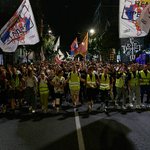
Vučić was reportedly prepared to overturn his election defeat by force, deploying thousands of masked men and police around the presidential palace on election night. He ultimately backed down after pressure from European leaders. #Serbia
Photos @PierreCrom @GettyImages


Brussels’ response was muted as students marched across the country, with EU officials largely avoided criticizing Vučić directly. #Serbia
politico.eu/article/serbian-…

"Combined with efforts to bypass state institutions and create separate structures in Republika Srpska, they are reinforcing a scenario of de facto separation,"
#Bosnia
thegeopost.com/en/ballkan/ra…

Security in #Serbia has been raised to its highest level following a terrorist attack at the Israeli embassy in Belgrade last night.
en.vijesti.me/amp/833575/RTS…

A teenager, supporter of the Islamic State, armed with 2 knives attacked and wounded the guard of the Israeli embassy in Belgrade during a terrorist attack last night. He was killed on the spot. #Serbia
n1info.rs/vesti/dacic-izvede…

“Russia, the EU, literally nothing. But that was super smart, because that's the only way to gather so much support.”
#Serbia
occrp.org/en/feature/is-this…

Competing claims over the ceasefire mark the latest tensions between the White House and the Vatican.
#russia
aljazeera.com/news/2026/10/2…

The call drew criticism from Danish Prime Minister Mette Frederiksen, who said she saw no indication that #Russia wanted peace and urged European countries to remain united rather than act individually.
hromadske.ua/en/war/273270-p…

RTV opens evening news with apology to viewers over years of biased reporting
#Serbia
n1info.rs/english/news/rtv-o…

The Serbian experience challenges conventional assumptions about the resources necessary to defeat an entrenched incumbent.
#Serbia

HOW STUDENTS DEFEATED VUČIĆ WITHOUT PLAYING HIS GAME
In yesterday's early parliamentary elections in Serbia, the Student List, a political movement initiated by university students in December 2024, defeated Aleksandar Vučić's Serbian Progressive Party by 51 percent to 39 percent.
The outcome presents an analytical puzzle. The incumbent commanded all the traditional instruments of political survival: public finances, state institutions, a nationwide patronage apparatus, and fourteen years of accumulated power. The students possessed neither financial resources nor clientelistic networks, no leader, and had no prior electoral experience. Yet they defeated the regime without adopting its methods. I explain this outcome in five points.
1. The Accumulation of Discontent
The students' victory did not come out of nowhere. They inherited more than a decade of growing discontent with Vučić, which had repeatedly erupted into public protests but had never produced political change.
Vučić assumed power in 2012 by mobilizing widespread resentment against post-communist transition reforms that took place in 2001-2012. Over time, this dissatisfaction inverted. By 2016, the former incumbents (now in opposition) had lost credibility, prompting voters to search for alternatives and new agents. This dynamic produced a sequence of political new agents whose electoral appeal consistently deteriorated. Each initially raised hopes of political change, but these hopes faded as some newcomers undermined themselves while others struggled to compete in an increasingly unequal political environment. Meanwhile, Vučić had transformed Serbia's already weak democracy into a hybrid regime with increasingly authoritarian features. Control over state institutions, public resources, and much of the media allowed him to compensate for declining popular support, weaken the opposition, and maintain his hold on power.
Simultaneously, anti-regime sentiment manifested in successive waves of street protests, recurring roughly every 18 months on average. Each wave mobilized more people than the previous one, but each eventually subsided without achieving political change. (Similar dynamics was seen previosuly in Poland in 2015-2023.) Growing mobilization was thus accompanied by growing disappointment. Dissatisfaction with Vučić continued to accumulate, while confidence in the possibility of removing him gradually declined. By 2024, many voters had also lost faith in traditional opposition parties, which they perceived as part of the same clientelistic system. Increasingly convinced that political change was impossible, many withdrew from electoral politics altogether.
2. Overcoming the Coordination Dilemma
Discontent alone is insufficient to defeat an incumbent. Voters must also believe that others will support a viable alternative. Before the students emerged, many dissatisfied citizens abstained because they considered Vučić unbeatable and the opposition incapable of replacing him. Their expectations reinforced the very outcome they feared.
Beginning with university occupations in December 2024, mobilization culminated on March 15, 2025, when roughly 300,000 people gathered in Belgrade, in what was arguably the city's largest political demonstration since its liberation from German occupation in 1944. The event revealed the scale of opposition and, more importantly, made it visible to everyone. For the first time, many voters saw an alternative capable of defeating Vučić. Whether they identified with the students' political views became secondary. What mattered was their shared opposition to the incumbent and their belief that others would support the same alternative. The students had become a focal point for electoral coordination.
3. Clean Hands, No Ambition for Office
The students differed from previous opposition movements in another crucial respect: they were politically clean. Many established opposition politicians were widely perceived as belonging to the very clientelist system they claimed to oppose. The students, by contrast, were simply too young to have developed or joined such networks. They had no history of political deals, public appointments, or access to state resources. In a system defined by patronage, their lack of political experience became their greatest strategic advantage.
What followed was even more remarkable. When in May 2025 the students demanded early parliamentary elections, they imposed an unusual condition: no student could appear on their electoral list. The implicit message was clear: we want to remove the incumbent without taking his place. It was not about privileges, but about the system itself. This was a striking departure from conventional party politics, where parties seek power primarily to secure office and spoils for their leaders. When the students finally submitted their list of 250 candidates, not a single one was a student, let alone a member of the student movement.
By refusing to seek office themselves, the students made their promise to change the system more credible. This commitment appealed to voters on both the left and the right, including those disappointed by successive opposition failures and those who had withdrawn from electoral politics altogether. The breadth of this appeal was reflected in turnout of approximately 70 percent, with roughly 600,000 more people voting than in December 2023. Their self-denial did the trick.
4. Vučić Became Culturally Obsolete
The students' appeal was not simply that they were politically clean. They were also young, mostly in their late teens and early twenties. Like every generation, they had their own culture, their own values, and their own understanding of what was acceptable, desirable, or simply cool.
What Vučić (and not only him) represented did not belong in it. For them, Vučić was culturally obsolete. He represented a political world with which they no longer wanted to identify: patronage, clientelism, corruption, informal deals, and a system in which personal connections and political loyalty mattered more than education, competence, or merit. This was simply not their thing. The movement attracted and mobilized an extraordinary number of young people who saw Vučić as culturally irrelevant, in much the same way Vučić himself had mobilized voters resentful of post-communist transition reforms in 2012.
This attitude gradually spread beyond their generation. Older voters who had long grown dissatisfied with Vučić, but had repeatedly failed to find a credible alternative, began to identify with the students' rejection of his political culture. With this cultural innovation, the students changed the terms of political competition. Vučić could promise higher wages, offer young people subsidized apartments, or distribute cash benefits, but these traditional instruments had little effect on people who no longer wanted to belong to the political world he represented. It was precisely this system of corrupt clientelism and vote buying that they fought against.
5. It Wasn't the Economy, Stupid!
The explanations above emphasize what was unusual about the students' victory. But several more conventional factors also contributed to Vučić's defeat. Demographic change gradually weakened his electoral base, which relied heavily on pensioners, while younger voters constituted a core constituency of the student movement. Between the previous election and October 2026, approximately 270,000 people died, mostly elderly, while around 170,000 young people completed secondary school. The students also adopted a catch-all approach, attracting both pro-European liberals and nationally oriented conservatives who had previously supported different opposition parties.
The students also developed a different form of political organization. Instead of relying on patronage, financial incentives, and centralized party structures, they mobilized thousands of volunteers who contributed their time and energy without expecting personal rewards. Their motivation was arguably stronger than that of many members of Vučić's political machine. Political commitment thus became an alternative to the material incentives on which conventional party organizations depend.
Just as the students mobilized without material rewards, Vučić was defeated without an economic crisis. Authoritarian incumbents often become vulnerable when economic conditions worsen, as illustrated by Orbán's Hungary in April 2026. Ironically, Serbia was different. Over the preceding five years, the economy did well: living standards had risen, unemployment remained relatively low, real wages and pensions had increased, and the currency was stable.
6. Conclusion
Ultimately, the Serbian election was not merely a contest between political alternatives, but between two fundamentally different ways of organizing politics. The Serbian experience challenges conventional assumptions about the resources necessary to defeat an entrenched incumbent. The fact that a loosely organized, decentralized movement with meager financial resources, no leader (!), no clientelistic networks, and no political experience managed to defeat a powerful clientelistic political machine will become an important subject of scholarly research. The Serbian case will be taught at universities in comparative politics and political economy courses and discussed in academic articles and books.

🇷🇸 Jovo Bakić za RT Balkan: Studentska lista neće uvoditi sankcije Rusiji
▪️Predstavnik "Studentske liste", profesor Jovo Bakić ponovio je da nova vlada Srbije neće uvoditi sankcije Rusiji, uprkos tvrdnjama bivšeg predsednika Aleksandra Vučića da će se to dogoditi za nekoliko meseci.
"Mi Rusiju poštujemo i kao veliku silu i kao našu istorijski važnu partnerku i u mnogim slučajevima zaštitnicu. Tu (u spoljnoj politici zemlje) neće biti nikakvih promena", izjavio je Bakić gostujući u emisiji "Srbija bira" na TV RT Balkan.
International observers cite serious shortcomings in #Serbia's parliamentary elections
n1info.rs/english/news/inter…

#Serbia's student-led movement has said it does not plan to impose sanctions on #Russia and intends to stop arms exports to #Ukraine through Western intermediaries.
hromadske.ua/en/politics/273…

Non-hierarchical movement is seeking to ‘rebuild society’ in Balkan country after years of authoritarian rule
#Serbia
theguardian.com/world/2026/o…

It’s 2 PM in Belgrade and people are still celebrating their victory over Vucic
#Serbia
Student List secures 52.54 percent of the vote in #Serbia’s snap parliamentary elections
n1info.rs/english/news/elect…
