Cada miércoles y sábado un nuevo episodio en https://xitter.cf/t.co/XgDhoItiTb
Joined July 2019
- Tweets1.7K
- Following62
- Followers1.8K
- Likes3.4K





Pinned Tweet
Nueva Edición Limitada
Misterios de las Obras de Arte
Con @Maruxavaz
go.ivoox.com/sq/3226565

En 1096, miles de campesinos, mujeres y niños partieron hacia Tierra Santa impulsados por el fanatismo y el hambre.
¿Quieres conocer su historia?
go.ivoox.com/rf/181147658

Victoria Podcast retweeted

Mola mucho estar ahí con @PodcastVictoria 😎

🎭 La cultura tiene muchas historias y voces por descubrir.
Ponemos en valor el talento independiente de los #PremiosiVoox2026 con esta 10 #VocesIndependientes de Cultura 🎧
¡@davidsainz @PodcastVictoria @laORBITAdeENDOR @VengadorT @Kelurobles y más!
👉 ow.ly/3Vqg50ZVPx8

La identidad, el libre albedrío o la caída de un mundo tallado por los dioses son la seña identitaria de las diferentes odiseas modernas que emulan a la de hace más de dos milenios.
go.ivoox.com/rf/180837912

Cuando un barco se aleja de la costa, siglos y siglos de descubrimientos les ayuda a llegar a su destino sano y salvo.
Te contamos su evolución, desde la observación de las estrellas a los satélites de navegación.
go.ivoox.com/rf/180786468

La especulación desmedida en Buenos Aires hizo temblar al sistema bancario de Londres.
La factura la pagaron los argentinos con años de dura recesión.
go.ivoox.com/rf/180560471

Victoria Podcast retweeted

@rama_con , @PodcastVictoria , @LABIBLIOTECADE3 ... Una grande de los cielos que se nos va al Cielo.


Victoria Podcast retweeted

🎭 La cultura tiene muchas historias y voces por descubrir.
Ponemos en valor el talento independiente de los #PremiosiVoox2026 con esta 10 #VocesIndependientes de Cultura 🎧
¡@davidsainz @PodcastVictoria @laORBITAdeENDOR @VengadorT @Kelurobles y más!
👉 ow.ly/3Vqg50ZVPx8
Un claustro de estilo románico aparece en la finca de un millonario en Girona. ¿Monumento medieval del SXII expoliado o falsificación?
go.ivoox.com/rf/180103761

La insurrección del 10 de agosto de 1792 puso fin a la monarquía. La Guardia Suiza de Luis XVI fue el último bastión en las Tullerías.
go.ivoox.com/rf/179988645

Victoria Podcast retweeted

Este próximo 16 de octubre se celebra en Cartagena el Congreso Conmemorativo · V Centenario 'Bazán y su tiempo', en el que participa, entre otros ponentes, @Guille_Nicieza, autor del libro 'Álvaro de Bazán. El Invicto'. Organiza @31EneroTercios. Aquí el programa 👇👇👇


Desde sus orígenes míticos en la India hasta los duelos legendarios que marcaron el siglo XX, el ajedrez ha sido símbolo de estatus y campo de batalla ideológico.
go.ivoox.com/rf/180014087

En este episodio reconstruimos la historia de este hallazgo prehistórico y reflexionamos sobre el valor real del patrimonio frente a la fría lógica del mercado negro y la especulación con metales preciosos.
go.ivoox.com/rf/179858673

Victoria Podcast retweeted
"Este poder, tanto fiscal como, en el fondo, político, era un arma formidable en manos de un monarca que, en suelo inglés, ya de por sí era poderoso. ¿Una “revolución” en toda regla?".
zendalibros.com/el-fin-de-un…

Victoria Podcast retweeted

Gracias a Esau por su interés y por esta hora de conversación hablando de novela histórica, de nuestro @CINHDe y muchos amigos como Soto Chica, @olivares_javier o @VILLENMARIO.
No os lo perdáis – at Úbeda, Spain

La Novela Histórica ha sido la puerta de entrada de muchos de nosotros a la Historia. Uno de los mejores e el Certamen Internacional de Úbeda, donde cada año reune a autores, editores y lectores en Jaén.
go.ivoox.com/rf/179623592

La Novela Histórica ha sido la puerta de entrada de muchos de nosotros a la Historia. Uno de los mejores e el Certamen Internacional de Úbeda, donde cada año reune a autores, editores y lectores en Jaén.
go.ivoox.com/rf/179623592
Victoria Podcast retweeted
Y tenemos podcast sobre el tema ¿verdad @antogom1 @PodcastVictoria ? Concretamente, este👇🏻
¡Te recomiendo que escuches este episodio de iVoox! V250 🩸 El Crimen de Ötzi. 3255 a.c., Primer asesinato documentado de Europa
go.ivoox.com/rf/103064851


The famous 5,300-year-old natural mummy known as Ötzi the Iceman (also called the Man of Similaun) shortly after his discovery in the Alps in September 1991....
Ötzi, an ancient mummified human body that was found by a German tourist, Helmut Simon, on the Similaun Glacier in the Tirolean Ötztal Alps, on the Italian-Austrian border, on September 19, 1991.
Radiocarbon-dated to 3300 BC, the body is that of a man aged 25 to 35 who had been about 1.6m tall and had weighed about 50kg. Initially it was thought that he had fallen victim to exposure or exhaustion while crossing the Alps and died of freezing, but X-ray examination in 2001 showed that an arrowhead was lodged in the Iceman’s left shoulder, suggesting that he had likely bled to death after being shot. The small rocky hollow in which he lay down to die was soon covered (and protected) by glacial ice that happened to be melting 5300 years later when his body was discovered by modern humans. His nickname, Ötzi, stems from the Ötztal Alps, where he was found.
It was at first believed that the Iceman was free of diseases, but in 2007, researchers discovered that his body had been infested with whipworm and that he had suffered from arthritis; neither of these conditions contributed to his death. He also at one time had broken his nose and several ribs. His few remaining scalp hairs provide the earliest archaeological evidence of haircutting, and short blue lines on his skin (lower spine, left leg, and right ankle) have been variously interpreted as earliest known tattoos or as scars remaining from a Neolithic therapeutic procedure.
The various clothes and accoutrements found with him are truly remarkable, since they formed the gear of a Neolithic traveler. The Iceman’s basic piece of clothing was an unlined fur robe stitched together from pieces of ibex, chamois, and deer skin. A woven grass cape and a furry cap provided additional protection from the cold, and he wore shoes made of leather and stuffed with grass. The Iceman was equipped with a small copper-bladed ax and a flint dagger, both with wooden handles; 14 arrows made of viburnum and dogwood, two of which had flint points and feathers; a fur arrow quiver and a bow made of yew; a grass net that may have served as a sack; a leather pouch; and a U-shaped wooden frame that apparently served as a backpack to carry this gear. His scant food supply consisted of a sloeberry, mushrooms, and a few gnawed ibex bones.
Ötzi and his artefacts have been exhibited at the South Tyrol Museum of Archaeology in Bolzano, Italy since 1998.
The mummy is stored in a specially devised cold cell and can be viewed through a small window. Ötzi’s numerous pieces of equipment and clothing have been painstakingly restored. Visitors have been amazed by the skills of Stone Age people. The mummy was dubbed Ötzi by the Austrian journalist Karl Wendl, who was looking for a catchy name. The name refers to the discovery site in the Ötztal Valley Alps.
The South Tyrol Museum of Archaeology belongs to the autonomous province of Bolzano and is associated with the South Tyrol Regional Museums.
#archaeohistories

¿Cómo se combinaban la brutalidad del castigo con la rutina burocrática y la vida cotidiana de un hombre que ejecutó a más de 500 condenados bajo seis papas diferentes?
go.ivoox.com/rf/179445175

Victoria Podcast retweeted

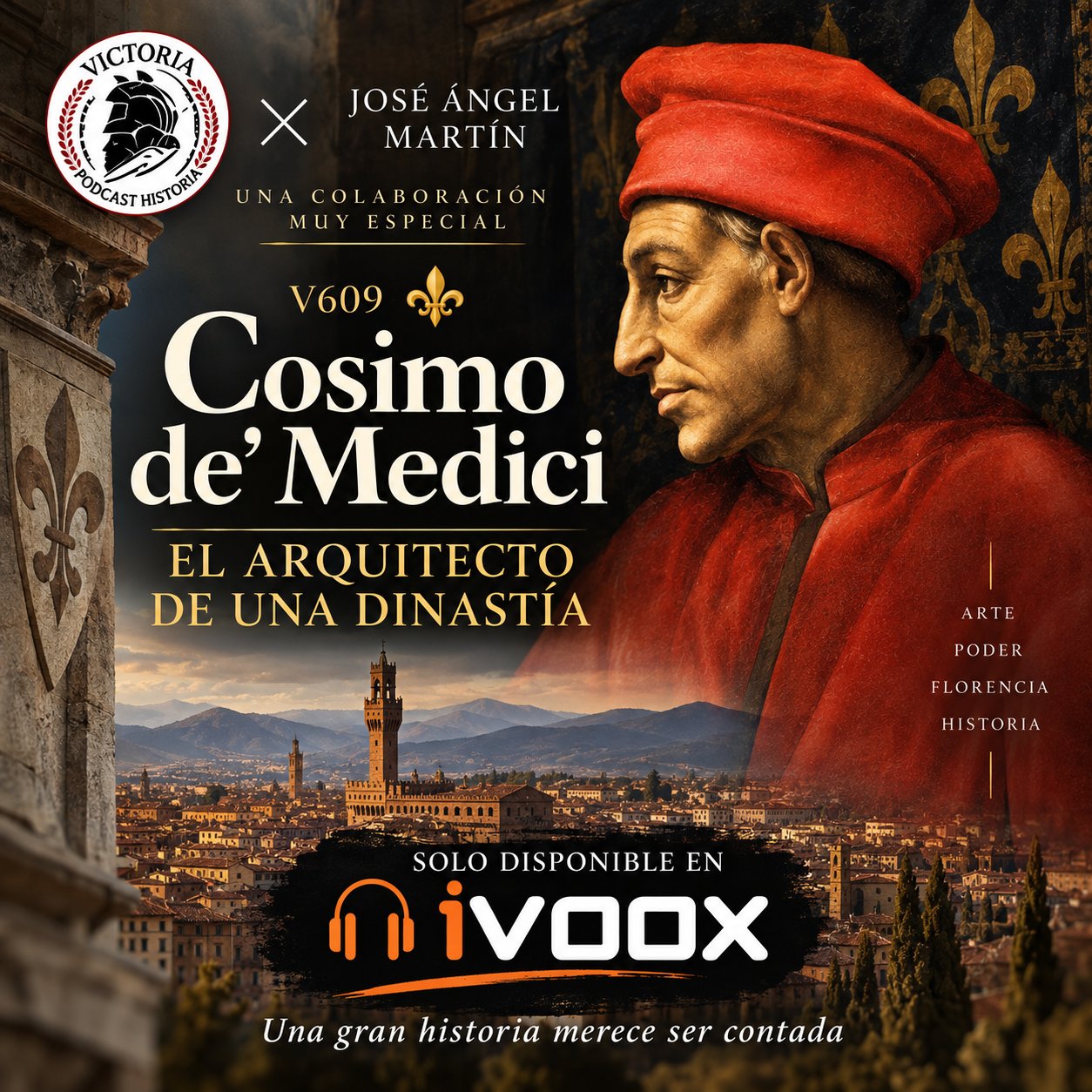
Hoy viajamos a la Florencia del Renacimiento para descubrir la historia de Cosimo de’ Medici, el hombre que sentó las bases de una de las dinastías más poderosas de Europa.
Una colaboración muy especial que hice con Victoria Podcast Historia.
@PodcastVictoria