

Não tenho conta aqui há uns 5-6 anos. Só criei porque esse site não deixa mais ver conteúdo sem estar dentro. Orthodox, Male.
BR
Joined July 2023
- Tweets5.9K
- Following340
- Followers528
- Likes4K



Postulio ☦️🇧🇷 retweeted

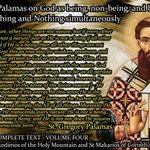
“Paul was created only so long as he lived the life that came into being from non-being by the command of God; but when he no longer lived this life, but the one that came to be by the indwelling of God, he became uncreated by grace, just as Melchizedek and everyone who has acquired within himself only the living and active Word of God.”
-Saint Gregory Palamas

Postulio ☦️🇧🇷 retweeted

🔸 November 14 - Saint Gregory Palamas 📿🔸
Today, we commemorate Saint Gregory Palamas, Archbishop of Thessaloniki. He was a monk, theologian, and leading proponent of Hesychasm - the tradition of inner stillness and noetic prayer (often through repetition of the Jesus prayer), with the aim of purifying the heart and experiencing God’s uncreated energies. St Gregory was born in Constantinople in 1296 to a noble Anatolian family. Though emperor Andronikos II Palaiologos had ambitions for him to serve in the imperial court, Gregory was drawn to monasticism.
He even persuaded his brothers and sisters, along with his widowed mother, to take up the monastic life. In 1318 he went to Mt Athos where he learned the tradition of hesychastic prayer. With the encroachment of the Turks, Gregory fled to Thessaloniki where he was ordained a priest in 1326. Returning to Mt Athos in 1331, he became embroiled in the ‘Hesychast Controversy’ with Barlaam, a humanist scholar and theologian from Calabria.
Barlaam condemned the Latin addition of the Filioque to the Nicene Creed, arguing that since God is ultimately unknowable, it was impossible to use human reason to prove that the Holy Spirit proceeds from both the Father and the Son. He also mocked the hesychast monks as ‘navel-gazers’, ridiculing their practices as anti-intellectual. Criticizing Barlaam’s ultra-rationalism, St Gregory defended the hesychast position that while God’s Essence is ultimately inaccessible, humans can still perceive His uncreated Energies, allowing direct participation in His divinity.
This Essence-Energies distinction is known as ‘Palamism’. Around 1338, St Gregory wrote the Triads defending the Athonite monks from the attacks of Barlaam, and affirming the experience of God’s uncreated Energies through Hesychasm. He defended Hesychasm at 3 Synods in Constantinople (1341, 1347 and 1351) which condemned Barlaam as a heretic. In 1347, St Gregory was made Archbishop of Thessaloniki. Captured by the Turks on a voyage to Constantinople, he was held captive for a year. After his ransom was paid, he returned to Thessaloniki where he continued his episcopal ministry until his repose in 1359.


Postulio ☦️🇧🇷 retweeted
Sainthood is not univocal in Orthodox Christianity. Attaining the status of sainthood merely means that it is evident that one is not in Hades. A lay martyr is not level with Saint Symeon the New Theologian. According to Saint Cleopa, there are nine types of prayer, and only one in ten thousand earnest strivers for true prayer reaches the sixth stage, while only one person in a generation reaches the ninth. Saint Nicodemus the Hagiorite lists six categories of the saved in the Eschaton. The implications of this hierarchy of holiness are profound.
Postulio ☦️🇧🇷 retweeted

“The Jesus Prayer will raise you to a spiritual state wherein the whole of nature will appear to you with indescribable beauty. Creation will seem to converse with you, to smile upon you. And when, through the Prayer, you are drawn into higher realms, you will behold nature in its transfigured form. All creation will seem to co-pray with you.”
- Saint Ephraim of Katonakia, The Fragrance of Christ

Postulio ☦️🇧🇷 retweeted

Against the heretics who say that we are sinful by nature, by St Photios the Great:
"A book was read [to me], entitled: 'Theodoros of Antioch, Against Those Who Say That Men Sin by Nature and Not by Will' ...
He writes this book against those of the West who have fallen sick with this disease … The points of their heresy, to state them in summary, are these:"
...
"They say that not even infants, though newly born, are free from sin, since from Adam’s transgression the nature has come to exist in sins, and the sinful nature (as they would call it) extends to the whole race descended from him. They bring forward “I was born in sins” and the like; and holy baptism itself, and the communion of the immaculate Body for the remission of sins, and the fact that these are given to infants also, they produce this in confirmation of their own opinion."
"Such are the positions of the heretics. Theodoros does well to reject them; in places he strikes excellently and with force at the strangeness and blasphemy of their notions, and, fitting the proper senses to the words of Scripture which they wrongly understood, he utterly convicts them of ignorance."
Note: Theodoros of Antioch believed that we do not inherit any corruption from Adam, and Photios disagreed with him on this. But regarding inherited guilt/sinning in Adam, Photios expressed his delight in agreeing with Theodoros and said that he destroyed the "Western heretics" with ease.
- Saint Photios the Great, Bibliotheca

Postulio ☦️🇧🇷 retweeted
One of the meanings of the Greek word for salvation, sozo (σῴζω), is literally "to heal". Salvation is a lifelong process, therefore a therapy, and Christ is the physician. He calls Himself a physician in Luke 5:31 and Mark 2:17, and the disciples of the apostles have said the same since St. Ignatius of Antioch.
These people should just drop salvation (theosis!) and embrace Satan already, since they love being externally imputed with an empty belief that never produces any ontological change.
Postulio ☦️🇧🇷 retweeted
Okay, time to go full autism on Bleach and religion (don’t take it too seriously)...
I listed some of the similarities between Bleach and Orthodox Christianity, and I also created a fictional scenario.
* * * *
IF BLEACH TOOK PLACE IN AN ORTHODOX CHRISTIAN PARALLEL UNIVERSE:
• Shinigami: Saints and intercessory angels who act as co-administrators of heavenly affairs (they are Ortho-Shinigamis and Ortho-Angels)
• Seireitei: The Communion of Saints and Angels (also Ortho-Shinigamis and Ortho-Angels)
• Division Zero / Royal Guard: Archangels or Orthodox Elders (gerondas, starets)
• Central 46: The Celestial Pan-Orthodox Council, which is also correlated with the biblical concept of the Divine Council
• Rukongai and its districts: The 'many mansions in the Father’s house' (different levels and hierarchies in Heaven)
• Hollows in general: Demonic beings, the hole in their bodies symbolizes that sin has no substance
• Hollows gillian, adjuchas, vasto lordes and arrancars: principalities and powers, nephilim (bizarre hybrids) and elite demonic beings (Espadas)
• Vaizards: bizarre hybrids, but right-hand-path occultists, they’re a hermetic and christian neoplatonic syncretic order that was anathematized by the Byzantine Soul Society.
• Quincy: apostate Jews who reject the Soul King and fight against the messianic figure of Ichigo, who possesses a shinigami nature and a human nature, in addition to the quincy nature he inherited from his mother
• Dangai: The pathway related to the soul’s transition and journey, connected to the orthodox doctrine of the Aerial Toll Houses. These trials begin already on Earth through Hollow attacks and continue afterward, leading either to the Byzantine Soul Society or to condemnation in Hueco Mundo/"Hellish Hueco Mundo" (Orthodox Sheol or Hell, but not the Helish Lake of Fire yet)
• Hueco Mundo: Hades, Sheol or Hell - The underworld understood as having various degrees or levels according to the state of each soul - for example, baby-form Nel Tu and her friends don’t really suffer
• Bleach’s version of Hell: The Orthodox Lake of Fire (gehenna, eternal damnation, the worst Hollows and Nephilim are there)
• Zanpakuto and Asauchi: It’s your guardian angel who assists you; you get one when you're baptized after Chatolic Orthodox Shinigami Academy and become an Ortho-Shinigami
• Shikai: Theoria (illumination), achieved through introspection and 'nepsis' (watchfulness) in the inner world of the Ortho-Shinigami
• Bankai: Theosis (deification), when the light of your soul, united with the Uncreated Light, manifests outwardly and transmits grace. The Orthodox Shinigami doesn’t shout “Bankai!” - he shouts “THE—OSIS!”. To achieve Bankai in Bleach, you have to dive into the inner universe of your own soul. In Orthodox theology, we have something called the noetic universe of the soul, where the nous, or the 'Eyes of the Heart', must be opened through purification (katarsis), because the heart is a literal temple where the Holy Spirit dwells. Our guardian angel helps with that.
• Hollow's Resurrección: or demonosis... Many Vasto Lordes shout "DEMONOSIS!" when they transform
• Quincy Vollständig: or Kabbalism... Many Quincies shout "OY VEY" when they transform
• Reishi: The Logoi (divine principles or inner reasons within things, in Orthodox theology)
• Reiryoku: Radiant, uncreated grace. In Orthodoxy, it’s what we call a theophoric soul, or a vessel of God
• Shunpo: The miracle technique of bilocation
• Kido, Hado and Bakudo: Exorcism techniques performed through the recitation of prayers and akathist hymns by wonderworking Ortho-Shinigamis
• Jibakurei: Demonic possession or the souls of people facing the Aerial Toll Houses
• Soul King: A God-like figure, crucified before the foundation of the world (theology of Pre-Incarnate Logos, perhaps?)
• The Primordial Sea: Maybe something related to the Divine Essence? Saint Gregory of Nazianzus calls God a Sea of Essence in his Orations. Or perhaps this concept could also be connected to the Orthodox doctrine of the uncreated energies, which are always active. The Primordial Sea is the dwelling place of Adnyeus, the Soul King in Bleach, and the Bible says in Psalm 18:11 that God made darkness His secret place. Well, Kubo didn’t elaborate much on this part of Bleach’s cosmology, which seems somewhat monistic and at the same time de-teleologized, BUT NOT IN ORTHODOX BLEACH!
• Aizen: a precursor to the Quincy-Antichrist and a fallen Ortho-Shinigami
• Yhwach: The Antichrist Jew
• Wandenreich: The army of Jews and Gnostics
• Ichigo: A Christ-like figure. Just as Christ, in His kenosis (self-emptying), assumed a fallen nature and faced the Blameless Passions, Ichigo, in his perfect will, did not give in (okay, that one was pretty forced...)
• (the Orthodox Ichigo touches his Ortho-Shinigami emblem, an Orthodox Cross, to leave his body)
• Urahara: an important Desert Father and a respected Hesychast. However, due to some of his heterodox views, he was banished from the Byzantine Soul Society - a controversial expulsion that remains disputed to this day. Even so, he continues to defend the Soul Society and serves as Ichigo’s spiritual father
Additionally, just as the Shinigami possess a hierarchical order, the Orthodox Bleach parallel universe also features monastic degrees: dokimos, rasophore, stavrophore, and the Great Schema - alongside ecclesiastical ranks within each squad of the Gotei 13: deacon (5th Seat), presbyter (4th Seat), bishop (3rd Seat), archbishop (Lieutenant), patriarch (Captain), and primate (Commander of the 1st Division).
#Bleach
#TYBW
#Anime
#Orthodox
#Christianity


Postulio ☦️🇧🇷 retweeted
Logos is the singular of logoi and logoi is the plural of logos. It's obvious that the uncreated Logos is the Son, but there is no division between the Divine Logos and his logoi, since each logoi are eternally contained in the Logos as his intentions, ideas and predeterminations. When we say that creation is ex nihilo, it's not from nothing as if by magic, but rather that every aspect of creation is based on its respective logoi, like a map by which the architect of the universe will raise its foundations so that later he can build upon them. What we call logos and logoi is nothing other than the subtle structure of reality; it's God himself dispersed in all things, binding universals to particulars without dissolving them. Some monks and saints are able to contemplate the logoi directly by observing the nature around them with the purified nous united to the heart, because the logoi are part of the uncreated divine energies.
Regarding St. Photius, again, he was correctly opposing Plato's transcendental and dualist realism, which believed in essences separate from concrete things, as if they existed only in a parallel intelligible world, treating the sensible world as something imperfect or inferior. On this point he is correct, but if his conceptualism goes beyond that and treats transcendental categories and every abstract object such as universals as if they existed only in the human mind/deprived of ontological status, he is factually wrong! Logic was divinely established and is not reduced to the mind, although it's also in the mind and that is why we can defend the correspondence between subject and object (Romans 1:20). This logic is even above the saints, who are not immune to errors (St. Augustine defended double predestination, for example). And the logical consequence of treating every abstract object as something that has no relation to external transcendental categories can lead you to two errors: at one extreme, to nominalism, at the other extreme, to panpsychism where the whole of reality is a mind, which only works in a monist, pantheist or acosmist metaphysics, but not a Christian one.
That said, I definitely need to read more texts of St. Photius because this platform loves cherry-picking, lol. I say the same of St. Gennadios. I am very far from being an expert on the subject.
teapawt.org/Postulliok/status/2118…


Sorry, but you're wrong. The word logoi is nothing more than the plural of logos, and its translation literally means "reasons." St. John of Damascus calls these logoi exactly divine ideas, and St. Dionysius calls them predeterminations. Other saints call them by other names, also treating them as divine words spoken by the Word, who in turn was spoken by the Father through the Holy Spirit, as the divine Person who makes possible the harmonious transition/connection from the transcendent to the immanent.
There are multiple valid translations to express the concept. Yes, divine intentions is also correct, but it is precisely because they are intentions that they are the ideas of the one who intended them, and that is why there is telos in the world and creation is a free act of God rather than mechanical emanations in which the divinity needs to "disintegrate" monistically in order to produce multiplicity. The logoi have true existence because they possess ontological status (they are embedded in the divine energies), just as universals and essences (which are created on the basis of their logos) possess ontological status instead of existing only in our mind. If it were not so, logic itself would be impossible, since it preexists the human mind, and St. Paul says in Romans 1:20 that divine logic is observed in nature (that is, there is logic external to the mind because there are logoi sustaining each thing).
The logoi are neither universals nor essences, but that which makes universals and essences possible: it's the uncreated God in created things. God is literally present in every atom. It's correct to treat the logoi as divine archetypes or the architectural blueprint of reality. It's only necessary to qualify.
TL;DR There is no separation between the Logos (the Word) and the logoi, just as there is no separation between you and your thoughts.
Postulio ☦️🇧🇷 retweeted

"In hell there is a democracy, but in Heaven there is a Kingdom."
- St. John of Kronstadt
Pray for us blessed saint!

Postulio ☦️🇧🇷 retweeted
"[Antony] lead Orthodox thought away from the scholastic-rationalistic path and onto the blessed ascetic path."
- St Justin Popović, The Mystery of the Personality of Metropolitan Anthony and His Meaning for Orthodox Slavdom


'First of all, let us examine the words of the Apostle Paul to the Romans (5:12): “As by one man sin entered into the world, and death by sin, and so death passed upon all men, in whom all sinned.” If “in whom” is understood as “in which”, it is unclear what this “which” refers to. To the one man? The words stand too far apart. To the world? Possibly. To death? That too is possible, for in Greek “death” (θάνατος) is masculine. We take up the Russian translation and at once see the treacherous italics, where, as has already been said, Catholic and Lutheran conjectures are mostly to be found: “because in him all sinned.” Were this interpretation correct, it would be the chief, and perhaps the only, basis for the juridical theory and for ascribing to God a blood-feud against a whole race. “As from an infected spring,” we read in the textbook, “flows corrupted water,” and so on. But permit me: a spring and its water are one thing; living, morally responsible people are quite another. It is not by our own choice that we are Adam’s descendants, so why should we bear the guilt of his disobedience? To make Christ’s redemption our own we must struggle hard; can it be, then, that the condemnation of all on account of Adam befell men apart from the guilt of each one of them? The Apostle says here that the gift was poured out more richly than the condemnation (Rom. 5:15), whereas the juridical interpretation yields the very opposite.'
- Metropolitan Antony Khrapovitsky, The Dogma of Redemption, 1917

Postulio ☦️🇧🇷 retweeted
Seeing a lot of people posting the works of this supposed Georgian archpriest who in fact does not actually represent the Georgian Church, but only an irrelevant circle of old Latinising Russophones whom the Georgian Church wants to do away with. The foremost heresy of Jincharadze is his belief that the descendants of Adam are actually culpable and blameworthy for the sin of Adam (in his 2024 book).
Let's take a look at what the Georgian Church actually teaches and also what the Orthodox position is on the culpability of original sin:
First of all, in 2007, the Patriarchate of Georgia officially approved of the anti-Latin work of Vladimir Lossky especially regarding his treatment of original sin. It was printed with the blessing of Bishop Euthymius (Lekava) and also deemed valid to be published by Edisher Chelidze, head of the Patriarchate's Department of Theology.
In the Easter Epistle of Patriarch Ilia II of 2013, he says:
"Thus death and corruption became the lot of humanity and the visible world subject to it
...Before God, however, everyone answers only for their own transgression."
In the same year, Deacon Irakli Tsakadze from the Orthodox theology centre of Georgia, plainly states:
"Original sin is not [to be] understood in juridical terms
... [and] although we are not guilty of the [ancestral] sin, we are nevertheless affected by it in some different way."
The St Nino Orthodox Apologetic-Missionary Centre of Georgia gives the most direct and vernacular answer to the issue:
"Are Adam's descendants therefore guilty? Or are they answerable for this sin?
Of course not; they are innocent and do not bear responsibility for it."
Now to briefly address the guilt of original sin, once again. Not a single Eastern Father, or even Western (before Augustine) ever affirms that the descendants of Adam are actually culpable and blameworthy of original sin, the guilt/liability they inherit is a condition. Culpa/blame is an entirely separate category that absolutely no one, until after Augustine, ever dared to assign to the descendants of Adam. That understanding was also completely unknown to the Byzantine Church and doesn't even deserve refutation but St Maximos the Confessor in very clear terms precludes any possibility for this to ever become an idea:
"Thus two sins came about in the forefather through his transgression of the divine commandment: the first was blameworthy, but the second was blameless, having been caused by the first. The first was a sin of free choice, which voluntarily abandoned the good, but the second was of nature, which involuntarily and as a consequence of free choice lost its immortality."
St Cyril in further detail and plain terms also refutes any idea of such notion:
"But since he produced children after falling into this state we, his descendants, are corruptible, coming from a corruptible source. Thus it is that we are heirs of Adam’s curse. That cannot mean at all that we are punished for having disobeyed along with him the divine injunction which he received; it means that he became mortal, as I said, and transmitted the curse to his seed after him (for we are born mortal from a mortal source)."
Blessed Theodoret of Cyrus:
"All therefore, as having sprung from him, inherited a mortal nature. Now such a nature has need of many things, food, and drink, and clothing, and houses, and various arts, and the use of these oftentimes excites the passions into excess, and excess begets sin; and therefore the holy apostle says, that Adam having sinned, and become mortal through that sin, both descended to his race, for death came upon all men, in that all have sinned, for not on account of our first father’s transgression, but for his own, each receives the sentence of death."
Saint Symeon the New Theologian:
"For just as those who are like the old Adam, who transgressed the commandment of God, remain outside the Kingdom of Heaven, despite the fact that they are not by any means guilty of the fact that they are like their forefather Adam, so also Christians, like the New Adam, their father Christ, enter into the Kingdom of Heaven despite the fact that their likeness to Christ is not their own doing, since this is accomplished by means of the faith which they receive in Christ."
St Athanasios Parios:
"It is asked, and very reasonably, on what account the condemnation of the disobedience passed even to those who did not transgress, that is, who did not eat of the forbidden fruit? For as we know it is properly and primarily the soul (will) that sins.
...As time went on and the human race multiplied, sin too began to multiply with it; every kind of wickedness and evil was ventured, and every soul was gradually pulled towards evil from its youth."


Postulio ☦️🇧🇷 retweeted

''Όσοι ομιλούν για “ένωση Εκκλησιών”, δεν γνωρίζουν ούτε την νοοτροπία των ετεροδόξων, ούτε το ύψος της Ορθοδοξίας...'' ~ Όσιος Σωφρόνιος του Έσσεξ
''Η διδασκαλία της Εκκλησίας, που έλαβε την τελική της μορφή από τις Οικουμενικές Συνόδους, δεν επιδέχεται καμιά αλλαγή...
Όλη η μετέπειτα επιστημονική εργασία, πρέπει απαραίτητα να συμφωνεί μέ ότι δόθηκε στη Θεία αποκάλυψη, και διατυπώθηκε στη διδαχή των Οικουμενικών Συνόδων της Εκκλησίας...
Το ίδιο ισχύει και για τη χάρη. Το πλήρωμα της χάριτος μπορεί να κατέχει μόνο η Μία και μοναδική Εκκλησία...''
*****
Μὲ τὸν τρόπο ποὺ προσεύχονται οἱ Δυτικοὶ δὲν μποροῦν νὰ καταλάβουν τὶς πολύωρες προσευχὲς τῶν Ὀρθοδόξων Μοναχῶν. Αὐτοὶ μὲ μισῆ ὥρα προσευχὴ κουράζονται, γιατί προσεύχονται μὲ τὸ μυαλό, διανοητικά. Οἱ Ὀρθόδοξοι προσευχόμαστε μὲ τὸν νοῦ (καρδιακά).
Οἱ Ἰουδαῖοι προσεύχονταν μὲ τὴν λογική τους. Τὴν ἡμέρα τῆς Πεντηκοστῆς δόθηκε στοὺς Ἀποστόλους τὸ Ἅγιον Πνεῦμα ὡς πύρινες γλῶσσες καὶ κατάλαβαν ἕνα ἄλλο εἶδος προσευχῆς, τὴν καρδιακὴ προσευχή. Πρώτη φορὰ προσεύχονταν μὲ τὴν καρδιά τους.
Ὑπάρχει μεγάλη διαφορὰ μεταξὺ Ἀνατολῆς καὶ Δύσεως.
Ἕνας Δυτικὸς ποὺ βαπτίζεται Ὀρθόδοξος, θὰ περάσει πολλὰ χρόνια μέσα στὴν Ὀρθόδοξη Ἐκκλησία, μὲ καθοδήγηση ἐμπείρου πνευματικοῦ ὁδηγοῦ γιὰ νὰ ἀποκτήσει καθαρὸ Ὀρθόδοξο φρόνημα καὶ ἦθος…
Αὐτὸς εἶναι ο λόγος ποὺ ΔΕΝ μπορεῖ νὰ γίνει «ἕνωση τῶν Ἐκκλησιῶν»…
Ἡ «ἕνωση τῶν Ἐκκλησιῶν» εἶναι δύσκολη, ἕως ἀδύνατη!
Ὅσοι ὁμιλοῦν γιὰ «ἕνωση Ἐκκλησιῶν» δὲν γνωρίζουν οὔτε τὴν νοοτροπία τῶν ἑτεροδόξων οὔτε τὸ ὕψος τῆς Ὀρθοδοξίας!
Δὲν ἐπιθυμῶ νὰ γίνει, τουλάχιστον τώρα, ἡ «Ἕνωση τῶν Ἐκκλησιῶν», διότι οἱ Ρωμαῖοι (Λατίνοι) δὲν θὰ ἀλλάξουν, ἀλλὰ καὶ οἱ Ὀρθόδοξοι θὰ διαφθαροῦν…
Νὰ κρατοῦμε τὴν Ὀρθόδοξη πίστη!
Καί, ἐπειδὴ ζοῦμε σὲ δύσκολους καιρούς, θὰ λάβουμε μισθὸ περισσότερο ἀπὸ ἄλλους ἀνθρώπους ποὺ ἔζησαν τὶς παλαιότερες ἐποχὲς καὶ κράτησαν τὴν πίστη...
~ Όσιος Σωφρόνιος του Έσσεξ
___________________________________
Επιλεγμένα αποσπάσματα απο το βιβλίο «Οἶδα ἄνθρωπον ἐν Χριστῷ» (Β έκδοση), του Μητρ. Ναυπάκτου και Αγίου Βλασίου, Ιεροθέου Βλάχου.
pneumatoskoinwnia.blogspot.c…

Postulio ☦️🇧🇷 retweeted

St. Theophilus of Antioch destroying Calvinism’s predestination heresy before Calvin was born
Someone, however, will say to us, "Was man made by nature mortal?" Certainly not. "Was he, then, immortal?" Neither do we say that. But someone will say, "Was he, then, made nothing?" Not so, I reply. By nature, in fact, he was made neither mortal nor immortal. For if God had made him immortal from the beginning, He would have made him God. Again, if He had made him mortal, it would seem as if God were the cause of his death. He made him, then, neither mortal nor immortal, but, as we said above, capable of either. Thus, if he should incline to the ways of immortality, keeping the command of God, he should receive from God the reward of immortality, and become God. If, however, he turn aside to the ways of death, disobeying God, he should become for himself the cause of death. For God made man free and self-determining
St. Theophilus of Antioch, To Autolycus 2, 27


Postulio ☦️🇧🇷 retweeted

“Unfortunately, the spirit of moralism which we mentioned earlier, i.e., basing the Christian life on moral improvement, has adversely influenced the piety and spirituality of Christians to a significant degree even here in our land. We often cease to pursue Theosis because of western influences on our theology.
Guidance that only aims for moral improvement is anthropocentric – it is centered on man, and in it, human effort dominates, and not the Grace of God. It then seems as if it is our own morality that saves us, and not the Grace of God. Life under these conditions does not give us genuine experiences of God, therefore the psyche is not truly satisfied because its thirst remains unquenched. This method of guidance has been tried, and it failed because it does not represent the genuine spirit of Christ’s Church. It is often responsible for atheism and for many people‘s indifference towards the spiritual life, especially among the young.
In our catechisms, sermons and everything said by parents, teachers, clergy, and other workers of the Church, instead of talking about sterile improvements of mankind, let us educate Christians towards Theosis. This is the genuine spirit and experience of the Church. Otherwise, the virtues, regardless of how great they may be, do not, in fact, fulfill the purpose of the Christian life. They are simply ways and means which prepare us to accept Theosis, The Grace of the Holy Spirit, as Saint Seraphim of Sarov taught so clearly.”
Theosis: The True Purpose of Human Life, Archimandrite Georgios (Kapsanis),


Postulio ☦️🇧🇷 retweeted

On Confucius and Isaiah the Prophet:
9.28 The Master said, "Only after Winter comes do we know that the pine, cedar, and cypress are the last to fade."
-- "The Analects"
"And the glory of Lebanon shall come to thee, with the cypress, and pine, and cedar together, to glorify my holy place."
-- Isaiah 60:13
"Thou was crucified, O Son of God, on the pine, the cedar and the cypress; Sanctify us all, and count us worthy to look upon Thy life-giving passion."
-- Matins canon, Ode 4, 4th Friday of Great Lent

Postulio ☦️🇧🇷 retweeted

According to Father Seraphim Rose, an Orthodox Christian, astral projection and near-death-experiences are real, but they take place in the “toll houses” or the aerial realm, the lowest level of heaven, where deceptive spirits disguise themselves as beings of light and try to drag departed souls into hell. In the Scriptures, Satan is called the prince of the power of the air.


Postulio ☦️🇧🇷 retweeted

NEW BLOG POST - Neo-Barlaamism and Academic Theology
“Theology without experience,” said Saint Paisios the Athonite, “is like a blind mole-rat trying to describe the sun.” One can write about Palamas without living Palamas. One can write about theosis without pursuing purification. One can analyze Hesychasm without ever understanding why the Fathers insisted upon purification of the nous. Theology, that is, “speaking of God”, is not... (1/2)


