






Potrock retweeted

I have been doing software development the last few months. The endeavor seems entirely changed versus both the majority of my career, during which I solo shipped two SaaS products the old fashioned way, and even against 12 months ago.
kalzumeus.com/2026/11/25/mul…
Potrock retweeted

Claude Opus 5.6 is likely now being tested for a subset of Claude users (some in Claude Code, some in Chat, and some without it anywhere), in a similar fashion to how Opus 5.5 was tested
It's quite a jump over Opus 5.5 (comparison and prompt to check in replies)

Potrock retweeted

Hey @askcircuit build me a news trading agent that longs BTC/ETH/SOL perps on defensive cryptography news and shorts on the opposite
Potrock retweeted

Lido Lend: Security-First Lending
Lido contributors are unveiling the development of ‘Lido Lend’, a new decentralized lending market, designed with a novel set of security-forward safeguards and utilities that benefit both lenders and borrowers.
research.lido.fi/t/unveiling…
Potrock retweeted


We’re releasing a broad range of new mathematical results produced by an internal frontier model.
We’ve been consulting with the independent Advisory Group on Mathematics and Artificial Intelligence at the Institute for Advanced Study, and we have drawn on their advice and public recommendations to inform how we release these results.
github.com/openai/math

Potrock retweeted
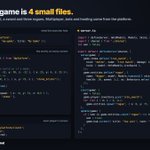
Opus 5.5 and I built a multiplayer game engine that runs in your browser. In 3 days.
9 games, from a Call of Duty clone to Battlefront II with sabers. Lobbies, Discord login, achievements, cosmetics.
All open source. Build your own games with Claude and I’ll host them.

Potrock retweeted

Announcing Centaur 2.0!
Centaur is frontier, agentic infrastructure that you own. Centaur is like Claude Tag, but open source and on steroids.
Centaur 2.0 can connect to everything you have access to, and can reason over it next to where you work, either in Slack, Discord, Teams or in your local Codex or Claude Code via an MCP.
But context isn't useful if it can be accessed by anyone, so we rebuilt Centaur from the ground up for security. Centaur obviously doesn't have access to secrets because we're leveraging egress proxies.
Centaur 2.0 takes that a step further enabling administrators to configure who can access what from where. This means that Centaur can have access to private information that you normally wouldn't feel comfortable giving it access to (e.g. DMs or sensitive channels and docs) but only expose it to authorized principals.
It also means you can add Centaur to external channels and leverage it as a virtual colleague that doesn't live only in your Slack, for example, but also your Slack Connect channels! This is extremely powerful as we start moving to a world where agents cross organizational boundaries.
Also in case anyone's wondering, yes we rewrote it in Rust! Centaur is now way way more stable at durably executing threads, and its workflow engine is now based on Absurd.
We have been operating Centaur since January, officially launched and Open Sourced it in May, and now we're full speed towards making it the #1 open source agentic infrastructure.
To succeed at that, I'm thrilled to welcome @mslipper to the @paradigm team who will be leading all our Applied AI work, while continuing to maintain and extend Iron Proxy as the leading secure secret access for agents. Welcome Matt, it's an honor after all these years of knowing you!
Read the full blogpost below, and apply to join our team!
Potrock retweeted

This is all *real*, my friends. It's really happening. RSI *will* happen. The machines *will* build even smarter machines. New architectures *will* be invented. AI *will* become indistinguishable from a conscious entity. We humans *will not* always be in control.
This all seems purely theoretical with a tinge of sci-fi for now, but I think it's actually coming our way quite fast. Just think about how far we've come in <2 years since o1-preview, realize that we have been significantly accelerating since then, then extrapolate another ~2 years into the future.
And there is no imaginary pause button we can hide behind. We must take a deep breath and face this brave new world.
For better or for worse, like it or not, it is coming.
Potrock retweeted

I'd like to do two things: (1) tell you where I think I erred in my original post about Kimi and (2) set the record straight about my views on open-weight AI.
Before I joined OpenAI (and folks who are new followers: I joined the company less than two weeks ago and it is my first job in the technology industry), I often tweeted about the controversy of the day in a cold and analytic fashion. One aspect of my style was saying brutally honest things, including things inconvenient for my 'side' and my beliefs. The post about Kimi was largely written in that vein.
When I said that the USG would probably realize its best option is to do ill-justified soft-law discouragement of Chinese AI, I wasn't proposing it like a good idea. Why on Earth would I do that? Why would I frame something I'm advocating for in such brutal terms? I am trying to describe what I believe will happen, not advocate for anything.
My first mistake: What I now realize is that this style of analysis is no longer tenable. There is simply too much scrutiny on my words, too much temptation to draw conspiracies from my claims, and the like. It is my fault for not realizing this.
Second mistake: I was relatively imprecise, writing, as I usually do, for a fairly high-context audience that was inclined to give me grace rather than pick apart every word. I should not have said, for instance, that open-weight models are unqualifiedly 'decelerationist'; I don't believe that. I only believe specifically that open-weight models decelerate capex spending on the margin, which is straightforwardly true. I did not say it was decelerationist for any other reason than that, and this is the only way in which I think open-weight AI is inherently decelerationist (though it is a big way). In many other ways, open-weight AI is profoundly accelerationist.
Now, to where I stand on open-weight AI. My earliest experiences on the internet were posting in forums about philosophy, music, and movies in the early 2000s. Over time I realizes that forums on different websites had the same underlying forum software; this was the first time it occurred to me that 'software' is a thing people make (I realize this is a simple observation, but we are talking about an 11 year old with no prior exposure to computers).
I looked into the software, and discovered that it was 'open source,' built and maintained for free by thousands of people around the world to facilitate the communication of millions of strangers. This notion struck me as deeply beautiful, and I decided I'd try to help. I began writing technical documentation, and later on, code, for this little forum project. This was how I first learned technical skills. I cherish that time, that software, and I have deep and abiding affinity for open-source software.
The vast majority of the people commenting on my post have very little context for my prior writing. For instance, the fact that I wrote, in 2024, things like:
"those who wish to hoard our software technologies may well be foreclosing on—or perhaps not even understand—the staggering civilizational victory that we earned through openness"
or
"I would like for AI to result in a similar smashing victory for America. To do that, we will need to set the global standard yet again. And to do that, we will almost certainly need to lead in open-source AI, because it is open protocols and open software that tend to define global standards in information technologies."
I stand by these things. When I was in government, I worked alongside my colleagues to develop ideas and rhetoric that was strongly supportive of open-weight AI, and some of this work made it into the current US AI strategy. I stand by that work too.
I also wrote, more than two years ago:
"The day may come when frontier AI really is too dangerous to open source. If so, that will be a sad day. But we’re not there yet. Today’s models are not sufficiently useful—or dangerous—to justify such a drastic shift in public policy."
I think it's pretty clear that we are approaching the point I describe--the point where, absent a major technical safety breakthrough, the national security implications of frontier open-weight model distribution are simply too severe. I don't think we're there yet (as I said in the piece), but the direction of travel is clear, and an analyst must be honest about this. Governments will realize these risks eventually, and when they do, they will have much lower risk tolerance than I have. We see this today with the Trump Administration, which once proudly championed open-source AI and now has a de facto licensing regime for frontier AI that I suspect will make it a challenge (if they still end up enforcing it) to release the weights of models of the "Mythos" tier. Every government will be safetyists once they understand themselves to be in the foxhole.
You don't have to *like* this. I don't. But it is the reality as I see it, and what I have always tried to do with my writing is describe reality as I see it, even when it is inconvenient for me and my preferences.
I intend to continue doing this. I will not be silenced by ignorant and loud critics. Yet I will have to work to find the new register I should adopt in my current job, which clearly changes the nature of my public communications even more than I had thought.
But believe me: I'm not going anywhere. I am not retreating from public writing, and I am not retreating from saying inconvenient things in public. I am unfazed by harsh criticism, and I know that a reaction of this magnitude is in part the result of having struck a chord. Bear with me, and if you can, remember that I am a human being with a six-month old boy to raise, a book to write, a new job, and much more questions than answers about our collective future.

I’m afraid to tell you that it is effectively impossible to do the kind of writing I used to do on this website, not because anyone at OpenAI censors me but because of the sheer volume of hostility I get for sharing my analysis as a frontier lab employee.
I enjoyed writing quick takes on this website for one basic reason: I could get rapid feedback on my own ideation process in real time. Post the early version of the take here, see the criticism; then refine, sharpen, and repeat. Unfortunately now that feature of this site is gone, because the feedback I get is now almost exclusively colored by resentment at the fact that I work at a frontier lab or other forms of hatred for my employer. The feedback signal is essentially useless now, so writing on here is not fruitful for me anymore.
Literally everything I write now is responded to with “of course you said that because <OpenAI>.” I am truly just writing what I think and would have written anyway, but everyone reads what I say in the shrieking tone of “this is what openai thinks!!!!” (to be clear, my posts are not what openai thinks). This is an unpleasant and more importantly unproductive pattern for me.
I anticipate that the shape of this account will change significantly as a result. I do not currently know how. It will not become a LinkedIn feed. It will change in some other way. It will no longer be a real-time accounting of my own thinking as it develops, since this is precisely the thing that seems impossible to do now. That will have to shift to private channels.
Potrock retweeted

put simply, i think this claim is incredibly false, and this is what drives a lot of my understanding and assumptions around how all this will play out. i think viewing models as slowly replacing individual tasks and functions and "locking in" once they achieve sufficient capabilities there is deeply myopic. we will not have "the prior economy except with models doing the work". in fact what will happen is the same thing that always happens. new capabilities will lead to *new categories* of work, done by models not humans, and create huge swaths of value that was previously untouchable and incomprehensible. when you can pay for frontier++ intelligence to loop and automatically discover 3 new world-changing drugs per month, people will pay for this. in fact they will saturate spend on this, because the value of these opportunities is so so high. when you can pay for frontier++ intelligence to fanned-out run entire companies as mini experiments, you will do such, because it gives massive competitive advantage and scale in every possible niche. or maybe *you* won't, but others will, and they'll be the ones who remain economically relevant while you're having GLM 5.2 rewrite your emails and update your SaaS landing page. when frontier++ models are capable of iterating on chip design and distributed software architectures we currently view as only possible with decades of effort, countless corporations will pay the costs, because they'll generate economic returns at scales orders of magnitudes above what models are doing now.
the intelligence waterline keeps marching up. so you solved health insurance claims review with a fine-tuned Qwen that achieves 100% perfect accuracy at optimal cost without frontier models? awesome, yeah honestly that will make you a bunch of money for a while especially given regulations are gonna be slow to change. but *relative to what will happen elsewhere*, your slice of the pie will shrink to irrelevance, because other newer areas will be so so so much more incredibly valuable.


Potrock retweeted

SP500 options just went live on Hypercall.
teapawt.org/SynapseProtocol/status…
Calls, puts, spreads, and Standard Margin shorting are now live on-chain with the upgraded desktop shell.


Potrock retweeted

Extremely funny; METR estimates gpt-5.6's 50% time horizon as between 5 hours and 11,400 hours
metr.org/blog/2026-06-26-gpt…


Potrock retweeted

NSA saying Mythos, in hours broke into nearly all of their classified systems ??
Per The Economist

Potrock retweeted

To be extremely candid - the thing I'm most concerned about in the ongoing Fable dispute is that it could be the loud noise in the canyon that triggers an avalanche whose outcome is normalizing electronic citizenship verification as a step in using software.

