

Emeritus Chemistry Professor, PhD, DSc Geochemistry. 386 publications peer-reviewed journals. 2 Books, Former Executive Dean & Chief Research Scientist CSIRO
Sydney
Joined January 2016
- Tweets19.2K
- Following399
- Followers3.1K
- Likes7.9K






Prof Mick Wilson 1 retweeted

A fascinating glimpse into wartime London. Clean streets, tailored suits, and servicemen passing through. Filmed in 1943.
Prof Mick Wilson 1 retweeted

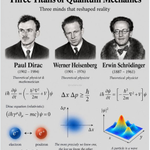
Everything we see is built from twelve spin-½ fermions whose charges come only in thirds or whole numbers.
Quarks carry +2/3 or −1/3 and come in three generations of rising mass. Leptons carry −1 or 0 and follow the same generational pattern. The gauge bosons that bind them have integer spin and the exact charges needed to keep the whole algebra consistent.
The pattern is not decoration. It is the smallest set of quantum numbers that lets every known force act without contradiction.
The universe is written in the language of these discrete charges.


Prof Mick Wilson 1 retweeted

😂 Remember these tables on the back of our exercise books in the 1950s?
SO much harder than when decimalisation came in!

Prof Mick Wilson 1 retweeted

Les modèles sont 1000 fois trop grossiers; la perturbation des émissions de CO₂ est ≈0,035 W/m² an⁻¹. L’incertitude liée aux nuages CMIP5=±4 W/m² soit ±114 fois le forçage. Le signal doit être 10 × > à l’incertitude.
Foutaise.
Voir § 4.3.2.6 (gratuit)
researchgate.net/publication…


Prof Mick Wilson 1 retweeted
Climate alarmists and planet saviors are not interested in confronting rational ideas but only have an interest in pushing dogmas. The energy transition is one more example of their logical failure.

Debates with renewable energy advocates always follow the same pattern. You can point out the inherent stupidity of making your power grid weather dependent, but they always reply that the problem is under-investment in the grid, where if only we spent another £100bn on grid infrastructure (that we would not otherwise need) and added some inventive and ruinously expensive contraptions to stabilise the volatility, then the system would work.
It doesn't occur to them that the system has to be cost effective and that people have to be able to afford electricity. It's an ideological commitment to making a bad idea work, regardless of the harm it does. Just like any other left wing idea.
Prof Mick Wilson 1 retweeted
Neil Ferguson's models from the same ICL university anticipated for Covid (March 2020 study-Report 9) that up to 40 million people could die globally in the first year of the pandemic.
Now they fabricate the 2026 summer heat wave deaths toll.
Those charlatans need to be unpluged.

Modelling says 50,000 people died from heat in Summer 2026.
But how did they get to that number?
climaterealism.com/2026/10/w…


Prof Mick Wilson 1 retweeted

It doesn’t get more American than this.
My blood pressure rose, and my heart started pounding just from watching this video.
Prof Mick Wilson 1 retweeted

CO2 mistakenly blamed for recent warming?: Chuck Wiese on declining albedo from the late 1880s, and especially starting around 1970.
Prof Mick Wilson 1 retweeted
Myhre et al. (1998) law is derived from Stefan-Boltzmann (Eq. 105-150, p. 110-115) for 310 to 410 ppm:
ΔF=5.35 ln(C/C₀) & ΔT=1.66 ln(C/C₀)=0.31ΔF
=> ΔT=0.35 K+0.15K for WV feedback (Clausius-Clapeyron) one gets ΔT=0.5K
CO₂ is not a cimate driver.
researchgate.net/publication…


Prof Mick Wilson 1 retweeted

Excellent 👌👍

It’s extraordinary how selective these environmental arguments are. Apparently, eating meat is destroying the planet, but the environmental damage caused by producing plant-based foods barely gets a mention.
Take avocados. Research has estimated their water footprint at around 1,400 litres per kilogram, with intensive cultivation in parts of Mexico linked to deforestation and pressure on local water supplies.
Or soya. Its cultivation has contributed to habitat destruction in South America. Tofu doesn’t magically arrive on supermarket shelves without land, water, agricultural machinery, processing and transport.
And what about the insects? Industrial crop production involves pesticides, harvesting and habitat destruction, killing countless insects and other animals. We don’t have a reliable global figure, but pretending plant-based agriculture is free from animal deaths is absurd.
Then there’s the health argument. Many vegan burgers, sausages and meat substitutes are ultra-processed products containing added salt, flavourings and other ingredients. A 2025 study found that people consuming the highest proportion of nutritionally poor, ultra-processed plant-based foods had a 46% higher incidence of coronary heart disease than those consuming the lowest proportion. That’s an association, not proof of causation, but hardly something to ignore.
And those dramatic water figures? They routinely combine rainfall, irrigation and water needed to dilute pollution, as though they were all equivalent to taking drinking water from someone’s tap. They’re not.
None of this means animal agriculture has no environmental impact. Of course it does. But replacing one simplistic narrative with another, while ignoring biodiversity, soil health, food processing, nutritional value and local growing conditions, isn’t environmental science.
If we’re serious about sustainability, we should be talking about how food is produced, not pretending that everything labelled ‘plant-based’ is automatically healthy, ethical or environmentally harmless.


