





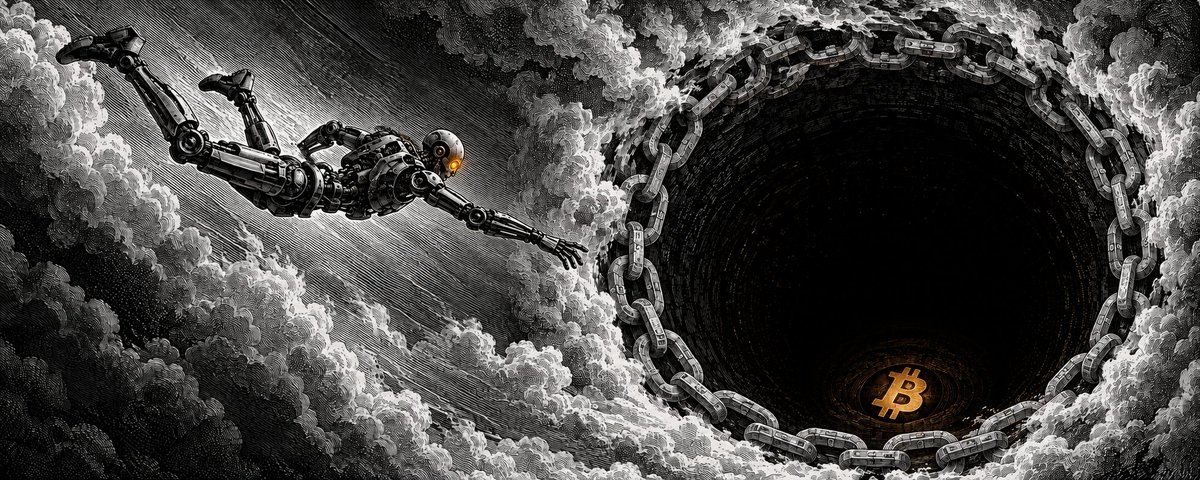
It’s inevitable
Banks integrating with blockchain is only the beginning.
AI agents directing capital is the bigger shift.
They’ll route funds toward the best risk-adjusted opportunities across banking rails, Bitcoin, on-chain markets, & autonomously.
If the better opportunity is onchain, the capital follows.
And autonomous capital will need verifiable execution.
Proof21.

BlackRock is mapping an economy where AI agents move money.
But an agent can make a valid payment and still fail the job.
That gap is why we’re building Proof21.
BlackRock’s new paper, The Machine-Native Economy, captures the convergence:
“AI represents machine-native intelligence, while digital assets represent machine-native money.”
It explores agents purchasing services, sourcing compute and using programmable payments, with protocols such as MCP, A2A and x402 helping connect the pieces.
Our takeaway: giving software the ability to spend money creates another responsibility.
We need to establish what it actually did.
Consider a simple example.
You instruct an agent to send 100 USDC to a supplier on the agreed network.
It sends 100 USDC to the wrong address.
The transaction can be valid. The network can process it correctly. The agent still failed your instruction.
“Payment confirmed” and “job completed” are different claims.
Now extend that problem across agents hiring other agents, selecting providers, allocating resources and executing payouts.
When something goes wrong, another “task completed” message is not enough.
You need the original instruction, the relevant evidence and the rules used to evaluate the result.
That is the distinction we care about at Proof21.
We’re developing an evidence layer designed to bind a specific operation to its instruction, policy, source records and findings—so another system can inspect what was checked and what the evidence actually supports.
The goal is not to stamp an agent “trustworthy.”
It is to make specific actions and processes checkable.
A signature should not be mistaken for a successful job. Missing evidence should not become a green check. An unresolved result should remain unresolved.
This complements payment infrastructure rather than replacing it.
BlackRock’s paper also discusses authorization safeguards such as AP2. The point is not that existing protocols ignore trust.
It is that permission to act, successful settlement and fulfillment of an instruction are different questions.
They deserve distinct checks.
For the Bitcoin and Digital Matter Theory community, this is the connection we’re pursuing.
Our DMT design uses explicit, versioned interpretations of Bitcoin block data as inputs to reproducible processes. It records the source block, supported element definition and derivation so another system can repeat the relevant calculation.
The opportunity we see is to bring Bitcoin-derived, checkable processes into agent workflows.
That does not make Bitcoin a universal AI fact-checker. It does not mean a calculation proves ownership or mint validity. And it does not require minting a token or writing a Bitcoin transaction for every receipt.
The important part is the relationship between the source, the rules and the result.
Can someone else check it?
That question becomes more important as work moves between systems that do not share the same operator, database or assumptions.
An agent’s explanation should not be the only thing that survives the handoff.
BlackRock is clear that agentic payment activity remains early. Proof21 is also still in development.
Our conviction is that this is the time to build evidence into those workflows—not wait until a disputed action makes the missing record obvious.
Machine-native intelligence and machine-native money deserve machine-checkable evidence.
“Don’t trust. Verify.” should not stop at the wallet.
Agent builders: when another agent says “done,” what evidence do you require?

Our latest research paper explores the growing connection between AI and digital assets and explains why broad AI adoption may drive new demand, utility and applications across the digital asset economy. blackrock.com/us/individual/…


Proof21 retweeted

👀 DMT being utilized for AI agents?
Yes please.

This is the layer we are building toward with Proof21.
Bitcoin gives agents shared public history.
DMT gives them reproducible source material.
Proof21 turns source + rules + result into portable evidence another agent can verify.
x402 can move the value. Proof21 helps prove the process.
proof21.xyz ◼︎21
This is the part of agentic commerce that matters next.
x402 can solve how agents pay.
The harder question is: what was authorized, what actually happened, and can anyone prove the agent got what it paid for?
That’s the gap we’re building Proof21 to address.


A more verifiable agentic world starts with evidence machines can independently check.
Proof21.xyz