

Exploring life, booms and busts in 18.6 year cycles.
Joined June 2020
- Tweets5.8K
- Following157
- Followers6.8K
- Likes2.9K








Pinned Tweet
Did you know? When copper prices soar, you can’t afford a house.
It sounds surprising, but it’s a proven historical rule from Phil Anderson’s The Secret Life of Real Estate and Banking.
How do we know this? Just look at history.
At the end of every 18.6-year real estate cycle (like 1989–1990 and 2007–2008), construction, power grid expansion, and speculative building hit a fever pitch.
As Phil explains in his book, copper prices skyrocket at the exact moment land values reach their absolute peak, driving raw material costs through the roof.
What happens when copper finally falls?
Raw material input costs drop, construction costs ease, and housing affordability gradually resets.
Watch Copper - it tells you when the land mania has hit its limit and when affordability is returning.


On Oct 13, 2026, PIMCO CIO Dan Ivascyn warned that while housing is already weak, commercial real estate (CRE) is now showing "more substantial weakening" as policy remains tight.
Just as @Phil_J_Anderson documented in 2007 in his book The Secret Life of Real Estate and Banking, banks overloaded on late-cycle land and CRE collateral face a liquidity squeeze that turns a rate shock into a credit crunch.
#BankingSystem #CommercialRealEstate #MacroEconomics
Learn more if you want to understand the system: realestate.propertysharemark…
Property Sharemarket Economics retweeted

PCE (Personal Consumption Expenditures) is the Fed's preferred inflation gauge and the measure behind its 2% inflation target.
It covers a broader range of household spending than CPI and accounts for changes in consumer spending patterns.
Core PCE excludes volatile food and energy prices, providing a clearer picture of underlying inflation pressures.
This makes its direction important to watch. Persistent or rising Core PCE could keep interest rates higher for longer, or increase the risk of further rate hikes.

Property Sharemarket Economics retweeted
How do you invest when markets send mixed signals?
Yields are rising fast, US stocks are leaning on a few names, and stress is building in property and private credit.
In our Q3 update, @AkhilGPatel and @TimMoffOak break down the September quarter, what they’re watching heading into Q4, and how we’re positioning the Oakleigh 18.6 Strategic Investment Portfolio.
Watch here: youtu.be/ve4mKcFtAbQ

In the latest podcast with @retipsterseth , @Phil_J_Anderson warns that the 14-year expansion since the 2012 market bottom is reaching its peak in 2026.
Full podcast:
youtube.com/watch?v=yivw05ku…
The $3.5 trillion proposed merger of SpaceX and Tesla is fundamentally a "land story" disguised as a space story.
SpaceX and Tesla's massive capital projects, like the newly announced $100 billion Starbase in Louisiana, rely heavily on massive physical footprints, infrastructure development, and long-term land speculation.
With a combined debt load of $56 billion, the mega-entity relies on continuous asset appreciation and capital expenditures ($85 billion in 2026 alone) to justify its massive, speculative valuation.

If you want to know more about the real estate cycle and how it drives the world's biggest corporate moves, follow us for more
realestate.propertysharemark…
Property Sharemarket Economics retweeted

Can a family’s wealth and privilege ever be separated from the injustices of the past?
🎬 The Estate tells the story of an aristocratic family struggling to save its ancestral home as its debts mount and a dark legacy of social injustice comes to light.
Watch the film on Thursday, 29 October.
A thought-provoking film about inheritance, land and social justice.

China's property downturn has persisted for more than three years, despite efforts to revive the market.
What do you think is most important for a lasting property market recovery?
40%Restore buyer confidence
16%Reduce excess housing
28%Boost household incomes
16%More policy support
25 votes • Final resultsExplore the bigger picture with PSE's free newsletter: realestate.propertysharemark…
When bond yields rise, the impact doesn't stop with the bond market.
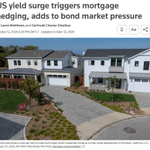
Rising US Treasury yields have pushed 30-year mortgage rates to around 7.4%, near a three-year high.
Higher borrowing costs squeezed affordability, sidelining buyers and putting pressure on property demand.
How much does the cost of credit shape the property cycle?

Explore the forces behind property markets with our free newsletter: realestate.propertysharemark…
Property Sharemarket Economics retweeted

These are the books to pick up first! 📚
Two reads that change how you think about money, housing and the economy, both by Fred Harrison.
Have you read one of these before? Tell us below 👇🏼
Find them at shepheardwalwyn.com

Property Sharemarket Economics retweeted
Born on 19 October 1433, Marsilio Ficino continues to inspire readers more than five centuries later. To mark his birthday, Shepheard-Walwyn is proud to announce the final volume of the series, now open for pre-order. 📖
Pre-order Volume 12: shepheardwalwyn.com/product/…

Property Sharemarket Economics retweeted
What if you had a compass for life’s biggest decisions? 🧭
'The Saint and the Drunk' is for the moments when the path isn’t clear, and every option feels like it could be the wrong one. Pick it up, and find your bearings.
Order now at shepheardwawlyn.com

Did you know Australia is leaving practically $45 billion a year on the table?
While private mining and gas corporations make record-breaking profits during commodity booms, Australian public royalties stay completely flat.
What does it mean?
Australia is sitting on a massive natural wealth source, but everyday people aren't seeing that return.
Low royalties are a total policy choice. Other places like Norway and Alaska prove we could be doing things very differently.

Find out here:
citdiv.org/
