

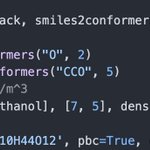


One of my newer packages: github.com/zincware/hillclim… - a Python interface for biasing simulations with plumed.
You can install it directly into your python environment with all wheels included (e.g. you don't need to install plumed manually) and start your simulations.

What started out as some utility functions inside IPSuite is now the molify python package and my first JOSS publication.
joss.theoj.org/papers/10.211…

I was looking into how AI detection in text works. It's quite simple, you can e.g. use GPT2 to get the probability on the next word in the given context. I put that into a textual app github.com/PythonFZ/findllm (The code is 99% generated by claude agents - no warranties!)
Fabian Zills retweeted

@MoritzRSchfer1, @PythonFZ, and team introduce APAX, a high-performance JAX-based framework for building machine-learned interatomic potentials with active learning.
Learn more about APAX and how they use DVC in their workflow. 👇🏽
hubs.la/Q03Pkljm0

Which foundation MLIP is best suited for your application? The MLIPX framework can help you answering this question. Checkout the Paper iopscience.iop.org/article/1… and github.com/basf/mlipx
#MLIPX
Thanks to @SandipDeScience with whom we started this project during my internship @BASF and all the co-authors who made this possible!
Fabian Zills retweeted

New Publication 👏
We are excited to share our latest paper, "Apax: A Flexible and Performant Framework for the Development of Machine-Learned Interatomic Potentials", published in the JCIM.
Read the full paper: pubs.acs.org/doi/10.1021/acs…
Code: github.com/apax-hub/apax

Fabian Zills retweeted

Started with some slides for AutoAdsorbate-ended up with an animated deep dive into surface site detection.
It works on any surface, no bulk symmetry needed.
Here’s what this one-liner really does:
s=Surface(slab211)
code: github.com/basf/autoadsorbat…
paper: tinyurl.com/yfbxnbds
Fabian Zills retweeted

📢For those still hanging out here, a new #cookbook recipe landed, demonstrating >2x speedup of *conservative* MD for the PET-MAD universal #MLIP using multiple time stepping. Check out the details at the other place, or head to atomistic-cookbook.org/examp… #compchem #machinelearning
🔥 Embarrassingly parallel, embarrassingly simple!
🚀 Swap out tqdm for Laufband and scale across as many SLURM jobs as you want.
No complicated code changes, just results!
👉 github.com/zincware/laufband

Finally got around to updating the ZnTrack docs—took me way too long, but here we are! 🚀 Check them out zntrack.readthedocs.io/en/la…
Fabian Zills retweeted

🚀 MLIPX is Live! 🌟
Check out our new open-source code from @BASF for evaluating machine-learned interatomic potentials. Dive into advanced evaluation methods, visualisation tools, and more! Special shout out to @PythonFZ and Sheena agarwal! github.com/basf/mlipx
Want to build a Christmas tree out of molecules? Checkout my first entry for #AdventOfCode using #ZnDraw - find out how at zndraw.readthedocs.io/en/lat… @SimTechStuttga2 @Uni_Stuttgart @zincwarecode


Want to add a custom getter to your dataclass field? Checkout github.com/zincware/znfields

Want to setup a simulation box of a bulk system. Checkout github.com/zincware/rdkit2as… and go from SMILES -> results by using ASE and e.g. MACE-MP-0.

Fabian Zills retweeted
Exciting new developments in computational chemistry!
Link: esat2024.exordo.com/programm…
Marcelle Spera and her team from the
@Uni_Stuttgart presented a poster at the 𝟑𝟑𝐫𝐝 𝐄𝐮𝐫𝐨𝐩𝐞𝐚𝐧 𝐒𝐲𝐦𝐩𝐨𝐬𝐢𝐮𝐦 𝐨𝐧 𝐀𝐩𝐩𝐥𝐢𝐞𝐝 𝐓𝐡𝐞𝐫𝐦𝐨𝐝𝐲𝐧𝐚𝐦𝐢𝐜𝐬 (𝐄𝐒𝐀𝐓 𝟐𝟎𝟐𝟒) on using DVC to manage and track changes in molecular dynamics simulations.
By applying DVC to their molecular simulations, the team could version important inputs like:
🔹Molecular structures.
🔹Force field parameters.
🔹Initial configurations.
This allows for better reproducibility and transparency when running complex simulations.
Computational research often involves iterating on models and data, making version control critical. But traditional tools aren't always a great fit.
Kudos to Marcelle and her team for pushing the boundaries of what's possible in molecular simulations! 🧬💡
