Physics PhD analyzing quantum technology for investors & curious minds. Follow if you want to understand quantum tech without the hype. Not financial advice.

Joined May 2026
What is quantum sensing? It can share technology with quantum computing, but serves a different purpose. Both use quantum physics. While computing gets attention, sensing has decades of real-world use, with $INFQ building a sensing business and $IONQ entering through Vector Atomic. The field spans very different levels of maturity. The first atomic clock was demonstrated in 1949, and quantum magnetometers followed in the 1950s. Some other technologies are only now moving from laboratories toward real-world deployment. That uneven maturity is what makes the field interesting from an investor perspective. So for this deep dive, I want to understand the technology, separate what is established from what is emerging, and see where the frontier actually sits today.
4
1
1
4
4,313
The US vs. China fight comes for quantum next? If you own US quantum stocks like $IONQ, $RGTI, $QBTS or $INFQ, Washington's new quantum headline changes less than it sounds. On October 22, the Treasury proposed the rule that puts the COINS Act into practice. It limits American investment in Chinese companies working on chips, AI, supercomputers, biotech, hypersonic weapons and quantum. Chips get a middle lane, where some deals are allowed as long as you report them. Quantum gets no such lane, and neither does AI, which the rule now bans outright. Quantum computers would be banned outright, and the list goes deep. It covers not only the machines, but the dilution refrigerators and cryocoolers that keep them cold and the software that designs and controls them. Quantum sensing is banned when it serves the military, intelligence or mass surveillance. Quantum networks are banned more broadly, including any built to link quantum computers or for secure communications such as quantum key distribution. That sounds dramatic, but quantum was already in the banned bucket under the rules in force since January 2025. The new rule keeps it there and widens the list. Congress wrote the program into law last December, and this rule fills in the details. Comments close December 7. I'm watching whether the final rule keeps quantum entirely in the banned bucket, and whether China answers by tightening its own side of the supply chain.
1
21
$NVDA committed at least $6.5 billion to photonics this spring, to move AI data, not to compute. It made me wonder about another NVIDIA job: decoding quantum errors for $QNT. Quantinuum's Helios decodes its errors on NVIDIA GPUs in real time. I suspect that decoder won't stay electronic. In superconducting machines, the next limit may be getting error data out of the fridge. A 2025 lab demo read out one qubit using only light. But what if decoding becomes neural network math, the kind optical chips are built for, and data leaves the fridge as light? Does the decoder go photonic? This hypothesis has a weak spot: today's decoders, like matching, make step-by-step choices, and light is bad at that. It's built for doing one big calculation all at once. I'd watch for the first decoder that computes with light, not just carries data.
1
1
354
Sources: NVIDIA QEC 0.6: nvidia.github.io/cuda-quantu… Helios on NVIDIA GPUs: nvidianews.nvidia.com/news/s… Fridge I/O limit: arxiv.org/abs/2208.08547 All-optical readout: nature.com/articles/s41567-0… NVIDIA photonics bets: cnbc.com/2026/05/29/nvidia-p… Image: NVIDIA, QEC 0.6 blog
27
A private startup now says RSA-2048 could be broken with 72,000 physical qubits in 3.7 days. That's about 12x fewer qubits than $GOOGL's 2025 estimate at a similar runtime. It's only a simulation for now, but the Q-Day math keeps getting cheaper. Iceberg Quantum (Sydney) built a faster decoder, Crevasse, and ran a trillion samples per code. On its main code at a 0.1% physical error rate it saw 3 logical errors, about 2 per 10 trillion logical qubit cycles. RSA needs under 1 per trillion. The fine print: 0.1% error on every operation, a 1 µs code cycle, and qubits that connect beyond their neighbors. No machine has all three at this scale. Crevasse averages 4 µs per round, so it doesn't yet keep pace with that 1 µs cycle. At a 1 ms cycle, typical of atoms, the same table says 2.1 million qubits and 32 days. And there's no peer-reviewed paper yet, not even a preprint to check. As an investor, I now see decoding speed and connectivity as the likely bottlenecks, so that's what I'd track in hardware roadmaps.
We’ve run trillions of simulations to test our fault-tolerant quantum architectures, thanks to our new decoder, Crevasse. We think it’s the first QLDPC decoder with both the speed and accuracy needed for utility-scale quantum computing. Release: iceberg-quantum.com/blog/rel…
1
87
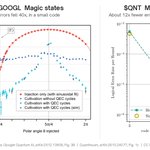
$GOOGL is placing a bet on AI-made quantum software. Google Quantum AI opened a Kaggle competition this week, paying $50,000 for a smaller quantum circuit. What if the next leap needs fewer qubits, not more? Entrants, expected to use AI agents, compress three costly building blocks of future algorithms, for fusion, optimization and chemistry. Every entry must pass Google's verifier and is scored on qubits and gates. The trigger was ecdsa.fail. Over 100 people, most with no quantum background, used AI agents to cut the cost of elliptic curve attack circuits roughly in half. Elliptic curves protect Bitcoin's signatures. That is not a new Q-Day date. It is a reminder that the attack can get cheaper with no new hardware. The chemistry task centers on a quantum lookup table, the same step $XNDU said this month it cut by nearly 4x. My guess is that the algorithm race is starting to matter as much as the qubit race. As an investor, I wonder what it means for pure-play quantum software companies.
To bring quantum applications within reach sooner, we must compress the circuits that power them. Join our @Kaggle competition to build efficient, verifiable circuits using our new open source kickmix library: goo.gle/4BqF2QX
1
101
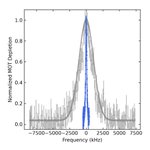
One line in ytterbium's spectrum could become a clock, a voltmeter and a thermometer. That's the case a new NIST preprint with an $INFQ co-author makes. A Rydberg atom has one electron lifted far from the nucleus. That loosely held electron reacts strongly to electric fields and to heat radiation, which is what makes it a good sensor. Ytterbium has a lucky ladder. A middle energy level sits at about 49.7% of the energy needed to free the electron. So two photons of the same violet color, 399 nm, can lift the atom from its ground state to a Rydberg state without much laser power. Send those two photons from opposite directions and the atom's motion cancels out. A moving atom sees one beam shifted up in frequency and the other shifted down by the same amount, so their sum stays fixed. One beam gives a blurry line. Two opposing beams make it 14 times sharper. The authors say it's the sharpest line of its kind measured so far. And sharp is what makes it useful. The line barely moves when magnetic fields change, so it can tick a clock. It does move when an electric field changes, so it can measure voltage. And it moves with heat in the room, so it can measure temperature. One line, three sensors. This was done in a big lab setup with super-cold atoms, not in the small, simple box a real product would need. In the field of quantum sensing, size matters. Part of my deep dive into quantum sensing:
What is quantum sensing? It can share technology with quantum computing, but serves a different purpose. Both use quantum physics. While computing gets attention, sensing has decades of real-world use, with $INFQ building a sensing business and $IONQ entering through Vector Atomic. The field spans very different levels of maturity. The first atomic clock was demonstrated in 1949, and quantum magnetometers followed in the 1950s. Some other technologies are only now moving from laboratories toward real-world deployment. That uneven maturity is what makes the field interesting from an investor perspective. So for this deep dive, I want to understand the technology, separate what is established from what is emerging, and see where the frontier actually sits today.
2
1
12
589
The paper: arxiv.org/abs/2610.22574 Funded by NIST, ONR and NSF. Co-author Tobias Bothwell's listed present address is Infleqtion. Image: Fig. 4(a), Hunt et al., arXiv:2610.22574, CC BY 4.0.
1
88
$QNT's Helios is now inside $ORCL's cloud, but only as a beta, and Oracle picks who gets in. Oracle opened its OCI Quantum AI Compute Beta this month. Approved organizations get cloud access to Helios alongside Oracle's GPUs and HPC. For investors, distribution through a big cloud is a real plus. The open question is who owns the customer. No pricing, customers or revenue were disclosed. Helios itself is still "advancing toward installation" at Oracle. I'll watch whether any of this shows up as revenue.
Big milestone in our partnership with @Oracle. Organizations can now apply for early access to Quantinuum's Helios quantum computer through Oracle's Quantum AI Compute program. This marks an important step forward in our collaboration and in advancing hybrid quantum-AI computing at enterprise scale, giving organizations new ways to explore how quantum computing, AI, and HPC can be combined to address some of the world's most computationally demanding challenges. Next week at Oracle AI World, our Chief Commercial Officer Larry Stack joins Oracle Cloud Infrastructure President Mahesh Thiagarajan on the main stage to discuss what this progress means for customers and how these capabilities can accelerate discovery, simulation, optimization, and other high-value enterprise applications. We're excited about what's ahead. Read more here: quantinuum.com/blog/quantinu…
187
An interesting observation from $HON's Q3 filing. $HON carries its 48% stake in $QNT at $7.1 billion. At today's price, the market says it's worth about $4.6 billion. Why does it matter if you're a Quantinuum holder? The lock-up ends November 30. That gap probably makes a near-term Honeywell sale less likely, since selling now would lock in a loss against book value. The numbers come from Honeywell's 10-Q, filed today. On September 30 the stake's book value was $7.1 billion and its market value $6.2 billion. Since then $QNT has fallen about another 25%. Under equity accounting, Honeywell doesn't mark the stake to market each quarter. It writes it down only if it judges the drop to be more than temporary. I will watch for an impairment. Once the stake is written down, selling no longer books a new loss.
1
228
Sources: Honeywell 10-Q, Q3 2026 (Oct 22, 2026), Quantinuum note and fair value table: sec.gov/Archives/edgar/data/… $QNT price history: nasdaq.com/market-activity/s…
187
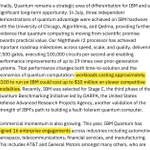
$IBM made a claim last night that $IONQ and $QNT investors should check. In its earnings remarks, IBM said a workload costing about $100 on its chips "could cost up to $10 million on slower competitive modalities." IBM named no rival, but slower usually means trapped ions and neutral atoms. Their gates run slower than superconducting ones. Speed is only half the bill. Ions make fewer errors per gate, so they can need fewer repeats to get a usable answer. The fair test is cost per correct answer, and IBM gave no workload or method. What I was looking for didn't come: still no quarterly quantum number, and Kookaburra, IBM's first error-corrected module due this year, wasn't in the prepared remarks. What we got instead: 16 enterprise quantum engagements this year, including AT&T and General Motors, and the closing of a $1 billion Commerce award for Anderon, its quantum wafer foundry. So the next thing to watch is IBM's Quantum Day on December 10, and whether a named workload stands behind the $100 claim.
5
5
40
7,582
Sources: IBM 3Q26 prepared remarks (quantum section, p. 5 to 6): ibm.com/downloads/documents/… IBM 3Q26 press release: newsroom.ibm.com/2026-10-21-… IBM 3Q26 charts (Anderon CHIPS award, p. 9): ibm.com/downloads/documents/… Image: IBM, 3Q26 earnings prepared remarks, p. 5 (cropped)
1
354
$IBM reports after today's close. Here is what I'd want to see on quantum. For the valuation: a quantum number. IBM has signed more than $1.1 billion in quantum contracts since 2017, but never says how much lands in a quarter. Even a rough quarterly figure would let me start valuing it as a business, not a story. For the technology: Kookaburra. IBM's first module built to store and process error-corrected qubits is due this year. Delivered on time, it is the first real step toward Starling in 2029. A quiet slip would matter more than any new partnership. If I get neither, quantum stays what it is today: a promise inside a big company.
1
298
A UCSB team put a whole cold atom laser system on one chip while using Infleqtion's ($INFQ) miniMOT. The good: one chip makes the laser light for a cold atom trap, tunes it, stabilizes it and aims it at the atoms. Two lasers, frequency control, power control and three trapping beams, on a chip of 6.3 by 5.3 cm. Fed into Infleqtion's miniMOT vacuum cell, it trapped more than 1 million atoms at about 350 microkelvin. The bad: it's not a sensor yet. No clock, no gravity or rotation measurement, just the cold atom cloud a sensor would start from. One device, made in a university cleanroom, lasers attached by hand. The ugly: the chip is now the small part. The coils and the vacuum package take about 96% of the estimated power, and the laser drivers dwarf the chip in volume. So the optics are no longer the reason cold atom sensors can't be portable. Watch for a real measurement from a box you can carry, and for how many of these chips a foundry can make.
What is quantum sensing? It can share technology with quantum computing, but serves a different purpose. Both use quantum physics. While computing gets attention, sensing has decades of real-world use, with $INFQ building a sensing business and $IONQ entering through Vector Atomic. The field spans very different levels of maturity. The first atomic clock was demonstrated in 1949, and quantum magnetometers followed in the 1950s. Some other technologies are only now moving from laboratories toward real-world deployment. That uneven maturity is what makes the field interesting from an investor perspective. So for this deep dive, I want to understand the technology, separate what is established from what is emerging, and see where the frontier actually sits today.
1
1
6
631
Tomorrow is the deadline for every federal agency to send the White House a plan for moving to post-quantum cryptography. A plan, not a migration. And every plan starts with the same unglamorous step. Find where the old cryptography lives. The encryption and digital signatures protecting most systems (RSA, elliptic curves) could be broken by a large enough quantum computer. NIST has already standardized replacements. The hard part is finding every place the old math hides. Servers, ID cards, firewalls, cloud services, code nobody has touched in years. That step is further behind than it sounds. Agencies have had to file a cryptography inventory every year since 2023. When GAO audited the 24 major agencies through September 2025, only one had a complete inventory of its priority systems. None had tested the new algorithms in its own environment. The memo itself sets the order: discovery and planning in 2026 and 2027, pilots next, new key exchange for priority systems by 2030, new signatures in 2031. I suspect that the first federal money goes to discovery and inventory tools, then to upgrades that ride normal refresh cycles for firewalls, key-management hardware and cloud. That is mostly classical cybersecurity work, not quantum hardware.
2
4
3
17
4,371
Sources: OMB M-26-15 (June 24, 2026; plans due within 120 days): whitehouse.gov/wp-content/up… GAO-27-108740 (audit February 2024 to September 2025): gao.gov/products/gao-27-1087… OMB M-23-02 (yearly inventories since 2023): whitehouse.gov/wp-content/up… Image: OMB M-26-15, page 1 (US government work, public domain)
185