

Building Post Quantum Security Infrastructure for Regulated, Mission Critical Systems.
Joined January 2026
- Tweets197
- Following83
- Followers32
- Likes152




Pinned Tweet
Long lived data requires long term thinking
Quantum Vision Holdings develops post quantum security infrastructure designed for mission critical systems as computing risk evolves
The hardest part of modernization is not installing new technology.
It is changing one part of the stack without breaking another.
Certificates change. Algorithms change. Signatures have to verify. Legacy systems still have to communicate.
That challenge gets harder as organizations prepare for post-quantum migration.
Thymos is designed for cryptographic discovery. Enqrypta is designed for cryptographic lifecycle management and crypto-agility.
Modernize without rebuilding blindly.
12
The FAA halted departures nationwide today after a telecommunications outage disrupted air traffic control communications.
No malicious attack has been identified.
But the infrastructure lesson is clear: one critical dependency can affect an entire system.
Thymos is designed to help surface cryptographic vulnerabilities and hidden dependencies before they become operational risk.
Resilience starts before the outage.

2
519
Choosing a post-quantum algorithm is not the same as being ready to deploy it.
🔹Keys change.
🔹Policies change.
🔹Standards change.
🔹Applications still have to keep running.
Enqrypta is designed around lifecycle management, policy and crypto-agility so cryptographic infrastructure can evolve as requirements change.
Watch how QVH is approaching the control layer. 👇
18
Your PQC migration depends on cryptography you may not control.
NSA, CISA and Australia's cyber agency are now telling organizations to ask vendors directly about their post-quantum readiness.
Why?
Your cloud provider's crypto is part of your dependency chain too.
Thymos is designed to help identify where cryptographic vulnerabilities and transition requirements exist.
Watch how discovery starts. 👇
1
23
Hackers stole about €100M from a French bank after reaching it through a third-party provider's platform.
That is the risk modern infrastructure creates:
🔹Your network may be secure.
🔹Your dependencies may not be.
🔹Trust extends wherever your systems connect.
Do you know which vendors sit inside your security architecture?
19
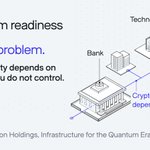
Your bank can prepare for post-quantum cryptography.
Its vendors can still hold the migration back.
Nacha has released a quantum-safe vendor questionnaire for banks and credit unions covering standards, timelines and migration impacts.
That is the supply-chain problem:
Your cryptographic readiness extends beyond systems you control.
QVH is developing around discovery, lifecycle management and crypto-agility.
Ask your vendors now: what is your PQC plan?

28
Post-quantum cryptography is already being used by attackers.
Lazarus-linked malware is using ML-KEM-1024 to protect communications and payload delivery.
That is the important distinction:
PQC is a capability, not a guarantee of trust.
QVH is developing infrastructure around cryptographic policy, lifecycle management and crypto-agility so organizations can better govern the cryptography operating inside their environments.
Do you know what cryptography your systems are using today?

31
Some post-quantum security upgrades may require more than new software.
They may require new hardware.
The UK Ministry of Defense is assessing which cryptographic systems can transition through software or firmware and which may eventually need physical replacement.
Why does that matter?
If cryptography is embedded into hardware that was never designed to change, a security migration can become an infrastructure replacement project.
QVH is developing around that challenge through cryptographic discovery, crypto-agility and hardware-rooted trust.
Ask the question before migration becomes urgent:
Can your security change without replacing the system?

1
24
$6.3 BILLION. NO CONFIRMED PRIVATE-KEY THEFT.
So how did the Binance attack happen?
Early findings point to compromised infrastructure and abused transaction authority, not broken cryptography.
A valid signature isn't always a legitimate action.
QVH secures what comes next.
The U.S. government has a PQC problem that has nothing to do with inventing new algorithms.
Visibility
The Government Accountability Office reviewed cryptographic transition planning across 24 major federal agencies and issued 89 recommendations to 23 of them.
The recurring challenge:
🔹Find the vulnerable cryptography.
🔹Understand what depends on it.
🔹Fund the migration.
PQC migration starts with discovery.

24
A security team reportedly got into sensitive Anthropic systems in under 12 hours.
The weakness was not Claude itself.
It was third-party business software connected to the environment.
That distinction matters.
Advanced systems are only as secure as the infrastructure, integrations and identities around them.
For QVH, that is the larger lesson: trust has to extend beyond the core technology and into the architecture connecting it.
Security is only as strong as the systems surrounding what matters most.
18
Two critical PHP flaws can let an attacker execute code on a server without logging in.
The vulnerabilities sit inside PHP itself, beneath millions of websites and applications.
Then the situation accelerated.
Technical details circulated before the coordinated patch window was complete. Exploit activity emerged. Governments in Europe took public-facing sites offline while administrators raced to update vulnerable systems.
The bigger lesson:
When foundational infrastructure breaks, response speed depends on knowing where it exists and what depends on it.
You cannot secure what you cannot see.

1
103
Quantum defense is getting bigger than quantum computing.
Canada is building secure infrastructure around sensing, communications, algorithms and hardware assurance.
The U.S. is pushing PQC into national-security procurement and federal migration.
NATO is building testing, standards and interoperability into its quantum roadmap.
The pattern matters.
The strategic advantage will not come from one technology.
It will come from the infrastructure that can integrate, secure and trust the entire stack.
22
Zero Trust is moving deeper into physical infrastructure.
NSA's new guidance for critical operational technology says defenders should assume compromise and continuously verify users, devices, workflows and communications. That changes the security model.
A device should not remain trusted simply because it is inside the network.
In critical infrastructure, digital trust can have physical consequences.

21
The quantum race is entering a harder phase: Prove it.
DARPA has advanced four more teams into the final stage of its Quantum Benchmarking Initiative.
Stage C moves beyond roadmaps and into independent government verification of whether proposed utility-scale quantum systems can actually be constructed and operate as designed.
As quantum technology matures, technical credibility increasingly depends on measurable evidence.
Verification is becoming part of the quantum infrastructure.

16
PQC standards exist.
That does not mean an organization is quantum-ready.
The harder work is finding where cryptography lives, understanding what depends on it, protecting keys and identities, updating hardware, replacing certificates and changing algorithms without breaking critical systems.
NSA now requires new commercial National Security Systems to support quantum-resistant algorithms beginning in 2027.
Post-quantum security is becoming an infrastructure discipline. The algorithm is the beginning.
25
A quantum-defense breakthrough may eventually travel inside a strand of glass.
Army researchers have demonstrated a new method for routing light through microscopic structures in optical fiber.
The research could ultimately contribute to more resilient communications and lighter quantum-navigation systems.
That is the larger quantum-defense story:
Capability has to survive outside the laboratory.

22
The U.S. national-security transition to PQC now has harder edges.
Beginning in 2027, new commercial National Security Systems must support quantum-resistant algorithms.
Legacy systems that cannot support them are targeted for phaseout by 2030.
That changes PQC from a future-security discussion into a procurement and architecture requirement.
The migration problem is becoming operational.

1
13
Quantum defense is moving beyond strategy.
NATO has now published a roadmap spanning quantum computing, communications, sensing, post-quantum cryptography, interoperability and operational testing.
That matters.
The next phase is not just inventing quantum technology. It is deciding how allied systems test it, integrate it, secure it and trust it across real military environments.
Quantum readiness is becoming infrastructure.
17