

Statistical geneticist @UWMadison
Madison, WI
Joined November 2014
- Tweets2K
- Following646
- Followers1.2K
- Likes2.1K


Pinned Tweet
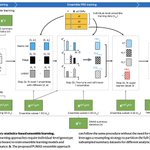
PUMAS-ensemble is published! We can now create regularized ensemble PRS on GWAS sumstats. Individual-level hold-out sample is no longer needed for sophisticated ensemble learning. Led by Zijie Zhao & @stphn_drn
Paper📰: rdcu.be/FJnCoc5qW9Da
Software🧑💻: github.com/qlu-lab/PUMAS

Qiongshi Lu retweeted

Excited to share our paper in @NatureGenet! PUMAS-ensemble constructs regularized ensemble PRS using only GWAS summary statistics.
Paper: doi.org/10.1038/s41588-026-0…
Code: github.com/qlu-lab/PUMAS
Thanks to @Q_StatGen, @ZijieZhao1996, and all our co-authors!


PUMAS-ensemble is published! We can now create regularized ensemble PRS on GWAS sumstats. Individual-level hold-out sample is no longer needed for sophisticated ensemble learning. Led by Zijie Zhao & @stphn_drn
Paper📰: rdcu.be/FJnCoc5qW9Da
Software🧑💻: github.com/qlu-lab/PUMAS
Qiongshi Lu retweeted

Ensemble-based polygenic risk score construction without the use of individual-level data for training nature.com/articles/s41588-0… @NatureGenet
Qiongshi Lu retweeted

This is what we have been using and a good solution for selecting ever-growing PRS methods. Congratulations for the publication!
PUMAS-ensemble is published! We can now create regularized ensemble PRS on GWAS sumstats. Individual-level hold-out sample is no longer needed for sophisticated ensemble learning. Led by Zijie Zhao & @stphn_drn
Paper📰: rdcu.be/FJnCoc5qW9Da
Software🧑💻: github.com/qlu-lab/PUMAS
@stphn_drn did a tweetorial back when it was first preprinted. To me, the most advance here is its ability to self-evolve. This is not just another PRS. We should continuously include better PRS models, including FUTURE models, into ensemble learning.
teapawt.org/stphn_drn/status/18640…

My first co-author paper is now preprinted! With
@ZijieZhao1996 and @Q_StatGen
we introduce PUMAS-ensemble, a regularized ensemble PRS requiring only GWAS summary statistics and LD reference data as input.
biorxiv.org/content/10.1101/…

1
128
Every future PRS method should consider this strategy to combine the cumulative wisdom from existing models. Summary statistics-based ensemble learning is the core technique that makes this possible. Try it out and let us know what you think!
github.com/qlu-lab

117
My group has gained an interest in biological aging recently, and I'm happy to share our first-ever preprint on this topic. We introduce SARDINE, a method for estimating DNAm clock-phenotype associations using EWAS summary statistics.
Preprint📰:doi.org/10.64898/2026.11.05.…

So if you use DNAm clocks/biomarkers in your research, perhaps now you have a different way of doing these analyses. See if there are large EWAS already conducted for the outcome of interest (or maybe conduct your own).
SARDINE software is available at: github.com/qlu-lab/SARDINE

1
53
This project was led by @yy_stat and Yushan Wang (undergrad applying for phd programs this year). It's a collaboration with @LoveEpiPsych @laurenlschmitz and the team at @TruDiagnostic. Biological aging will be another area of focus in my group moving forward. So stay tuned!
1
54
Qiongshi Lu retweeted

Joint work with @AltenSjoerd, @SilviaHBarcell1, Stephen Dorn, @GalamaTitus, Catharina A. Hartman, @Q_StatGen and @DilyaMuslimova. Read the paper: arxiv.org/abs/2610.06088 12/12

Qiongshi Lu retweeted

🔥 Excited to share that #paper2agent is published in @Nature today!
Papers have long been the primary format for communicating scientific knowledge, but they remain static. Putting that knowledge to work requires connecting findings to data, navigating supplementary materials, and adapting methods to new questions - effort repeated by each new reader.
We introduce Paper2Agent, a multi-agent framework that automatically turns research papers into virtual authors. Paper2Agent turns a paper’s manuscript, code, data, and supplements into an MCP server that any AI agent can access, with automated testing and iterative refinement in an agentic loop. The paper then becomes a virtual author you can talk to: trace claims to evidence, analyze your own data, and collaborate with other papers’ virtual authors
Agentifying a paper turns it from something people read into something people and AI agents can discover and build on - providing the context needed to interpret its findings and reuse its methods reliably. We tested how reliably these agents put papers to use. Across multiple benchmarks, agents created by Paper2Agent outperformed baselines such as Claude Code working directly with papers' PDFs and code repositories.
Once papers become virtual authors, they can collaborate - much like human researchers do. In one case study, agents built from AlphaGenome and two large-scale genetic perturbation studies worked together to propose a new computational approach for integrating evidence across different perturbation datasets. By connecting predictions from one paper with experimental data from others, they helped pinpoint a likely causal gene for psoriasis.
We hope Paper2Agent makes scientific knowledge easier to access, reuse, and build on - a first step toward a future where millions of paper agents proactively collaborate with human researchers and one another to advance discovery.
🤖Talk to the virtual author for Paper2Agent itself: paper2agent.ai
📎Paper: nature.com/articles/s41586-0…
💻Code: github.com/jmiao24/Paper2Age…
VERY grateful to work with this incredible team: @james_y_zou, @jkpritch, Yaohui, and Joe!

Qiongshi Lu retweeted
We showed that polygenic components of treatment efficacy capture far more variation than individual variants, but it's hard to detect them from treatment samples alone (too small). Need transfer learning from large GWAS to pull it out.
medrxiv.org/content/10.1101/…


Qiongshi Lu retweeted

Interested to pursue graduate studies (MS/PhD) at the intersection of biological, biomedical problems and data science? Join us for a virtual open house on Nov 13th to learn more about our Biomedical Data Science program at UW Madison @UWMadison!
biostat.wiscweb.wisc.edu/edu…
@Jiacheng_Miao's PIGEON paper on GxE methodology is now published @NatureHumBehav with a new title. In our view, this paper can reshape the study design for future complex trait GxE work.
Paper📰doi.org/10.1038/s41562-025-0…
Software🧑💻github.com/qlu-lab/GSUB

Based on this advance, we make two predictions:
1) The future success of complex trait GxE research resides in sharing and meta-analyzing GWIS summary statistics.
2) Future GxE method development should focus on techniques that rely only on summary-level data.
1
1
467
I had the wrong software link earlier in the thread. See below for the correct one. We've done three very different PIGEON GxE applications. Read the paper for more details. All sumstats produced in the paper are publicly available too.
Software🧑💻github.com/qlu-lab/PIGEON

2
392