



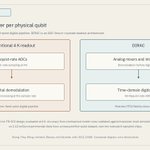


ALT Conceptual diagram, not a photograph. Title: Book the QPU in the same scheduler as the GPUs. A badge reads CONCEPTUAL DIAGRAM. Two columns. Left, Production today: the QRMI SPANK plugin plus a license, and the request --qpu=PASQAL_LOCAL. The QPU has no native consumable representation in Slurm itself. CINECA's Sol QPU runs this path today. Right, HRES path, Slurm 26.11: the HRES plugin plus QRMI, and the request --resources=PASQAL_LOCAL:1. Tested on Pasqal Cloud, including the physical QPU FRESNEL_CAN1, and on a simulated on-premises QPU. All four Pulser and CUDA-Q combinations passed. Footer: Programs stay the same under both paths. Sources: Pasqal blog, 16 November 2026; Pasqal newsroom, 19 November 2026; NVIDIA blog, 16 November 2026. HRES is not the production path at CINECA.


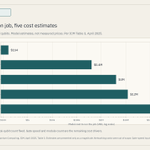
ALT Conceptual bar chart of model estimates, not measured prices. Horizontal log-scale bars compare April 2025 ICM Table 3 cost estimates for one nitrogen-fixation catalysis job with 100 billion T-gates and 2,500 logical qubits, across five qubit modalities. From top to bottom: silicon spins $164, superconducting $0.4 million, neutral atoms $4 million, photonic $12 million, ion traps $791 million. The caption states that T-gate count and logical-qubit count are held fixed, and that gate speed and module count are the remaining cost drivers. Source: Gould and Prebble, An Economic Analysis of Quantum Computing, ICM, April 2025, Table 3. The paper presents the estimates only as a magnitude. Networking costs were out of scope, and the model's numeric gate-speed inputs are not published.