

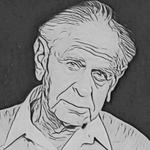
All life is problem solving. — Karl Popper
Joined November 2015
- Tweets510
- Following1
- Followers5.2K
- Likes2.1K




"The amoeba shuns falsification: its expectation is part of itself, and prescientific bearers of an expectation or a hypothesis are often destroyed by refutation of the expectation or the hypothesis.
Einstein, however, made his hypothesis objective. The hypothesis is something outside him, and the scientist can destroy his hypothesis through criticism without perishing along with it.
In science we get our hypotheses to die for us."
—Karl Popper, All Life is Problem Solving.
"Neither nature nor history can tell us what we ought to do. Facts, whether those of nature or those of history, cannot make the decision for us, they cannot determine the ends we are going to choose. It is we who introduce purpose and meaning into nature and into history."
—Karl Popper, The Open Society and Its Enemies, Vol. 2.
"For it is only in searching for refutations that science can hope to learn and to advance. It is only in considering how its various theories stand up to tests that it can distinguish between better and worse theories and so find a criterion of progress."
—Karl Popper, Conjectures and Refutations.
"What made a theory, or a statement, scientific was its power to rule out, or exclude, the occurrence of some possible events— to prohibit, or forbid, the occurrence of these events. Thus the more a theory forbids, the more it tells us."
—Karl Popper, Unended Quest.
"The very refutation of a theory--that is, of any serious tentative solution to our problem--is always a step forward that takes us nearer to the truth. And this is how we can learn from our mistakes."
––Karl Popper, Conjectures and Refutations.
"We must plan for freedom, and not only for security, if for no other reason than that only freedom can make security secure."
—Karl Popper, The Open Society and Its Enemies, Vol. 2.
"To err is human. All human knowledge is fallible and therefore uncertain."
—Karl Popper, In Search of a Better World.
"By criticizing our own attempts – our failures – we learn more and more about our problem: we learn where its difficulties lie. As with practical and pre-scientific problems, we learn from our mistakes, from our failures, by something like a feedback method."
—Karl Popper, The Myth of the Framework.
"In science 'repetitions' of observations are not inductive confirmations but critical attempts to check oneself—to catch oneself in a mistake"
—Karl Popper, Unended Quest.
"Always remember that it is impossible to speak in such a way that you cannot be misunderstood: there will always be some who misunderstand you."
—Karl Popper, Unended Quest.
"We must become the makers of our fate. We must learn to do things as well as we can, and to look out for our mistakes."
—Karl Popper, The Open Society and Its Enemies, Vol. 2.
"Only objective knowledge is criticizable: subjective knowledge becomes criticizable only when it becomes objective. And it becomes objective when we say what we think; and even more so when we write it down, or print it."
—Karl Popper, Objective Knowledge.
"The task of us all as thinking human beings is to discover the truth. The truth is absolute and objective, but we do not have it in the bag. We are constantly seeking it and often find it only with difficulty; and we keep trying to improve our approximation to the truth. If truth were not absolute and objective, we should not be able to go wrong. Or our mistakes would be as good as our truth."
—Karl Popper, All Life is Problem Solving.
"In science we get our hypotheses to die for us."
—Karl Popper, All Life is Problem Solving.

"The critical attitude may be described as the conscious attempt to make our theories, our conjectures, suffer in our stead in the struggle for the survival of the fittest. It gives us a chance to survive the elimination of an inadequate hypothesis—when a more dogmatic attitude would eliminate it by eliminating us."
—Karl Popper, Conjectures and Refutations.

"Since we can never know anything for sure, it is simply not worth searching for certainty; but it is well worth searching for truth; and we do this chiefly by searching for mistakes, so that we can correct them.
Science, scientific knowledge, is therefore always hypothetical: it is conjectural knowledge. And the method of science is the critical method: the method of the search for and the elimination of errors in the service of truth."
—Karl Popper, In Search of a Better World.

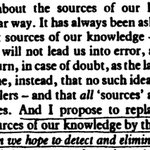
"The proper answer to my question
'How can we hope to detect and eliminate error?'
is, I believe, 'By criticizing the theories or guesses of others and—if we can train ourselves to do so—by criticizing our own theories or guesses.'"
—Karl Popper, Conjectures and Refutations.
"Utopian rationalism is a self-defeating rationalism. However benevolent its ends, it does not bring happiness, but only the familiar misery of being condemned to live under a tyrannical government."
—Karl Popper, Conjectures and Refutations.
"There are no subject matters; no branches of learning—or, rather, of inquiry: there are only problems, and the urge to solve them."
––Karl Popper, Realism and the Aim of Science.
