

Account for Y-DNA R2 (R-M479) and downstream clades Discord link (anyone welcome!): https://teapawt.org/t.co/6exvSazdoS Form: https://teapawt.org/t.co/W06UOZ7kyo
Joined January 2026
- Tweets28
- Following9
- Followers30
- Likes61



Pinned Tweet
We are planning on sponsoring samples!
If you are under Y-DNA Haplogroup R2, please feel free to fill out the form below:
forms.gle/WycWeaH3mp5A2U3n8


FYI the upgrades will primarily be the Family Finder NGS, and Y-37 test. We cant get a bunch of Big Y tests because we arent millionares lol🙃
2
63
Big Y Result of a Pashtun from Ghazni, Afghanistan.
R-M207>M479>P249>M124>P267>FGC12586>M9710>V1180>FGC17608>V3714>Z29158>SK2153>V3467>Z29192

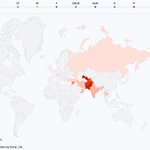
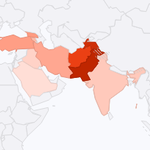
The Haplogroup (R-Z29192) that this sample falls under is quite an interesting one, as it is very diverse within a recent TMRCA (1250 BCE).
The distribution of this clade makes it hard to determine a proper origin, but it seems to be most concentrated in South Central Asia.

1
3
192

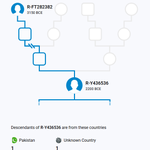
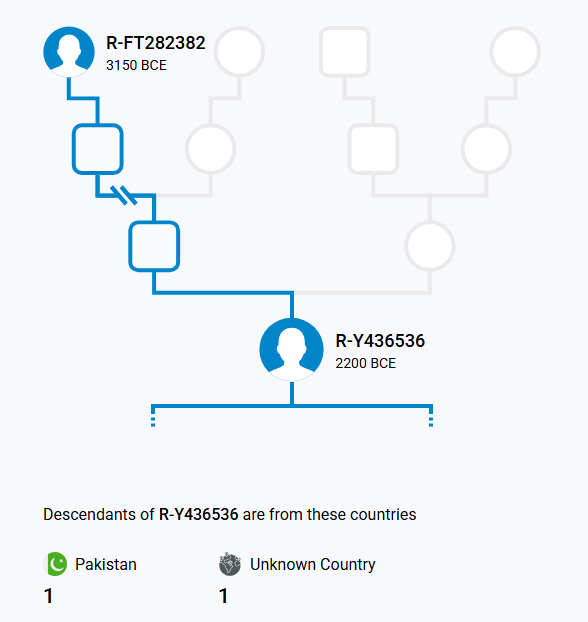
Big Y Result of a Swati from Qamber, Khyber Pakhtunkhwa Province, Pakistan.
R-M207>M479>P249>M124>P267>FGC12586>M9710>V1180>FGC17608>V3714>Z29158>SK2153>Y1285>Y1283>Y1282>SK2155>FT282382>Y436536
discover.familytreedna.com/y…
R2Haplogroup retweeted
WGS results of a Tajik from Kapisa, Afghanistan, with R2-F1758.
YFull. yfull.com/tree/R-F1758/
YFull ID. YF147161
R2a-F1758 is today most commonly observed among Mizrahi Jewish populations, while outside of them it appears to be relatively rare. In the Hindu Kush region, however, the lineage has previously been identified among Kalash, Nuristanis and Kho. Most of the R2a identified among the Kalash also appears to fall under F1758.
The connection between Hindu Kush populations and Mizrahi Jews is ancient rather than evidence of any recent shared ancestry. Available estimates place their common paternal ancestry several thousand years ago, well before the historic era.
One possibility is that Jewish F1758 descends from an undersampled or now-extinct population farther west, perhaps in Iran or Mesopotamia, while eastern branches survived among populations of the Hindu Kush. Their relationship may therefore reflect much older Chalcolithic-era ancestry connecting populations of the Iranian plateau, Mesopotamia and the Hindu Kush.

R2Haplogroup retweeted

New Pakistani Kashmir Gujjar Big-Y (R2) Results:
The results align with a more NW Pakistan origin as seen by the matches in the tree:
yfull.com/tree/R-FT103563/

R2Haplogroup retweeted
A general warning: AncestryDNA & MyHeritage raw data no longer includes Y-DNA . For males, we don’t recommend these tests. Autosomal DNA tests like FTDNA’s Family Finder are better. FTDNA also offers full/deep Y-DNA testing.
familytreedna.com/

R2Haplogroup retweeted
Global25 results of a Tajik from Kabul, Waisalabat
Y-DNA: R2a2b1b2b - R-SK2153
YFull: yfull.com/tree/R-L295/
FTDNA discover.familytreedna.com/y…
The profile shows an East Asian and Dardic shift, resulting in a relatively close genetic distance to Burusho populations. Similar profiles have previously been observed in Kabul among Tajiks and even some Pashtun individuals from Kabul those with admixture from Kashmiri, Dardic and Tajik groups can also show a similar genetic profile.

Big Y Result of a Safi Pashtun from Kapisa Province, Afghanistan
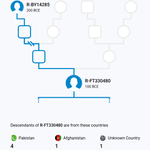
R-M207>M479>P249>M124>P267>FGC12586>M9710>V1180>FGC17608>V3714>Z29158>SK2153>V3467>V2434>Y1346>FGC18150>V1024>FGC18152>BY14285>FT330480
discover.familytreedna.com/y…

At the moment, not much details are known about the Pakistani samples, other than the fact that one is from Punjab province, but ethnicity is unfortunately not listed.
1
3
300

R2Haplogroup retweeted
Our project has received H1a and R2a Big Y results from the Bhittani tribe of Pashtuns in Tank, KPK, Pakistan.
H1a Bhittani
Y-DNA: H1a1a1c - Y24091
H-L901 > M2826 > L902 > M69 > M52 > L182 > M82 > Z14668 > Z34621 > Y24091
discover.familytreedna.com/y…
H-Z14668 had previously been identified in two Ghilzai Nasar Pashtuns, one from Nangarhar, Afghanistan and another from Balochistan, Pakistan. A Big Y test has now been ordered for the H1a Nasar Pashtun from Afghanistan to determine whether the Nasar and Bhittani H1a lineages share a closer relationship.
R2a Bhittani
Y-DNA: R2a2b1b2a - FT301429
R2-M479 > P249 > M124 > P267 > FGC12586 > M9710 > V1180 > FGC17608 > V3714 > SK2142 > Z29281 > Z29266 > Z29272 > Z29270 > Z29284 > Z29294 > FT301429
discover.familytreedna.com/y…
This is the first time this particular R2a subclade has been identified among Pashtuns. Additional Big Y testing of Pashtuns carrying similar R2 lineages will be necessary to better understand its distribution. More importantly, testing non-Pashtun populations with R2a lineage closer to the Bhittani R2a will help clarify the possible source and historical pathway through which this clade entered Pashtuns, e.g. the closest living vector population.
So far, the sample size from the Bhittani remains limited. However, even with the small dataset, they already display a relatively high diversity of lineages, with no single dominant paternal line emerging.
Particularly interesting is the presence of Q1b among them. This lineage was likely introduced through a Lodi/Lohani (most probably a Marwat) Pashtun who assimilated into the Bhittani tribe.

Big Y Result of a Marathi from Khandesh (Northwestern Maharahstra) Belonging to the Borse Clan.
R-M207>M479>P249>M124>P267>FGC12586>M9710>V1180>FGC17608>V3714>Z29158>SK2153>Y1285>Y1283>Y1282>Z29162>Z29165>Y1296>Z29175>F18906
discover.familytreedna.com/y…

1
10
979
Regarding his match, Singaporeans/Malaysians who have South Asian Y-DNA Haplogroups often get them from Southern Groups such as Tamils, and Sri Lankans, although there will occasionally be ones with descent from Northern Regions.
1
8
213