
Gabriel redesign, please hear me out on this.
☀️Wings are pure, condensed light like the halo
☀️The black parts are not exposed skin, it's chainmail/under-suit
☀️The skin is porcelain like, cold with blue shades and waves of warmth as red undertones
#ultrakill #gabrielultrakill
RG-L 767 retweeted
my collection of bugs 💉🩸🔬🦋 #ULTRAKILL

ALT gabv1el art referencing one of Fabián Cháirez's works gabriel pleadingly kneels in front of V1, his head near its crotch, where V1 threateningly presses its revolver to his faceplate
RG-L 767 retweeted
Show me your armour, lads!
I love armour in any forms and kinds (as long as it’s practical)
RG-L 767 retweeted
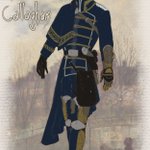
Sovereign rule - man-at-arms Class
commission work for @DubiousOrigins
RG-L 767 retweeted
portrait
#art
RG-L 767 retweeted
Carrying Weapons in Medieval Society
The Hundred Years' War in France serves as a primary lens through which to examine how medieval society viewed the carrying of weapons, a perspective that underwent significant transformation during this period. The concept of bearing arms has evolved continuously over the centuries, from the period of Charlemagne in the IXth century and the reign of Saint Louis in the XIIIth century, all the way to the present day, as codified in the modern penal code.
The Hundred Years' War was far more than a mere succession of sieges and battles; it was a profound social phenomenon. Military occupations, shifting territorial boundaries between factions, the presence of bandits and paid mercenaries, widespread pillaging, and large-scale cavalry raids chevauchées forced both rural and urban populations into a defensive posture. Archives, letters, and personal missives from the time serve as a goldmine for understanding how this society perceived and responded to such conditions. In wartime, the primary motivation for encouraging the carrying of weapons was not only to maintain public order, through the use of militias, watchmen, and troops, but also to defend the community itself. In times of unrest, the administration relied entirely on the loyalty of the populace.
Among the various records concerning the carrying of weapons, one of the most striking is found in archive JJ 175, entry no. 260, dated August 4, 1433; it details a case involving a woman who was found armed while dressed in men’s clothing.
During the period of the dual monarchy 1420s and 1430s, a weapon was truly a double-edged object for the English power occupying France :
People often armed themselves out of fear. Gervais Boudin, for instance, carried a "vouge" (a type of polearm) "for his safety and defense," as he feared "brigands." In Paris, Raoulin Petit kept a sword because he frequently "returned home late at night". Yet, it is most often the administration itself that mandates the carrying of arms. Jehan Berthault takes up a "war axe" to stand guard, as had been "ordered by the authorities." In Belleville, the inhabitants are required to equip themselves "in a state of defense to resist our enemies." In 1434, the people of Lisieux are even compelled to "arm themselves with weapons", in practice, swords.
At the same time, however, this very authority remains wary of weapons in the context of potential rebellion. In 1433, fearing that partisans of Charles VII might seize towns, the administration forbids rural dwellers from entering them while carrying "weapons or armor", these must be left outside. Jean de Saint-Fromont, lieutenant to the bailiff of Caen, notes with astonishment in a dispatch that the King of France and England has issued an order prohibiting any peasants "wearing armor or armed with clubs" from entering any towns.
For a weapon can easily change sides. Those whom official documents label "brigands", partisans of Charles VII, frequently steal arms; during one attack in 1434, they made off with a sword and six helmets. They also find assistance: Guillaume de la Haye purchases spears for them, and Laurent Hue is provided with a sword, a bow, and arrows upon joining their ranks. Those who are caught face dire consequences: one man, captured by the Englishman John Okeley, is hanged on the spot. The execution is so summary that Okeley is subsequently forced to seek a pardon for his actions, a notable occurrence, given that the Anglo-Burgundian government is not typically one to concern itself with the methods used to suppress dissent.
Weapons are also employed in the course of daily life and then everyday quarrels : Once an Englishman, John Lawrence, killed Jehan le Bouteiller, who had refused to give him… a "handful of hazelnuts".
Ultimately, the carrying of weapons in France would become strictly regulated by the time the Hundred Years' War officially ended in 1478, once "the English had been driven out of France."
RG-L 767 retweeted
Without Ao3 my brain starts to rot especially badly (T_T)
... Gabv1el I guess
(*゜▽゜)_□
#art #ultrakill #v1 #Gabriel #gabv1el


