

Dr. Erika Nolte, PhD pharmacology & toxicology. Science Director at @_readysetfood Sharing the latest news in the early allergen introduction space.
Los Angeles, CA
Joined September 2022
- Tweets46
- Following66
- Followers11
- Likes5




Dr. Erika Nolte retweeted

A big step forward for #foodallergies: new @US_FDA Food Code calls for allergen labeling of "unpackaged" food - made by restaurants, delis, bakeries etc.
But read our report on why state level advocacy is vital to achieve change.
@FoodAllergyEdu @NatashasLegacy @oakley_red
Thank you for tagging them! I think this will be such a useful position paper because it gives such clear, actionable guidance. Really great stuff.
All credit to the authors of this paper -
Elissa Abrams, MD, MPH, Moshe Ben-Shosan, MD, @jprotudjer, @DrElanaLavine and Edmond Chan, MD
Full statement: csaci.ca/wp-content/uploads/…
#allergies #foodallergy #prevention #earlyintroduction
So what are the key takeaways?
1. Infants should start potential allergens around 4 months
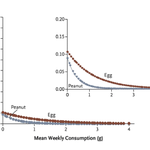
2. Common allergens should be eaten at least once per week
3. Infants should get about 2 g of allergen protein (about 1.25 tsp peanut butter for example) each week.
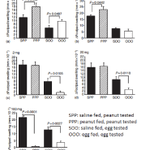
Case-controlled studies have found that intermittent or irregular consumption of cow's milk in infants actually increases the risk of a cow's milk allergy. However, in the SPADE clinical trial, daily ingestion of milk in infants reduced milk allergies.
In the LEAP trial, infants ate peanuts 3x per week (6 g/week). In the PETIT trial, infants ate eggs daily (0.875 g/week). In the EAT trial, infants ate allergens 2-3x per week (4 g/week). Observational trials have also highlighted concerns with intermittent consumption.
It is important to remember that the dual-exposure hypothesis that underpins early introduction depends on "consistent, regular oral ingestion to induce and maintain tolerance." This is supported by multiple clinical trials.
The authors highlight data from Australia that found that although the introduction of peanuts before babies are 12 months old increased 3x with new guidelines, peanut allergy has not decreased as much as expected. Only 30% of infants were eating peanuts regularly.
The Canadian Society of Allergy and Clinical Immunology & Canadian Pediatric Society came out with a new position statement on early allergen introduction, highlighting the most important factors for population-wide interventions. 🧵
Matthew Greenhawt gave a great interview about peanut allergy patch therapy in infants and toddlers (1-3 years)- this therapy is incredibly effective in these young children with few side effects! Early intro leads to early treatment and better outcomes!
medscape.com/viewarticle/984…

More studies are needed to really refine our understanding of the time dependency of early allergen introduction, but the data we have so far is clear: we need to introduce babies earlier. #foodallergy #peanutallergy #preventallergies
Early introduction matters in all kids, and it matters when you introduce common allergens. Medical guidelines direct parents to introduce infant safe forms of common allergens starting at 4 – 6 months. There is even a difference between 4 mo and 6 mo.

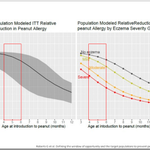
Introducing peanuts at 3 months, you reduce the risk of peanut allergy by >80%. Introducing peanuts at 9 months by ~50% and at 12 months by ~30% risk reduction.

Dr. Lack and his team modeled this data for all children and then for children by eczema status. As infants get older, there is a lower chance to reduce the risk of peanut allergy with early introduction.

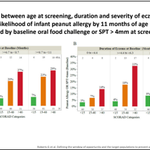
In kids w/o eczema, the risk of peanut allergy goes from 2% if peanuts are introduced by 6 mo to 7% if peanuts are introduced after 8 mo and 11% to 23% for children with moderate eczema over the same period. Delays in intro correlated with an increased risk of peanut allergy.

Using data from both the EAT and LEAP study, his team modeled outcomes based on eczema status age at introduction. In children with severe eczema, the risk of food allergy goes from 20% if peanuts are introduced before 6 months to 29% when introduced after 8 months.

Dr. Gideon Lack, lead on the pivotal LEAP trial, spoke at #ACAAI22 about what we have learned about preventing peanut allergy since his study published in 2015. What did he find? Early introduction of common allergens is important for every baby and when we introduce matters
I think that this has some interesting connotations for allergy introduction - early allergen introduction and early allergy identification can help with early OIT. bcchr.ca/sites/default/files…