

Focused on the Craft of Investing
Joined April 2018
- Tweets1.4K
- Following612
- Followers3.5K
- Likes24.6K





AI + Equity Research
1/ Same line as you. LLM writes assumptions and reasons. Scripts compute every number; gates reject bad inputs. A model never types a number into data.
2/ Routed by job, not measured quality per $. Claude Code and Codex do the modeling, research and reviews, depending on where I have usage. Gemini and Grok scout podcasts. No A/B yet.
3/ Reviewer is a fresh agent that did none of the work, 2 rounds max. It catches real errors (e.g. a growth % calculated across a loss-to-profit switch). No cross-family numbers.
4/ Leakage: I skip backtests for judgment. Models are built from filings only, blind to consensus and prices. Every view is locked (commit + hash) before earnings and scored after. Forward-only sidesteps "the model read the future."
5/ What broke: pass/fail bars. Same scan went 0 of 10 ideas, then 10 of 11, then 2 of 27. Forced ranking worked better. Rules change only on patterns across 3+ names.
6/ Specialists with narrow context, one plan file each. One master chat owns the shared docs. Hand-off loss bit when 23 chats came back in 23 formats. Fixed columns fixed it.
7/ Evals are my weakest part too. Script regression tests, models checked against filings, views scored at each print. No golden set.
8/ Plan, rules version, sources and output hashes saved per run. Not pinning model versions yet.
9/ Plan limits, not API billing, so no $ per report. I log usage per job, pilot 5 before running 18, and reuse prior work.


Honest question for AI engineers and quants actually running this in production:
For analysis workflows like DCF/valuation, bank-style research reports, backtests, and recursive research loops (generate thesis → test → log → new thesis), how are you allocating models?
One frontier model everywhere, or routed by role (cheap model for scouting/extraction, frontier for reasoning, a different model family as adversarial reviewer)?
Not looking for favorites. Looking for what you measured: error rates, cost per run, what broke.
Any resources? Frontier lab Ais are so bias that its not possible for me to get clear answers.
Thread below with the specifics.

And, what's helped most, in order:
10/ Blind first. Models are built from filings with no consensus or prices. The analyst then sizes beliefs against the Street, never against our own model.
11/ Lock it before the print. Every view and lead is committed and hashed with a confirming event and date. Hard to fool yourself after the fact.
12/ Pilot before fanning out. Running 5 groups before 23 caught a missing input and a broken bar that would have wasted every run.
13/ Rank, don't pass/fail. Models hedge every verdict. "If you could model one name in this group, which and why?" got better signal than any threshold.
14/ One master chat, one plan file per job, fixed output formats. Every new chat reads a handoff first. Most of my failures were hand-offs, not reasoning.
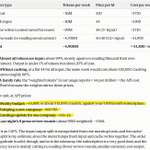
For equity research, I'm finding that building a new company model costs about $60-80 in compute at API prices, and a quarterly update about $15-35.
The point being, on a $200/month subscription, I can build roughly 40-50 models a week before hitting the limit.


Holy sh*t, Anthropic’s subscriptions offer so much more value, even compared to the new and efficient GPT-6.1 Sol. It’s not even close.
SemiAnalysis puts Opus 5.5 at over 5x the API-equivalent value of GPT-6.1 Sol for agentic workloads at the same subscription price. It’s not even close on this measure.
And on top: OpenAI just halved the usage limits on its $200 ChatGPT plan.


Comes down to underwriting duration as a near-certainty. Fine until the market questions duration. Valuation/multiple is levered to duration, and their whole book is one duration bet. Problem is their FCF/growth lens can’t tell you if the market’s right until years later.


Also a good reminder that the best investors build an investment process that gets them to #3/#4 but we're human and can block ourselves from getting past #1/#2-
1) never learn from your own mistakes
2) you learn from your own mistakes
3) you learn from other people's mistakes
4) you build a philosophy/process that adapts and does not need to see mistakes to navigate to the market
I had to double check this quote for myself. CEO of $TSM, love it.


But of course, caveat being much of it is timing. Capex hits the balance sheet 12-24 months before being monetized. MSFT looks best partly because more of its buildout is leases, third party capacity, etc.
Any finance folks tried starting an SMB bookkeeping side hustle as a way into fractional CFO/advisory work?
I've mostly ignored SMB Twitter, but lately I've had the itch to be more entrepreneurial. I only work 20-30 hours a week on the allocator side, and comp is very good but the upside is somewhat capped.
A CFA + equity research background is obviously overkill for bookkeeping, but I'm wondering if it could be a good funnel for upselling advisory.
SpaceX $SPCX projected to cross $3T in revenue in a decade and $5T in 15 years. So like 15% of today's US GDP. Got it.


Over the last ~12 months, my podcast feed has outgrown what I can consume in a week. Really like the idea behind the Podcast AI tab by @JaredKubin


Raleigh Partners retweeted

Market is overreacting to hyperscale credit spreads widening from my perspective. TL;DR Spot pricing for renting GPU compute materially above contracted rates implies hyperscalers are underearning while operating cash flow acceleration is an underestimated source of funds for AI capex.
The fact that spot prices for GPU rentals are at least 2x higher than contracted rates is the missing piece from the discussion about hyperscaler credit, which is the only fundamental factor behind this selloff. Multiple private companies are planning on spending at least 2x more per GPU for compute as contracts roll-off and some have spoken about this publicly.
As contracts roll-off, hyperscale growth rates are going to continue to accelerate as their installed bases of compute reprice higher. Hyperscale operating cash flow growth using a mix of estimates and actuals is modeled to accelerate from 31% in the first quarter of 2026 to 50% in the second quarter. This acceleration should continue for the rest of the year and this is not in estimates which incorrectly model a deceleration in the third quarter from my perspective.
Some math. Consensus estimates are probably for 25-35 gigawatts added by hyperscale and neoclouds in CY28 (using a range as standing up datacenters is hard and a lot of the neos plus labs are still private). At 60b per gigawatt, that is 1.5 to 2.2 trillion in capex. Consensus estimates for hyperscale/neo operating cash flow is 1.3 to 1.4 trillion. I think this gets revised up materially as contracts reprice and growth accelerates so the 100b to 700b that would hypothetically need to be plugged by debt goes away. And their credit profiles materially improve. Not to mention the said 100b to 700b would be less than 1 turn of incremental leverage on consensus EBITDA estimates. And obviously the Nvidia and Broadcom “credit wrappers” help improve creditworthiness as well given their FCF profiles.
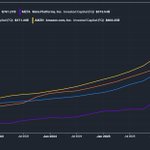
OpenAI, Cursor/Grok and the various Open Source inference clouds have accelerated materially over the last two months per public data and Anthropic continues to grow insanely fast while likely generating FCF. This - along with the fact that spot prices for GPU rentals are so far ahead of contract - are the missing pieces from the BofA chart on hyperscale FCF vs. semiconductor FCF.
Hyperscalers are underearning and anyone who signed a contract for GPU compute in 2024 and 2025 is overearning. Operating cash flow will be enough to fund capex but as contracts reprice and cloud growth continues to accelerate then spreads likely come in as well.
Would also note that CDS markets are easy to manipulate - was a huge feature of the GFC - short the stock and then buy the CDS. So I would not put attach much signal to CDS.
Net, net I’m not that concerned about the widening spreads in hyperscale credit. The real risk is that bringing power online and energizing all these GPUs is really hard but we are getting better at this every day.
🤖 Made with AI


Raleigh Partners retweeted

Over the last few months I’ve become more convinced that agents aren’t simply an automation opportunity for public market investors, but represent a fundamental challenge to the classic “Grinold frontier”:
> Fundamental Investing: high IC (information coefficient), low breadth
> Quant Investing: low IC, high breadth
The holy grail alpha machine is combining high information coefficient with high breadth. Fundamentally, this is what the multi-manager platforms achieve with focused, highly incentivized individual teams hunting for high IC opportunities, orthogonalizing those high IC pods together into a beautiful high breadth, high Sharpe alpha stream…it’s not a new concept, just one that is incredibly hard to scale (i.e. has required the ability to raise tens of billions of capital and attract & retain hundreds/thousands of talented investors).
Until now?
It feels to me like the vision of 5,000 digital analysts covering 5,000 individual stocks has the ability to shift the Grinold frontier to structurally raise IC while offering quant-level breadth to dynamically allocate capital to the “60/40” coin set ups that continuously emerge in markets, with real time 24/7/365 digital analyst coverage to validate or invalidate the set-up trigger. Layered into micro fundamental pattern recognition where the Spidey sense of “we’ve seen this story before” becomes an articulated agentic trigger.
I’m not fully there yet. But I’m there enough that I’ve shifted a good portion of my AI focus toward figuring this out, including getting more serious about point in time evaluation and the construction of a documented decision corpus.
If you are also working on this problem, I would love to compare notes. DMs open