

Working on AI and Security. CS Ph.D. student @UofIllinois, B.S. & M.E. @Tsinghua_Uni.
Illinois, U.S.
Joined August 2025
- Tweets31
- Following80
- Followers54
- Likes109


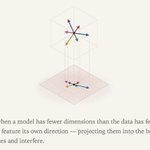


Does superposition contribute to adversarial vulnerabilities in neural networks?
We replicated and extended recent findings on the connection between superposition and adversarial examples in Vision Transformers (ViTs).
lesswrong.com/posts/TRe3CxDi…

An interesting result: adversarial training improved robustness by ~5× without measurable changes in final-layer interference or attack–geometry alignment.
Increasing model width also changed alignment without improving robustness.
1
2
51
These results suggest that robustness and representation geometry can change independently, raising questions about the causal role of superposition in adversarial vulnerability.
Full post, code, and models:
lesswrong.com/posts/TRe3CxDi…
Feedback and follow-up ideas welcome!
2
45
Xijia (Ray) Che retweeted

Our security researchers built an autonomous cyber vulnerability discovery, exploitation, and patching pipeline.
In a single run with an upcoming cyber model, it validated and generated patches for 948 local privilege escalation vulnerabilities in the Linux kernel at a total API cost of $1.2 million.


Xijia (Ray) Che retweeted

New work @secondlookxlab:
Anthropic found Claude passes five functional tests for a global workspace. Does GPT-2 small, a 124M base model, pass them too? Mostly, yes: it passes four of the five, but has almost none of the structure found in Claude.
So, either GPT-2 small has a minimal functional global workspace, or these four tests are weak evidence for one. We think it’s likely the latter, so a case that Claude has one would have to rest on what GPT-2 lacks: directed modulation and the structure.
Xijia (Ray) Che retweeted

In case you need more confirmation that GPT-Astra is terrifyingly good at no-CoT computation: I ran my replication of Ryan Greenblatt’s no-CoT evals on Astra (+ Gemini 3.1 Pro, Kimi k3, Fable 5.1). It is a qualitative jump on every dataset, especially competition math and multi-hop reasoning. 🧵

Excited to share that I'll be attending Context Week at Berkeley! Looking forward to connecting with others working on AI safety and security, and diving deeper into the space.
Link: bluedot.org/programs/context…
#AISafety #ContextWeek #Berkeley

3
76


Xijia (Ray) Che retweeted

Come work on replications of AI safety research with @zephaniahbroe and I at @SPARexec! @secondlookxlab is hosting 2-4 mentees over the Fall semester.
SPAR runs Sept-Dec, part time, and our application should take <1 hour. You can expect 2+ hours of mentorship from Second Look along with external mentorship from researchers at orgs like Anthropic, X AI, Oxford, Redwood Research, and Geodesic.
secondlookresearch.com/


OpenAI now has watermarks in audio! Great step. Hoping to see watermarks in more scenarios.

Great to see @OpenAI join @ElevenLabs in adopting @Google's SynthID for audio, enabling their users to have access to the same robust, imperceptible safeguards that power our own products.
For years, we at @GoogleDeepMind have been pioneering research on SynthID watermarking to address the risks of AI-generated media (particularly acute for audio and voices).
We had successfully integrated SynthID to safeguard our product surfaces - Gemini Live, Lyria, and Veo, but protecting the ecosystem requires an industry-wide effort to build foundational safety infrastructure together which is now gaining momentum!
SynthID: deepmind.google/models/synth…
OpenAI Verification Portal: openai.com/research/verify
ElevenLabs: elevenlabs.io/blog/synthid

3
172
Xijia (Ray) Che retweeted

Great to see @OpenAI join @ElevenLabs in adopting @Google's SynthID for audio, enabling their users to have access to the same robust, imperceptible safeguards that power our own products.
For years, we at @GoogleDeepMind have been pioneering research on SynthID watermarking to address the risks of AI-generated media (particularly acute for audio and voices).
We had successfully integrated SynthID to safeguard our product surfaces - Gemini Live, Lyria, and Veo, but protecting the ecosystem requires an industry-wide effort to build foundational safety infrastructure together which is now gaining momentum!
SynthID: deepmind.google/models/synth…
OpenAI Verification Portal: openai.com/research/verify
ElevenLabs: elevenlabs.io/blog/synthid
Xijia (Ray) Che retweeted
Can frontier models solve hard problems in a single forward pass without thinking? For my first project w/ @secondlookxlab I extended Ryan Greenblatt's no-CoT evals to Fable 5, Opus 5, and GPT-5.6-Sol and saw a substantial jump on some evals!

Why do adversarial examples exist? Recent research suggests that adversarial attacks leverage interference between features. We replicated superposition in toy models, and found that PGD attacks align with the optimal perturbation direction predicted by latent geometry.

Further, can superposition explain why adversarial examples transfer across independently-trained models? Yes, and here is the logic chain we proved: data feature correlation---> interference geometry convergence ---> adversarial attack transfer.
1
5
198
This is a work by @secondlookxlab, supervised by @zephaniahbroe. For more information, read the full post on Lesswrong: lesswrong.com/posts/rwu73dCE…

8
207