
News and views from researchers working on reef fishes at the MARBEC lab (https://xitter.cf/t.co/EM3cjM3k8H) and their close collaborators
Montpellier, France
Joined January 2017
- Tweets1.9K
- Following227
- Followers826
- Likes4.5K




ReeFish retweeted

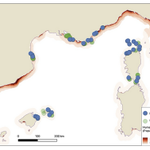
New paper out: No Sign of Homogenisation in Reef Fish Communities Across an Ecological Transition Zone Exposed to Warming - doi.org/10.1111/ddi.13923

ReeFish retweeted

Why do seahorses, goatfishes, dragonets and flying gurnards evolve differently across oceans? 🌏🐟 A new study led by Scripps researchers reveals that colonization dynamics drive the decoupling of species richness and morphological diversity. Dive in: journals.uchicago.edu/doi/10…

ReeFish retweeted

Super proud of my 2nd PhD paper exploring shifts in evo. integration among reef fish fins with expansions in locomotor modes, out now in Evolution. Within modes there is much diversity in fin shape and weak connections between form and function. doi.org/10.1093/evolut/qpae1…

ReeFish retweeted

NEW CORAL REEF RESEARCH: Environmental change and connectivity drive coral reef fish abundance in the Western Indian Ocean (OPEN ACCESS)
academic.oup.com/icesjms/adv…
Worldwide, coral reefs are facing risk from climate change. The Western Indian Ocean (WIO) harbours about 16% of global coral reefs with highly reef-dependent local communities. Coastal protection and food security depend on effective conservation management, which requires understanding species abundances. Here, we explore how fish group distribution and abundance across the WIO, categorized by their trophic function, are explained by oceanographic connectivity, sea surface temperature (SST), and chlorophyll a. We designed a proportional oceanographic connectivity metric describing the relative strength of connectivity between all WIO coral reefs and each survey site. We created statistical models for four trophic groups: grazers and detritivores, herbivorous excavators, corallivores, and primary piscivores across 51 sites in the WIO. We show that SST and chlorophyll a are strong predictors of all trophic fish groups and that the proportional oceanographic connectivity metric improved the model predictions significantly for grazers and detritivores and excavators. For excavators, peak abundances were predicted at medium connectivity, and for grazers and detritivores, at low and medium connectivity, suggesting that larvae dispersal predominates at a local scale. Decision making should include connectivity for efficient conservation area prioritization, for which our proportional oceanographic connectivity metric is a valid and useful parameter.
#coralreefs #coralfish #reeffish #fish #coral #connectivity #management #coralreefecology #research #marinescience #marinebiology

ReeFish retweeted

Looking to add statistical insights directly to your ggplot2 visualizations? The ggstatsplot package simplifies this by incorporating statistical tests, effect sizes, and other analyses right within your plots.
✔️ Enhanced Visuals: Automatically includes statistical information in your plots, providing clear insights without the need for extra steps.
✔️ Wide Range of Analyses: Supports various statistical tests, including t-tests, ANOVAs, correlations, and more, making it versatile for different types of data sets.
✔️ Customizable Output: Lets you control which statistical details are displayed and customize the appearance of plots, ensuring clarity and focus on key findings.
✔️ Seamless Integration: Designed to work directly with ggplot2, using the same syntax and functions you’re already familiar with.
The visualizations shown here are from the package website and demonstrate how ggstatsplot integrates statistical results seamlessly into ggplot2 graphics: github.com/IndrajeetPatil/gg…
Want to deepen your knowledge of ggplot2 and learn how to create informative visualizations? Join my online course, “Data Visualization in R Using ggplot2 & Friends,” starting on November 25, 2024!
Claim the early bird promotion before it closes on November 6.
Further details: statisticsglobe.com/online-c…
#DataVisualization #Statistical #programmer #VisualAnalytics #database

First launch of our swarm of Autonomous Underwater Vehicules #AUV sampling #eDNA, physico-chemical parameters, sounds, videos etc.
SEAMAP project funded by @Bpifrance
Developped by seaber.fr/ with @SPYGEN_Lab
Next try in La Ciotat with @SauvonsLeau
@umrMARBEC


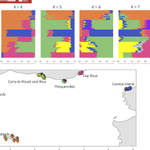
Congrat Letizia for this new masterpiece showing how to reduce the dimensionality of multitaxa eDNA samples to reveal biogeographic and human gradients
doi.org/10.1111/2041-210X.14…
Samples as mixtures of K different sources
PhD at @cefemontpellier @ETH_en @EPHE_PSL @WSLbiodiversity

ReeFish retweeted

Check out our new blog post that introduced ‘Life on the edge’, a new toolbox for predicting population responses to global change 🌎
buff.ly/3U2IP2H

ReeFish retweeted

⚡️Paper Alert⚡️
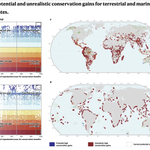
The socioeconomic and environmental niche of #ProtectedAreas reveals global conservation gaps and opportunities.
@CNRS @CNRSecologie @psl_univ @EPHE_PSL @criobe_pf @ocean_climate
doi.org/10.1038/s41467-024-5…

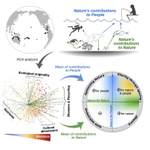
Measuring 29 fish community contributions to Nature or People on tropical reefs show that:
1. Contributions for Nature are correlated to biomass
2. Trade-offs among contributions are not the rule
3. Bright-spots can be in any country
doi.org/10.1016/j.oneear.202…
@BiodiversaPlus

Protected areas: rare opportunities identified on a global scale
doi.org/10.1038/s41467-024-5…
Socio-economic conditions had a greater influence than environmental conditions in the establishment of PA globally
HDI & NGOs ++
Accessibility & dependence on fish stocks - -
@FRBiodiv

ReeFish retweeted

Never to late to advocate for conservation: Thrilled to see that the German Press Agency (@dpa) featured my research on #WorldAnimalDay! 🐠🤖 My paper was showcased as a state-of-the-art example of #AI in conservation. read it e.g. @zeitonline: t1p.de/l7hf3 @LeibnizZMT
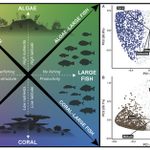
4 simplified distinct states on coral reefs using benthic cover and fish size classes, denoted as: Coral–large fish, algae–large fish, algae–small fish, and coral–small fish.
doi.org/10.1111/geb.13926
Multi-decadal state shifts in 88.1% of coral reefs
@FRBiodiv
@OFBiodiversite

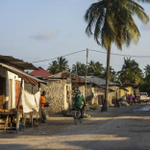
Marine protected areas boost the living standards of coastal populations after 18y in Tanzania
lemag.ird.fr/en/marine-prote…
Dividends of tourism not fisheries catches
doi.org/10.1111/conl.13048
Salaried employment pays much better than subsistence activities
@ird_fr
@umontpellier


Counterfactual scenarios predict 5.7% less fish biomass without fishing restrictions on coral reefs
doi.org/10.1073/pnas.2308605…
With 30% coverage of fully protected #MPAs, fish biomass would be ~17 to 28% higher depending on the context
Highest gains where human gravity is low

ReeFish retweeted

I'm glad to share our new paper published in @ESAFrontiers 🎉! We assessed the co-benefits and trade-offs between Natural Climate Solutions (#NCS) within 12 ecosystems and 150 Sustainable Development Goals (#SDG) targets.
🔗 Paper available here: doi.org/10.1002/fee.2807 🔗
1/5

ReeFish retweeted

SAVE THE DATE
Lundi 21 oct. Avant-première de la dernière Mission Gombessa de Laurent Ballesta
« Cap Corse : Le Mystère des Anneaux »
En présence de Laurent Ballesta
À plus de 100m de profondeur, des formations mystérieuses ont été découvertes
pulse.ly/xbkwj7qfqt

ReeFish retweeted

Ocean protection accounts for 10% of fish in the world’s coral reefs – but we could save so much more, say @JoshuaCinner and @ircaldwell.
Read on in their piece, out now via @ConversationUS
theconversation.com/ocean-pr…

ReeFish retweeted

🐙Some octopus and fish species appear to share leadership when hunting prey together, according to a paper in @NatureEcoEvo.🐡
More at👉 go.nature.com/3BobPv7
via @NaturePortfolio
Villages near Marine Protected Areas experienced a 50% higher improvement in living standards compared to those further from MPAs over 2 decades in Tanzania
doi.org/10.1111/conl.13048
Yet more benefits for people than for nature with lower catches
@umontpellier
@wiomsa
@ird_fr
