

New General Relativity and Quantum Cosmology papers from https://teapawt.org/t.co/djdjtXVzdG: gravitational physics. Thank you to arXiv for use of its open access interoperability.
- Tweets49.9K
- Following2
- Followers3.2K
- Likes1




ALT We investigate the optical appearance of a non–commutative Schwarzschild black hole surrounded by a transparent, geometrically thin emitting disk. A Lorentzian matter distribution supplies the effective exterior metric. We compute photon trajectories, disk transfer functions, and the observed bolometric intensity for static and circular emitters, taking into account gravitational redshift, orbital time dilation, and Doppler modulation. At fixed asymptotic mass, increasing θ=Θ/M² from zero to 0.03 reduces the critical impact parameter by approximately 16.1% and the innermost stable circular orbit radius by 23.7%. The narrow higher-order features follow this contraction, while the broad direct peak shifts by less than 1% for a fixed emission profile. With the same source normalization, the peak direct intensity and the signal integrated over the screen aperture increase by approximately 6.5% and 4.3%, respectively. Moreover, different radial emission profiles produce distinct central bri

ALT We consider models with the Gauss-Bonnet term multiplied to a function of the scalar field and propose a new inflationary model which provides a mechanism for the formation of primordial black holes (PBHs). For certain values of the model parameters, the predictions of this model agree with observational data from the Atacama Cosmology Telescope (ACT). Due to estimation of possiable PBHs masses, we demonstrate that they can be considered as a possible source for all or part of dark matter.

ALT We study a classical spinor field minimally coupled to gravity and described by a non-canonical Lagrangian depending on the fermionic kinetic scalar and the scalar bilinear. For purely kinetic theories, we show that the field equations split the solutions into two distinct branches. On the regular branch, the spinor satisfies the massless Dirac equation and contributes a vacuum energy determined by an additive constant in the Lagrangian. On the stationary branch, the spinor field equations become identically satisfied, while the energy-momentum tensor is exactly that of a cosmological constant for any spinor configuration and in any spacetime. The spinor evolution is therefore not uniquely determined by the field equations. In a spatially flat homogeneous universe, both branches act as cosmological-constant sources. We also give the dilution law for homogeneous configurations in theories with explicit dependence on the scalar bilinear. When a potential with a nonzero minimum is introdu

ALT We construct a static, spherically symmetric BI \AdS BH that carries a topological defect, either a GM or a CS, and is immersed in PFDM. The metric function collects four independent deformations of the Schwarzschild geometry: a constant solid-angle deficit (1-ξ) from the defect, the nonlinear charge sector controlled by the BI scale β, the logarithmic PFDM term set by the intensity λ, and the \AdS curvature Λ. We verify that the solution reduces to the charged \AdS–PFDM defect geometry as β→ ∞ and to Schwarzschild when all deformations switch off. The horizon, photon sphere, and shadow all grow monotonically with the defect strength ξ. We compute the innermost stable circular orbit and the epicyclic frequencies, read off the relativistic-precession predictions for twin-peak quasi-periodic oscillations, and confront them with five accreting sources through a Markov chain Monte Carlo fit. For spin-0 perturbations we obtain the scalar potential, the higher-order WKB QNM spectrum, and the

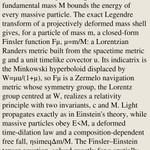
ALT We generalize special and general relativity so that, besides the speed of light c, an invariant fundamental mass M bounds the energy of every massive particle. The exact Legendre transform of a projectively deformed mass shell gives, for a particle of mass m, a closed-form Finsler function Fμ, μ=m/M: a Lorentzian Randers metric built from the spacetime metric g and a unit timelike covector u. Its indicatrix is the Minkowski hyperboloid displaced by W=μu/(1+μ), so Fμ is a Zermelo navigation metric whose symmetry group, the Lorentz group centred at W, realizes a relativity principle with two invariants, c and M. Light propagates exactly as in Einstein's theory, while massive particles obey E<M, a deformed time-dilation law and a composition-dependent free fall, ηsimeqΔm/M. The Finsler–Einstein tensor equation, solved exactly for a spatially flat universe, gives Friedmann equations with corrections proptoμ\dot H and leaves de Sitter space exact. Observed particle energies, equivalence-pr
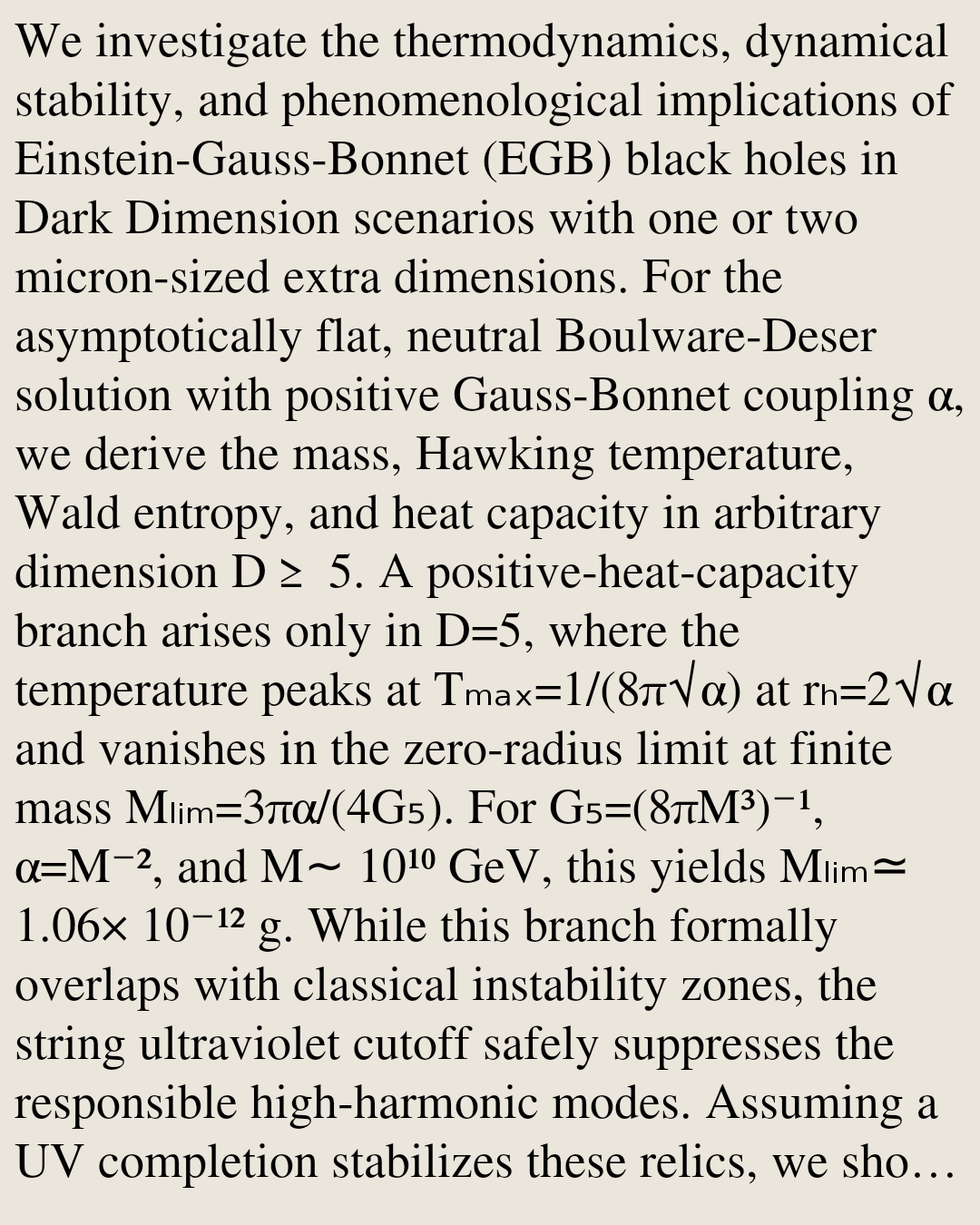
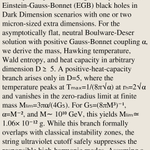
ALT We investigate the thermodynamics, dynamical stability, and phenomenological implications of Einstein-Gauss-Bonnet (EGB) black holes in Dark Dimension scenarios with one or two micron-sized extra dimensions. For the asymptotically flat, neutral Boulware-Deser solution with positive Gauss-Bonnet coupling α, we derive the mass, Hawking temperature, Wald entropy, and heat capacity in arbitrary dimension D≥ 5. A positive-heat-capacity branch arises only in D=5, where the temperature peaks at Tₘₐₓ=1/(8π√α) at rₕ=2√α and vanishes in the zero-radius limit at finite mass Mₗᵢₘ=3πα/(4G₅). For G₅=(8πM³)⁻¹, α=M⁻², and M∼ 10¹⁰ GeV, this yields Mₗᵢₘ≃ 1.06× 10⁻¹² g. While this branch formally overlaps with classical instability zones, the string ultraviolet cutoff safely suppresses the responsible high-harmonic modes. Assuming a UV completion stabilizes these relics, we show they can constitute all of cold dark matter. We map their observational signatures, highlighting a scalar-induced gravitational

ALT We present a generally covariant inflationary model in which curvature history activates a spatial symmetric-tracefree tensor-memory order parameter and generates a scale-dependent quadrupolar departure from primordial statistical isotropy. The curvature source is the four-dimensional Gauss–Bonnet completion of the Kretschmann invariant. A local (C,χ) representation is used only to implement the retarded theory: fixed retarded Cauchy data remove the homogeneous response modes, so the negative-sign localized combination is not an independent phase-space degree of freedom. The projected tensor sector is described by the dressed field Qμν=ℰ_CQ̂μν with ℰ_C=exp[B(C)□\wᵢdₑₕₐₜQ/2]. Its raw-field Hessian has the exact congruence form ℰ_C†(□_Q-mathsf M²)ℰ_C, so an invertible dressing preserves the solution count and the sign of the physical symplectic norm even when [B(C),□_Q]≠0. We derive the full quadratic Hessian, eliminate the ADM constraints and retarded response variables through an exact

ALT Simultaneous global-fit inference of the numerous sources observed by the Laser Interferometer Space Antenna (LISA) depends on accurate modeling of its stochastic components: instrumental noise, the Galactic foreground, and astrophysical or stochastic gravitational wave backgrounds (SGWB). Realistic features such as non-Gaussian transients and data gaps challenge traditional likelihood-based pipelines, creating an opportunity for simulation-based inference (SBI) to augment traditional analyses. Here, we present an SBI framework for LISA stochastic component separation built on the Simformer, a transformer trained with diffusion or flow matching that ingests the full time-delay interferometry cross-spectral matrix via a physics-aware embedding. We progressively relax standard simplifying assumptions on simulated 11.6-day datasets containing a loud foreground and a faint power-law SGWB. With unequal arms and per-link noise freedom, the networks match 17-dimensional MCMC posteriors after

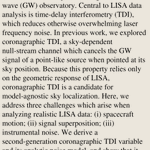
ALT The Laser Interferometer Space Antenna (LISA) is a future space-based gravitational wave (GW) observatory. Central to LISA data analysis is time-delay interferometry (TDI), which reduces otherwise overwhelming laser frequency noise. In previous work, we explored coronagraphic TDI, a sky-dependent null-stream channel which cancels the GW signal of a point-like source when pointed at its sky position. Because this property relies only on the geometric response of LISA, coronagraphic TDI is a candidate for model-agnostic sky localization. Here, we address three challenges which arise when analyzing realistic LISA data: (i) spacecraft motion; (ii) signal superposition; (iii) instrumental noise. We derive a second-generation coronagraphic TDI variable and its analytic noise model, and show that it reduces laser frequency noise in the presence of spacecraft motion while still recovering the position of the source. Using pairs of Galactic binaries (GBs), we find that sources can be localized

ALT We investigate the thermodynamics, quasinormal modes (QNMs), and shadows of the effective theory of quantum black holes (BHs) by expanding the physical constants in terms of the Kretschmann scalar. The resulting effective metric can contain two horizons, which is typical for a quantum-corrected Schwarzschild spacetime. The second-order corrected metric only shifts the first-order corrected metric, allowing investigation of IR phenomena from the pure first-order corrected one. From a thermodynamic point of view, the metric leads to a stable cold remnant with zero entropy, compatible with the third law of thermodynamics. In the perturbation regime, we use massless scalar perturbations to extract the effective potential, QNMs, graybody factor, and total absorption cross section. We show that double-horizon BHs have a double light ring in the potential, and for a certain value Ω/χ²=0.01, the QNMs are similar to the GR case since the horizon is Schwarzschild-like. We also tested the corresp

ALT We derive the relativistic form of Newton's Third Law governing the interaction between intermediate- and extreme-mass-ratio inspirals and surrounding relativistic matter fields. Working within a two-parameter expansion, we rewrite the evolution of the secondary's orbital elements in a form resembling the integrated forces acting on the environment, avoiding the need to calculate any gravitational perturbations sourced by the dynamical matter content. Using the retarded and advanced Green's functions, we obtain both instantaneous and orbit-averaged laws relating the rate of change of the secondary's orbital energy and angular momentum to that of the matter and the gravitational-wave fluxes at that order. Our results clarify and correct the mixture of ad hoc balance prescriptions currently employed in the literature, providing first-principles forcing functions for the secondary's orbital elements in two ready-to-use forms: a leading-order formulation suitable for fast evaluation with c

ALT Global analysis of Galactic compact binaries (GCBs) for space-based gravitational-wave detectors is computationally demanding in the high-frequency region (above ∼10 mHz), where resolvable signals are sparse but frequency samples are numerous. We propose a free-bin scheme that evaluates the nontrivial likelihood only in movable frequency windows centered on sampled signal frequencies. The method preserves the joint-likelihood structure by replacing only the signal-containing regions of a precomputed null likelihood, and avoids the fixed-bin edge effect by construction because the windows follow the sampled frequencies. In a simulated TianQin dataset containing 193 GCBs, 192 injected sources are recovered with waveform fitting factors above 0.99. Numerical comparisons demonstrate that the free-bin and conventional full-band likelihood implementations yield identical results when the same finite-length local waveforms and numerical settings are used. Computational benchmarks show that th

ALT We investigate how matter fields affect spacetime regularity in a class of gravitational theories with second-order field equations in spherical symmetry, of which general relativity is a special case, and which may encode effective corrections from an underlying quantum theory of gravity. Focusing on spherically symmetric black holes and cosmological spacetimes in theories in which vacuum spacetimes display bounded curvature invariants, we derive the conditions under which regular geometries can be supported by static and perturbative scalar fields, electromagnetic fields, and radiation fluids. We discuss the impact of matter on the regularity requirements of curvature boundedness and geodesic completeness relative to vacuum, finding in general that coupling to matter does not eliminate the existence of theories with regular solutions.

ALT We investigate the massless Dirac field in locally rotationally symmetric (LRS) spacetimes using a covariant spinorial-fluid representation, with the spinor current and spin direction aligned with the LRS frame. When the current has both vorticity and sheet twist, characterized by a constant ratio λ, the LRS integrability condition relates evolution and propagation derivatives, reducing the field equations to an ordinary differential system that can be integrated exactly. The integrability of the chiral angle forces the heat flux to vanish and the source to saturate the null energy condition along the two radial null directions. A constant boost in the radial Lorentzian two-plane maps the spinor current to a canonical congruence, which is stationary (LRS I) for |λ|>1 and irrotational and geodesic (LRS III) for |λ|<1. In this frame, the local metric is reconstructed in the Goode–Wainwright–Van den Bergh canonical form. For |λ|>1 the energy density is positive, and the metric is locally

ALT Based on current observational data, there is a strong possibility that dark energy was in a phantom regime in the near past, and a transition from a phantom to a quintessential regime may have occurred. Since then, many scenarios compatible with the DESI data have been proposed. In particular, there exist several realistic models in the framework of F(R) gravity. In this paper, we show that such realistic models of F(R) gravity may produce an anti-gravity or ghost graviton in the future. The problem could be avoided by further changing the parameters and fine-tuning the initial conditions, but we propose to introduce a potential barrier of the scalar field for the small scalar curvature region, which prevents the Universe from evolving into the anti-gravity or having a ghost graviton region, without the fine-tuning of the initial conditions. We also discuss how this regime can be tested using peculiar velocity and kSZ effect probes.

ALT We develop a microscopic framework for the cosmological backreaction of a hidden pseudo-Dirac fermion ensemble derivatively coupled to an ultralight Majoron. Starting from the effective action, we derive the exact operator Ward identity for the pseudo-Dirac current and the associated microscopic energy-transfer law. For a thermal density matrix prepared at a finite initial time, we calculate the subsequent collisionless, linearized coherence response without assuming continued thermal equilibrium or introducing phenomenological dissipation. The finite-time retarded solution retains the initial boundary transient and nonlocal memory contribution, allowing us to assess the validity of the leading local adiabatic approximation and distinguish reversible coherent energy exchange from dissipative friction. For a subdominant Majoron benchmark evolving in a prescribed FRW background, the local energy-transfer rate changes sign, while the present-day fractional velocity correction is only +5.2

ALT In this paper, we investigate Type-II quasinormal modes (QNMs) of a magnetically charged dilaton–Euler–Heisenberg black hole in anti-de Sitter (AdS) spacetime. The Type-II includes coupled gravitational, dilaton and electromagnetic perturbations. Its coupled equations are derived for ℓ=0,1,2 modes and the QNM frequencies are calculated by employing direct integration and Chebyshev pseudospectral methods, giving consistent results. For nondegenerate dipole (ℓ=1) mode at fixed curvature, the nonlinear correction starts at order Q² for electromagnetic-led branch and at order Q⁴ for scalar-led branch. In this case, stronger AdS curvature enhances reduction of the electromagnetic-led real frequency for positive coupling, while gravitational-led quadrupole real frequency changes weakly with charge. As the curvature weakens, the dipole frequencies approach the AdS normal-mode scale and their damping decreases. We find that all modes computed have negative imaginary parts for nonextremal black

ALT Gravitational-wave (GW) observations provide a powerful means of testing general relativity and exploring the physics of black holes and the early universe, motivating the development of complementary detection techniques. Here, we propose and theoretically investigate a GW detector based on massive-particle interferometry, in which the signal is encoded in the relative phase accumulated by a quantum particle traversing a closed-loop trajectory and a reference path. We derive the frequency-dependent GW-induced phase response and examine the parameters on which it depends. These parameters provide a means of tuning the detector response over a broad frequency range, motivating the exploration of tabletop detectors for GW signals at frequencies comparable to and below the LIGO band, in the idealized limit. By exploiting the trajectory-dependent gravitationally induced phase, the proposed scheme offers a distinct and potentially complementary approach to GW detection and motivates further

ALT The quasinormal modes (QNMs) of a black hole are defined by keeping only ingoing waves at the horizon. We ask what horizon regularity requires of the outgoing waves this condition discards. For a scalar-like perturbation, bounded first derivatives in a frame regular at the future horizon rule out outgoing waves that decay more slowly than the surface gravity κ, and smoothness singles out a ladder of frequencies, ω=mΩ_H-ijκ with j=1,2,… and Ω_H the horizon angular velocity. We call these the horizon modes. For Schwarzschild black holes and the dominant ℓ=m=2 Kerr modes, only the fundamental QNM decays more slowly than κ. These local statements leave the QNM spectrum unchanged but matter for merger ringdowns, because a source falling through the horizon drives the exterior at the horizon frequencies. Each QNM then has a driven and a free part, and the free part takes over only once the driving decays faster than the mode. The fundamental mode separates from the driving early. The overton

ALT In this work, we present the relativistic kinetic theory of a gas of collisionless point particles with non-constant mass, which can also be understood as being subject to a scalar force. Our results hold in an arbitrary conformal frame, and we explicitly derive how they transform between frames. The mathematical construction relies on a tilted Sasaki metric, whose associated phase-space geometry is adapted to particles of variable mass, as well as on the one-particle distribution function, from which macroscopic observables are derived. Finally, we show that the one-particle distribution function can always be taken to be gauge- and frame-invariant, and the corresponding generalisation of the Liouville (or collisionless Boltzmann) equation is satisfied in each frame.