

Revolutionizing research with AI-powered collaboration, smart insights, and seamless teamwork. Contact support: [email protected]
United Kingdom
Joined March 2025
- Tweets244
- Following43
- Followers168
- Likes161




Pinned Tweet
New on YouTube!
Take a quick tour of the ResearchCollab platform and discover how our AI-powered tools can help you navigate, organize, and accelerate your research.
Watch now: youtu.be/cFXT-aQ5f4s
#ResearchCollab #AcademicResearch #AI #ResearchTools

Get a critical read before you submit. ResearchCollab’s Virtual Peer Reviewer assesses factual accuracy, logic, source quality, statistical interpretation and counterarguments, with feedback to help strengthen your draft.
Try it: link.researchcollab.ai/Rc10
Reviewer 2 checks the same 5 things in your literature review:
1. Synthesis, not summaries
2. Citations you can trace
3. Studies that disagree with you
4. Conclusions that match the data
5. A real gap, not a search gap
Slides 1 to 4 below; the rest in the reply.


Get a sceptical second reader before the real one. The Virtual Peer Reviewer in ResearchCollab flags weak spots in your draft before you submit: link.researchcollab.ai/Rc10


Finding related papers is more than searching for keywords. It’s about seeing how research connects, discovering relevant studies, and finding new directions to explore.
ResearchCollab helps you map those connections and build a stronger foundation for your literature review.

PhD Students – How to identify related papers for your research paper?
1. Go to link.researchcollab.ai/rcfa
2. Paste your DOI or title of your research paper
3. @ResearchCollab_ will display the network of papers
4. Explore the network in following ways
→ Filter the network of papers based on research field
→ Filter the network based on thematic clusters
→ Filter the network based on keywords
→ and much more
As you find related papers, keep saving them.
This use case has multiple advantages.
➟ You won’t miss a related paper to cite in your paper
➟ You can identify related papers for your lit review
➟ You can explore new research directions and trends
➟ You can visualize the entire collection of papers
As a researcher, work smarter not just harder.
For this, try ResearchCollab:
link.researchcollab.ai/rcfa
Reading 100 papers doesn't make your review systematic.
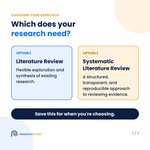
Literature review vs. systematic literature review (SLR): what's the difference?

Neither is "better." It depends on what your research needs.
ResearchCollab helps you organize and connect the literature in one place: link.researchcollab.ai/Oct
Which are you working on right now: a literature review or an SLR?
#LiteratureReview #AcademicResearch #PhDLife

Thorough ≠ systematic.
Reading 100 papers doesn't automatically make a review systematic.
What does is the method you use to find, select, and synthesize the evidence.

A quick test:
Could another researcher follow your process? Would they know:
✓ Where you searched
✓ What you searched for
✓ What you included and excluded
✓ Why you made those decisions
If yes, you're moving toward a systematic approach.

The key difference:
In a literature review, the researcher uses judgement to decide what to search for, what to include, and how to organize the literature.
In an SLR, those decisions are defined in advance, documented, and transparent.
A systematic literature review (SLR) follows a structured, reproducible process:
1. Define the question
2. Develop a search strategy
3. Set inclusion/exclusion criteria
4. Screen studies
5. Extract data
6. Synthesize evidence

A literature review is flexible and shaped by your purpose:
1. Find relevant research
2. Read and evaluate it
3. Identify themes and gaps
4. Synthesize the literature

Both examine existing research.
But the process behind them is different.
Let's start with the traditional literature review.
The path:
Summary → Comparison → Synthesis → Gap
Synthesis is where a list of papers becomes an argument.
Synthesis asks:
→ Where do studies agree?
→ Where do they contradict each other?
→ What patterns emerge?
→ Which methods were used?
→ What's still unclear?
→ Where does your research fit?
A summary says:
Paper A found X.
Paper B found Y.
Paper C found Z.
That shows you've read the literature. It doesn't show what the literature means.
A literature review isn’t a list of paper summaries.
The real work is connecting the literature:
→ What agrees?
→ What contradicts?
→ What patterns emerge?
→ What’s missing?
Summary → Comparison → Synthesis → Gap
link.researchcollab.ai/Oct
#LiteratureReview #Academic #PhD

A literature review isn’t just about getting a draft. It’s about understanding the research, finding the right sources, and building a strong foundation.
ResearchCollab’s Research Agent helps you work through that process, not just generate text.
PhD Students – You shouldn’t use ChatGPT for writing literature reviews.
It gives you the review, without knowing the process.
Instead use the following for literature reviews.
1. Go to link.researchcollab.ai/rcfa
2. From the left menu, click on Research Agent
3. Enter the topic of your literature review.
4. Adjust the following filters
- Written as
- Written for
- How far it goes
- Length
5. @ResearchCollab_ will give you the following.
- Topic summary
- Outline
- Draft
6. Download the draft.
Why it’s 10x better than ChatGPT?
- You have control over the process
- The draft contains verified references
- You can treat the draft as the starting point
Try ResearchCollab today for FREE:
link.researchcollab.ai/rcfa
ResearchCollab retweeted

PhD Students – You shouldn’t use ChatGPT for writing literature reviews.
It gives you the review, without knowing the process.
Instead use the following for literature reviews.
1. Go to link.researchcollab.ai/rcfa
2. From the left menu, click on Research Agent
3. Enter the topic of your literature review.
4. Adjust the following filters
- Written as
- Written for
- How far it goes
- Length
5. @ResearchCollab_ will give you the following.
- Topic summary
- Outline
- Draft
6. Download the draft.
Why it’s 10x better than ChatGPT?
- You have control over the process
- The draft contains verified references
- You can treat the draft as the starting point
Try ResearchCollab today for FREE:
link.researchcollab.ai/rcfa
Search is dead. Discovery is what matters.
ResearchCollab’s Topic Map helps you go from a research question to an interactive map of papers, sub-topics, connections, and gaps.
Explore smarter. Find what keyword searches miss.
Try it: link.researchcollab.ai/


Search is dead. Discovery is what matters.
@ResearchCollab_'s Topic Map completely changed how I explore a topic.
Instead of typing keywords and hoping for the best:
→ Start with a question
"How does climate change affect coral reefs?" Type it. Get an interactive mind map of papers, sub-topics, and gaps worth chasing.
→ See connections
Understand how topics relate. Discover related research you would've missed with a simple keyword search.
→ Move faster
From "I don't know where to start" to a structured understanding in minutes. Not weeks.
Backed by 460M papers. Used at Stanford, Oxford, and King's College London.
Try it free: link.researchcollab.ai/ANJ03
Literature review vs systematic review:
Could someone follow your written method and find the same studies?
Yes → systematic review.
Depends on your judgement → literature review.
Thorough searching ≠ reproducible searching.
link.researchcollab.ai/lit
#LiteratureReview
