

Those nights weren’t special then. CRT glow. Mix CDs. Classroom TV carts. SNES on the carpet. VHS tapes. Now you’d give anything for one more. 80s–00s vault.
Joined September 2018
- Tweets82.4K
- Following7.8K
- Followers28.8K
- Likes135K





Every year, a giant new phone book would show up at the front door.
The old one usually ended up in a kitchen drawer or under the telephone, even though nobody really needed two.
And if you wanted to find a restaurant, a repair shop, or someone's phone number, you actually had to flip through those pages.
There was always that one page somebody had folded over because they kept looking up the same number.

Halloween at school had its own kind of excitement.
You showed up already thinking about the costume parade, the class party, and whatever candy or cupcakes might be waiting later.
Some costumes were homemade, some came from a plastic bag at the store, and a few kids were already uncomfortable by lunchtime.
But for one day, school felt completely different.

You’d keep checking the window because your friend was supposed to be coming over.
Every car that slowed down made you look.
Then finally, there they were.
And suddenly the whole afternoon had somewhere to go.
There was a time when getting your favorite song meant sitting next to the radio with a blank cassette ready.
You'd wait forever for the song to come on, then scramble to hit record before you missed too much of it.
Sometimes you'd miss the beginning. Other times the DJ would start talking before the song was even over.
You kept it anyway.
Eventually you'd have a whole tape filled with songs you recorded, complete with all those little imperfections.


Remember when the whole family shared one computer, and the desk around it was always covered in stuff?
Stacks of burned CDs, printed emails, school papers, random cables, and a digital camera that someone needed to upload pictures from.
And somehow, everyone in the house had their own files scattered across that computer.
You'd spend 20 minutes digging through My Documents trying to find something you knew you saved somewhere.
That one computer really was the center of everything.


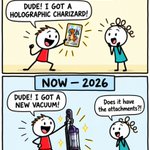
Thought I’d try my hand at making a Then vs. Now comic! Just a fun little take on how things have changed over time. Hope you guys like it!

I've been kicking around an idea for a new series on this page, making little Then vs. Now comics about how much everyday life has changed over the years. This is my first attempt at it, and I'm hoping to have some fun with the series as it develops. Hope you guys enjoy these as much as I will enjoy making them.
Red Alert 2 came out 26 years ago today.
"Kirov reporting."
If you played this back in 2000, you probably just heard that in your head.
Building massive bases, sending tanks across the map, and spending entire evenings playing skirmishes against the AI.
And those ridiculous live-action cutscenes were part of the charm.
Westwood really knew how to make a great RTS.

You'd be getting ready to leave a friend's birthday party when their mom would stop you at the door.
"Don't forget your goodie bag!"
Inside was usually a handful of candy, a plastic toy that barely worked, some stickers, and maybe one of those tiny bottles of bubbles.
You'd climb into the backseat and immediately dump everything into your lap to see what you got.
Your parents would tell you to save the candy for later, which you probably ignored.
It wasn't anything expensive, but getting that little bag somehow made an already great birthday party even better.
Halloween in the 90s was serious business.
You'd come home from school, eat dinner as fast as possible, and spend the next hour watching the clock until it was time to go trick-or-treating.
Plastic masks with tiny eyeholes, costumes thrown together at the last minute, pillowcases for candy, and that one house everyone knew gave out full-size candy bars.
Then came the best part: dumping everything onto the living room floor, sorting your candy, and making trades with your siblings.
Some Halloween traditions never get old.

Remember when you could leave the house in the morning, disappear with your friends for hours, and nobody worried as long as you made it home before the streetlights came on?
Back then, you rode your bike to see if your friends were home. You waited all week for your favorite show. You wandered around stores just to see what was new.
Today, everything is faster, easier, and right at our fingertips. And while that's a good thing, sometimes I wonder if we've lost a little of the magic along the way.
We didn't have everything back then, but somehow, the little things felt like everything.
If you grew up in the 90s, you probably remember Pepsi Stuff.
You collected points from Pepsi products and saved them up for T-shirts, jackets, hats, and other prizes. It was one of those promotions that seemed to be everywhere.
But in 1996, a Pepsi commercial made an offer that turned into a real-life legal battle.
The commercial showed a teenager arriving at school in a Harrier fighter jet, with the words "7,000,000 Pepsi Points" appearing on the screen.
Pepsi intended it as a joke.
But a 21-year-old named John Leonard decided to see if he could actually claim the jet.
He discovered something interesting in the promotion's rules. Instead of collecting millions of points by drinking Pepsi, customers could purchase additional points for just 10 cents each.
Leonard did the math and realized he could potentially get a military aircraft worth millions for around $700,000.
With financial backing, he gathered the money and submitted an official order form, 15 original Pepsi Points, and a check for $700,008.50.
He even wrote "1 Harrier Jet" on the order form.
Pepsi rejected the request, explaining that the jet was never a real prize.
Leonard sued.
In 1999, a federal judge ruled in Pepsi's favor, concluding that no reasonable person would have believed the commercial was a serious offer. The decision was upheld on appeal in 2000.
What started as a ridiculous moment in a 90s soda commercial became an actual federal court case.
And the whole thing happened because someone looked at a commercial offering a fighter jet, read the promotion's rules, and decided to take Pepsi up on it.

If you grew up in the 80s or 90s, you probably remember dropping off a roll of film and waiting to see how your pictures turned out.
You had no idea if someone's eyes were closed, whether the flash worked, or if half the pictures were blurry. You just hoped for the best.
Kodak was a huge part of those memories.
But there's a fascinating story behind the company that many people don't know.
In 1975, a Kodak engineer named Steven Sasson built the world's first self-contained digital camera.
It weighed about eight pounds, recorded black-and-white images onto a cassette tape, and took roughly 23 seconds to save a single photograph.
Kodak had helped invent the technology that would eventually change photography forever.
The company continued developing digital technology and eventually sold digital cameras of its own. But its business was heavily dependent on traditional film, and the transition to digital photography proved incredibly difficult.
In January 2012, Kodak filed for bankruptcy protection. It later emerged as a smaller company focused primarily on commercial printing and imaging.
What's remarkable is that Kodak helped create the technology that would transform the industry it once dominated.
And for those of us who grew up with film cameras, there was an entire experience that came with taking pictures.
Finishing a roll, dropping it off at the store, and finally opening that envelope of freshly developed photographs.
Some of those pictures are probably still sitting in a drawer or photo album somewhere, decades later.

Every family seemed to have one person who fell asleep in front of the TV and immediately woke up the second you tried changing the channel.
"I was watching that."
Some things never needed an explanation.

In 1990, more than 50,000 calls a week were coming into Nintendo from people who couldn't beat their video games.
And on the other end of those calls were actual people whose job was to help them.
They were called Nintendo Game Play Counselors.
Before YouTube walkthroughs, gaming websites, and online guides, getting stuck in a game could mean days or even weeks of frustration.
Nintendo had an entire team of people who were paid to play games, learn their secrets, and help frustrated players over the phone.
These weren't just people reading instructions from a script. They had consoles at their desks, computer databases, and thick green binders filled with handwritten notes and hand-drawn maps.
Some callers just needed a hint. Others needed someone to walk them through an entire section of a game.
Imagine being a kid in 1990, stuck somewhere in Zelda or Metroid, and convincing your parents to let you call Nintendo for help.
Somewhere in an office in Washington, there was an actual person who knew exactly how to get you past that part.
And there's a pretty good chance they had drawn the map themselves.

There was an actual strategy to circling things in the Christmas toy catalogs.
You couldn't circle everything. You had to make sure the really important stuff stood out.
Some of us were negotiating holiday budgets before we even knew what a budget was.