

Fulltime web3. Researcher & Moderator My profile: https://teapawt.org/t.co/Ta5eeBm8f1 Regional Helper at @RialoHQ Regional Mod at @utexocom Contributor at @SeismicSys
Đà Nẵng
Joined July 2016
- Tweets16.7K
- Following7K
- Followers7K
- Likes20.7K





Quantum computing won't replace classical computing overnight. The future is likely hybrid
NVIDIA's work with IBM and Fermilab reinforces an important point: GPUs and quantum processors can evolve together
This is what makes @QMSNetwork PoUW approach interesting to me as a builder
Classical solvers can handle optimization problems today, while the architecture leaves room for quantum hardware to compete as it matures
The real innovation isn't choosing between classical and quantum computing. It's building a network where both can contribute useful computation
#QMS #PoUW

Some of this week's biggest quantum computing news was actually about GPUs.
NVIDIA unveiled a faster decoder for quantum error-correction research and announced plans with IBM and Fermilab to pair quantum processors with GPU supercomputers.
It's a reminder that quantum computing is advancing alongside classical computing, not replacing it overnight.
QMS takes a similar approach to mining. Proof of Useful Work starts with classical solvers, but is designed so quantum miners can join as the hardware improves, without changing the consensus rules.

2
74
This is the kind of UX web3 need
Simpler onboarding without giving up selfcustody. Users shouldn't have to deal with seed phrases just to get started
Less friction. More control. That's what makes Fiber interesting

It's 2026. Skip the seed phrase hassle.
Fiber lets you sign in with email or phone number, without the seed phrase setup.
You can still export your private key if you want.
Easy to use. Still non-custodial.
1
2
79
Rialo Members of the Week, Another Round of Community Recognition
A strong ecosystem is built by people who consistently show up, contribute, and help others move forward
This week's spotlight celebrates members who stood out through their engagement, community support, onboarding efforts, and meaningful contributions across Rialo's global and regional channels
Big congratulations to everyone featured! You’re helping make this community stronger every week
And remember, the next spotlight could feature your name
Keep contributing. Keep connecting. Keep building
gRialo
@RialoHQ
#Rialo #RialoCommunity

3
1
121
What surprised me most was collateral allocation
As someone building a lending dApp on @QMSNetwork I find this particularly interesting
Optimizing where collateral sits across venues could reduce idle capital and improve capital efficiency
PoUW isn't just about mining. It could eventually help DeFi protocols make smarter decisions
#QMS1102
60
When Smart Money Gets FOMO: rasmr’s $44.8K MAX Loss
Let's investigate below together 👇
1⃣Can smart money get FOMO too?
I investigated @rasmr_eth, a trader with over 152K followers and roughly $320K in 90 day PnL, using @SurfAIHQ
One Solana token caught my attention: $MAX
According to Surf's position records, he deployed $95,000 and lost approximately $44,800 on launch day
Here's what I found
2⃣First, the trader's track record
Surf's latest research snapshot shows:
• 90 day PnL: +$320K
• Trading volume: ~$10M
• Win rate: 41.5%
• 548 scored positions
• Trading score: 45
Profitable overall, but not every position was successful
And $MAX was a particularly expensive example
3⃣The $MAX trade breakdown
Two position records, both opened and closed on November 11, 2026:
🟢 $20,000 deployed → +$3,200 (+16.1%)
🔴 $75,000 deployed → −$48,000 (−63.6%)
Total capital deployed: $95,000
Combined realized PnL: −$44,800 (~−47.2%)
One profitable position couldn't offset the much larger losing position
4⃣What makes this interesting?
$MAX experienced extreme volatility immediately after launch
rasmr closed both positions on launch day, avoiding continued exposure to the subsequent multiday decline
But the larger position accounted for most of the capital and produced a severe loss
The lesson isn't simply about being early or late
Position sizing can matter more than being right on one trade
5⃣I also compared this with another early $MAX buyer
Wallet DpBUrt6H… bought approximately 198,966 $MAX at launch and exited three seconds later
Result: −10.6%
Both traders lost money, but their capital exposure was dramatically different
A small percentage loss on a tiny position and a large loss on $95K are very different outcomes
6⃣Another surprising detail
Surf's historical records show rasmr's is_smart flag changing from True to False on November 14
His composite rank also declined from 339 to 724 between November 10 and 16
That doesn't prove $MAX caused the change
But it illustrates why a smart money label should never replace analysis of actual positions
7⃣Important research limitation
Surf provides rasmr's $MAX position level results, but not the underlying Solana transaction signatures, exact token quantities or intraday execution timestamps
So the ~$44.8K loss is platform reported realized PnL, not independently reconstructed onchain PnL
I won't invent entries or exits the data cannot establish
▶️My takeaway
Following smart money shouldn't mean blindly copying every trade
Even profitable traders experience large losses
What matters is understanding their position sizes, realized outcomes, risk exposure and the limits of the available data
Follow the evidence, not just the wallet label
Research conducted with @SurfAIHQ
#Surf #SmartMoney #OnChainResearch


2
2
129
340,000+ optimization problems. One block roughly every 12 seconds
What interests me as a builder on QMS isn't just the numbers, but the architecture behind them
Each block records a problem and its winning solution, making the computation inspectable
The real challenge comes next: moving from randomly generated test problems to client funded workloads while preserving security and predictable network performance
That's where Proof of Useful Work could prove its real value
#QMS #PoUW
More than 340,000 optimization problems have been used to produce blocks on QMS Testnet, roughly one every 12 seconds.
For now, these are randomly generated test problems. Each block records the problem and winning solution for anyone to inspect.
We're testing the foundation for a bigger goal: a blockchain where the computing power used to secure the network can also solve problems people need answers to.

1
2
80
This is exactly the kind of abstraction I've been exploring with Fiber
Moving USDC between Base and Arbitrum shouldn't require users to understand bridges, gas tokens, or complex routing
The interesting part isn't just simplifying transfers
It's making blockchain infrastructure less visible while keeping users in control
Same money. Different chains. One simpler experience
Received USDC on Base.
Your friend wants USDC on Arbitrum.
Same USDC. Different chain.
Somehow, it takes 10 minutes just to send money.
On Fiber, we handle all the bridging and gas.
You just click send.
2
5
79
Smart Money Forensics: Is Chopper Really Profitable?
I spent 6 research rounds using @SurfAIHQ to investigate @chopper_trades, analyzing 2,280+ trading records across ~800 tokens
Here's what the data revealed
1️⃣ Big winners, bigger questions
Surf's ledger reported:
• JEANPHIL: $1.7K entry → +$60K realized PnL
• MANY: $990 entry → +$45K
• NINJACAT: $1.8K entry → +$23K
But the losses were significant:
• SWOLE: −$12K
• HUHCAT: −$11K
• RIDE: −$9.2K
• STAMP: −$7.5K
Historical prices support several outcomes, but individual fills remain unverified
2️⃣ Position sizing changed everything
Equal weighted returns: +18%
Capital weighted returns: −0.25%
The largest position size decile generated approximately −$49.6K, suggesting capital allocation may have undermined profitable picks
Larger positions also correlated with later entries (ρ = +0.67), although causation remains unproven
3️⃣ Exit discipline matters
STAMP reached an estimated 6.8x before closing near −83%
A hypothetical 50% take-profit at 2x improved 85% of positions in a 20-token sample, but execution assumptions limit the result
4️⃣ The PnL discrepancy
Chopper's profile showed approximately +$44K, while 13 preceding weekly buckets summed to −$712
The difference was concentrated in a newly dated bucket, raising questions about aggregation
CLAUS also taught an important lesson: +$18.4K in Smart Money Inflow represented capital deployed, not profit
My conclusion: A few exceptional winners don't establish a repeatable trading edge
Without verified wallet attribution and transaction level fills, the evidence remains incomplete
Smart Money research isn't about copying trades. It's about verifying the numbers behind them
@SurfAIHQ
#SurfAI #SmartMoney


Smart Money Research #01: How Does Chopper Actually Make Money?
I used @SurfAIHQ to investigate @chopper_trades, looking beyond his 70.9 Trading Score and reported +$47K 90-day PnL
asksurf.ai/hub/kol/chopper_t…
Surf analyzed 2,284 trading records across 804 tokens, revealing an interesting pattern
1️⃣ Early entries, different outcomes
Chopper appears to favor newly launched tokens
Two standout examples:
• JEANPHIL: $1.7K entry → +$60K reported realized PnL
• NINJACAT: $1.8K entry → +$23K
Both were entered at relatively low implied market caps, around $89K–$102K
But early entry alone wasn't enough
HUHCAT and STAMP were entered at much higher estimated valuations and eventually produced significant losses
2️⃣ Entry timing wasn't his biggest weakness. Exits were
Surf's historical price analysis found:
• STAMP reached 6.8x after entry, yet the position closed at roughly −83%
• HUHCAT reached 2.9x, but eventually closed around −97%.
These are historical price peaks, not confirmed executable exit opportunities
Still, the contrast raises an important question about profit taking discipline
3️⃣ Position sizing tells another story
His biggest winners often came from relatively small positions, while several larger positions produced substantial losses
The five largest winning trades accounted for approximately 64% of gross profits
That suggests his performance was highly concentrated rather than evenly distributed across trades
My takeaway:
Chopper's trading history suggests an ability to identify some early momentum opportunities, but identifying a winner and converting it into consistent realized profits are two different skills
One limitation matters: Surf's dataset is daily aggregated, so exact fills, order sequencing, and execution prices couldn't be verified
That's why I find this kind of research valuable
Smart Money isn't just about who bought early. It's about entry valuation, position sizing, exit execution, and how much profit actually survives
Research conducted with Surf
#SurfAI #SmartMoney


7
9
165
Introducing QMS Lending V2, a DeFi lending & borrowing protocol I've been building on @QMSNetwork
My goal is simple: turn the QMS Testnet into a place where users can experience real DeFi interactions, not just send transactions
After weeks of building, testing, and improving the protocol, QMS Lending V2 is now publicly available for testing
What's live?
✅ Supply & withdraw assets
✅ Deposit & manage collateral
✅ Borrow & repay tokens
✅ Health Factor & borrowing risk monitoring
✅ Multi-asset markets: USDT, USDC, WBTC, WETH & WQMS
✅ Real time on chain protocol statistics
✅ User analytics & growth charts (7D/30D/90D)
✅ Wallet integration & personal position dashboard
What's next?
🔹 Better lending analytics and historical data
🔹 Improved UX and risk visualization
🔹 Exploring prediction market integrations
🔹 More community driven features based on feedback
This is an experimental testnet application using fixed demo prices, not live market prices
I'm building, learning, and improving one step at a time
🔗 Try: qms-lending.vercel.app/
Feedback from the QMS community is always welcome 💜
#QMS #DeFi #BuildOnQMS

3
4
153
Rialo Community Members of the Week
Another week, another group of outstanding contributors recognized by @RialoHQ
What I appreciate most is seeing members from different regions earning recognition through consistency, helping newcomers, and meaningful community engagement
Rialo is growing through the people who show up and contribute every day
Keep building, keep contributing. Your name could be next🚀
#Rialo #RialoCommunity

5
4
134
waiting...... @inkonchain 👀

completely get hear you and understand where you're coming from
as much as i do genuinely enjoy having fun on the timeline with typos or that "wen tge" pasta-like post i made on tg, i know there's a group of users that are not just genuinely curious about "wen tge" but realistically want to know what their historical onchain activity translates to in that regard
i'm not usually the type to hold back announcements or news. i like the "build in public" approach and i love sharing good things, and getting ahead of bad things whenever applicable by communicating any relevant news
teh alchemist said it in a post like almost two weeks ago - clarity and info around everything you've all been waiting for will come here in q4. tokenomics, timelines, dates, plans/roadmaps, the works.
this isn't engagement to generate hype or hopium. this is genuinely letting the community know that you will get answers here in q4. and i for one am excited af to share them.
1
2
104
Smart Money Research #01: How Does Chopper Actually Make Money?
I used @SurfAIHQ to investigate @chopper_trades, looking beyond his 70.9 Trading Score and reported +$47K 90-day PnL
asksurf.ai/hub/kol/chopper_t…
Surf analyzed 2,284 trading records across 804 tokens, revealing an interesting pattern
1️⃣ Early entries, different outcomes
Chopper appears to favor newly launched tokens
Two standout examples:
• JEANPHIL: $1.7K entry → +$60K reported realized PnL
• NINJACAT: $1.8K entry → +$23K
Both were entered at relatively low implied market caps, around $89K–$102K
But early entry alone wasn't enough
HUHCAT and STAMP were entered at much higher estimated valuations and eventually produced significant losses
2️⃣ Entry timing wasn't his biggest weakness. Exits were
Surf's historical price analysis found:
• STAMP reached 6.8x after entry, yet the position closed at roughly −83%
• HUHCAT reached 2.9x, but eventually closed around −97%.
These are historical price peaks, not confirmed executable exit opportunities
Still, the contrast raises an important question about profit taking discipline
3️⃣ Position sizing tells another story
His biggest winners often came from relatively small positions, while several larger positions produced substantial losses
The five largest winning trades accounted for approximately 64% of gross profits
That suggests his performance was highly concentrated rather than evenly distributed across trades
My takeaway:
Chopper's trading history suggests an ability to identify some early momentum opportunities, but identifying a winner and converting it into consistent realized profits are two different skills
One limitation matters: Surf's dataset is daily aggregated, so exact fills, order sequencing, and execution prices couldn't be verified
That's why I find this kind of research valuable
Smart Money isn't just about who bought early. It's about entry valuation, position sizing, exit execution, and how much profit actually survives
Research conducted with Surf
#SurfAI #SmartMoney
Day 9 (Exploring Fiber): Where Does Stablecoin Interest Actually Come From?
After exploring Fiber's trading experience, I wanted to understand another part of the product:
What actually happens when your stablecoin balance starts earning interest?
In DeFi, we often see APY displayed as a simple percentage
But I think the more important question is rarely asked:
Who is paying that interest, and what risks are involved?
According to Fiber's documentation, eligible stablecoin balances are routed into lending vaults on Morpho and Aave
The mechanism is relatively straightforward
Borrowers pay interest to access liquidity. Part of that interest flows back to liquidity providers, after protocol and platform fees
Fiber handles the underlying routing and vault interactions, while users see their eligible USD balance and estimated earnings inside one interface
What caught my attention is how Fiber combines this with its privacy architecture
The vault positions are represented by shares that can be shielded inside a private 0zk wallet
So the underlying lending activity remains onchain, but the goal is to prevent an individual's complete financial history from being easily linked to those positions
That's an interesting combination: DeFi lending infrastructure underneath, a simpler financial interface on top
But there's another detail worth understanding
Fiber keeps 25% of the interest generated, and the rates displayed in the app are already net of that fee
More importantly, these rates are variable, not guaranteed
Smart contract vulnerabilities, borrower defaults, liquidity constraints, and stablecoin depegging remain possible risks
And that's where I think financial UX becomes especially important
Making interest easy to access is one thing
Making the source of that interest, its costs, and its risks understandable is another
One final distinction from my own experience:
The $25 promotional bonus I previously received after depositing $100 was a separate incentive, not interest generated by lending activity
I think keeping those two concepts separate matters
For me, Day 9 isn't about chasing the highest APY
It's about understanding what happens behind the balance displayed on the screen
Day 9 complete
Next, I'll explore Fiber Assistant and whether AI can make financial tools easier to understand without compromising user control
Still exploring. Still taking notes. 👀
@fiber_evm

1
4
115
Ethereum's leanVM milestone is the clearest sign yet that post quantum security has moved from a research question to an engineering schedule
The problem is arithmetic, not ideology. leanXMSS signatures are ~3,000 bytes against 96 for BLS roughly 30× the data per slot. leanVM's answer is compression: fold many signature checks into one compact proof, verified end to end on Nov 3, with the EF targeting a full transition by Dec 2028
QMS starts one layer earlier. Block production here never needs a signature at all: proof of useful work awards blocks through work and hashing, and post-quantum signatures live in a separate finality layer so PQ overhead lands on finality latency, not block time.
Same challenge. Different layer to solve it at
Ethereum is proving the aggregation path works at scale. QMS is building a base layer that doesn't have to wait for it. Both directions make the post-quantum transition cheaper and that's the outcome that matters
Last week, Ethereum shared a major milestone for leanVM, a system being developed to make post-quantum signatures practical at scale.
Here’s the problem they’re working on: Post-quantum signatures are roughly 30 times larger than the signatures Ethereum validators use today. Simply replacing them would add a lot more data to the network.
Ethereum's solution is to bundle many signature checks into compact proofs.
At QMS, we're approaching this differently. Our Proof of Useful Work design doesn't require signatures to produce blocks. Post-quantum signatures are handled by a separate finality layer, so they won't slow down block production.
Both approaches address the same challenge, but from different starting points.
It's interesting to see how Ethereum is tackling a problem we've been thinking about since QMS was designed.
1
106
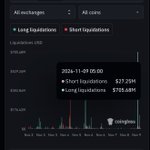
$1 Billion Liquidated in 10 Minutes? I Used Surf AI to Investigate What Really Happened?
Earlier, I came across a post from @WatcherGuru claiming that $1B had been liquidated from the crypto market in just 10 minutes
Instead of simply accepting the headline, I decided to investigate it using @SurfAIHQ
I asked Surf to examine liquidation data, derivatives activity, funding rates, market liquidity, and possible catalysts behind the selloff
Here's what stood out to me:
1️⃣ The headline didn't fully match the data
Surf's initial research questioned the $1B figure. After a second verification, it estimated approximately $580–700M in liquidations within the 10 minute window
That's still a massive event, but the difference matters when evaluating market conditions
2️⃣ The liquidation mechanism was more interesting than the number
Surf identified a synchronized, derivatives led liquidation cascade across major assets
Perpetual futures trading volume reached roughly 11–13x spot volume for BTC, ETH, and SOL during the event
This suggests that derivatives played a major role in amplifying the price movement
3️⃣ The cause wasn't as obvious as the headlines suggested
Funding rates were relatively neutral before the crash, but that doesn't necessarily mean leverage was low
Without reliable historical open interest data, it's difficult to determine how crowded leveraged positions actually were
And this is where Surf's follow up analysis impressed me most
When I asked it to critically review its own findings, it corrected several assumptions, downgraded unsupported conclusions, and acknowledged that the exact catalyst remained unproven
My takeaway:
A liquidation headline tells us what happened, but understanding the market requires examining how it happened, what the data supports, and what remains uncertain
That's the value I found in this Surf research experience
AI research shouldn't replace critical thinking. It should help us ask better questions
More research with Surf coming soon
#SurfAI


6
7
258
What if compliance wasn't an external checkpoint, but part of the blockchain itself?
One of the biggest challenges in onchain finance is making real financial products work under real-world rules
Today, compliance often depends on external services, issuers, and third party infrastructure
@RialoHQ is exploring a different approach
Its latest interactive demo on Rialo Learn shows how compliant stablecoin transfers could work with:
🔹Native Compliance: Policies are evaluated during transaction execution
🔹REX: Sensitive information can be processed privately while keeping outcomes verifiable
🔹Native Web2 Connectivity: The blockchain can consult external compliance data when needed
🔹Reactive Transactions: Recurring payments automatically recheck compliance before every execution
Here's an interesting scenario:
A recurring stablecoin payment works perfectly at first. But later, the recipient becomes restricted
Instead of blindly continuing the payments, Rialo re evaluates the policy and automatically blocks future transactions
No manual intervention. No external keeper needed to trigger the workflow
That's a meaningful shift:
Compliance doesn't just approve a transaction once. It can remain part of every execution
This is the kind of infrastructure that could make regulated onchain finance more practical
Explore the interactive demo:
learn.rialo.io/demos/stablec…
#Rialo

4
5
104
Surf Mystery Box is restocking soon @SurfAIHQ
Over $1.5M in tokenized stocks have already been opened through Mystery Boxes
Last week, a $15,000 box containing $AMZN was claimed onchain just 5 minutes after the drop went live👀
Another drop is coming, and I'm curious to see what surprises await this time
🗓️ Nov 6, 2 AM UTC
Explore here 👇
asksurf.ai/mystery-box
#SurfAI #MysteryBox

3
3
130
My first deep research experience with @SurfAIHQ
Today, I spent some time exploring the Deep Research capabilities of SurfAI, and I was genuinely impressed by how detailed and well structured the results were
I asked Surf to compare Ethereum and Solana based on real ecosystem adoption over the past 90 days
Instead of giving me a simple comparison, Surf generated a comprehensive analysis covering:
🔹TVL and capital distribution
🔹DEX trading volume and liquidity
🔹Stablecoin supply and activity
🔹Network fees and economic activity
🔹Data reliability, methodology, and potential risks
What impressed me most was the follow up analysis
When I asked Surf to critically review its own findings, it identified potential double counting, questioned misleading metrics, explained where conclusions were uncertain, and highlighted what additional data would be needed
That made the research feel much more transparent and professional
Of course, AI generated research still needs independent verification, but having this level of structured analysis in one place is genuinely useful
My takeaway: Surf isn't just giving me answers. It's helping me explore complex topics from multiple perspectives and understand the limitations behind the numbers
This is only the beginning of my journey with Surf AI
I'll continue exploring its other features, testing different research scenarios, and sharing my experiences with the community
More discoveries ahead 👀
🔗 asksurf.ai/
#SurfAI #DeepResearch

4
94
Day 8 (Exploring Fiber): The Trading Experience
After exploring Fiber's multi-chain experience, I wanted to look at another important part of the product:
How simple can onchain trading actually become?
In traditional DeFi, trading often involves several decisions before you even execute a transaction
•Which DEX should I use?
•Where is the best liquidity?
•Do I need to bridge assets?
•How much will I lose to fees and slippage?
For experienced users, these steps are familiar
But for someone who simply wants to manage different financial assets, they create unnecessary friction
This is where Fiber's trading design gets interesting
According to its documentation, Fiber brings supported crypto assets, tokenized stocks, and digital metals into a single trading interface
Instead of manually navigating different venues, users can review a quote while Fiber searches for a suitable execution route behind the scenes
One detail caught my attention:
Fiber's default trading flow includes price protection
Its documentation describes a default 2% slippage limit, with additional settings available on the web interface
But I think simplicity alone isn't enough
A good trading experience should also make it easy to understand:
• What asset you're buying or selling
• What you'll actually receive
• What costs are included in the quote
• What risks remain before confirmation
Because hiding unnecessary complexity is useful
Hiding execution costs or important risks isn't
Another important consideration is that tokenized stocks are not necessarily equivalent to directly owning shares through a traditional brokerage. Their rights, liquidity, and issuer risks can differ
For me, the interesting question isn't whether Fiber can make trading look simple
It's whether that simplicity can coexist with transparency, user control, and a clear understanding of the assets involved
That's what I'll be paying attention to as I continue exploring the trading experience
Day 8 complete
Next, I'll take a closer look at Fiber's stablecoin rewards and where those rewards actually come from.
Still exploring. Still taking notes👀
This is just personal experience, not investment advice
@fiber_evm

1
3
106