

(1931-1993) Lowell Observatory astronomer, author of Burnham's Celestial Handbook. Tweeting with permission of the Burnham estate. https://teapawt.org/t.co/y7GBqXmBFR
At the eyepiece
Joined October 2018
- Tweets6.3K
- Following12
- Followers478
- Likes77


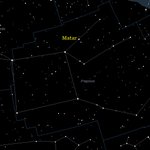


85 Pegasi: The great peculiarity of the system is that the two masses are nearly equal, as shown by the observed orbit, and the fainter star thus violates the mass-luminosity relation to an unusual degree.
85 Pegasi: This is one of the best studied and most interesting of the binary systems, always a frustratingly difficult object because of the closeness of the pair and the brightness difference of at least three magnitudes.

37 Pegasi: A rather close binary system with a period of about 150 years, and a much elongated comet-like orbit which is inclined at only about 2° from edge-on position. The true dimensions are fairly comparable to the size of the Solar System, mean separation is close to 40 AU.

Kappa Pegasi: A very close binary in rapid motion, discovered by S.W.Burnham in August 1880. T.Lewis, at the Royal Observatory at Greenwich, in 1894 called attention to the fact that the star was the most rapid binary then known.

Eta Pegasi: MATAR, from the Arabic Al Sa'd al Matar, 'The Fortunate Rain.' Eta Pegasi is some 360 light years distant; the actual luminosity is about 630 times that of the Sun.


Zeta Pegasi: HOMAM, probably from the Arabic phrase Sa'd al Humam, the 'Lucky Star of the Hero,' though Thomas Hyde derived it from Al Hammam, which seems to mean 'The Whispering One.'

5. I thought there would be no end
To this storm, but between the broken clouds I see
The serene moon rising.
Epsilon Pegasi: ENIF, from Al Anf, 'The Nose.' Medieval Arabian charts sometimes label it Fum al Faras or 'The Horse's Mouth.' The star is at a computed distance of about 780 light years, giving an actual luminosity of about 5800 times that of the Sun.


One of the Beta Canis Majoris variables, Algenib has an unusually short period of 0.1517495 day, or about 3 hours and 38 minutes. Stars of this type are believed to be rather massive, young stars which are beginning to evolve away from the main sequence.
Algenib (Gamma Pegasi) is a giant star, at a computed distance of about 570 light years, and with an actual luminosity of about 1900 times that of the Sun. The annual proper motion is 0.01"; the radial velocity is 2.5 miles per second in recession.
Gamma Pegasi: ALGENIB, probably from the Arabic Al Janb, 'The Side,' though some authorities derive it from Al Janah, 'The Wing.' Magnitude 2.84, spectrum B2 IV. The star marks the southeast corner of the Great Square of Pegasus.


If Beta Pegasi should replace our sun, the star would not quite fill the Earth's orbit. The computed distance is about 210 light years, the surface temperature about 3100 degrees K, the mass about 5 solar masses, and the average density about one millionth that of the Sun.
3. Come with me if you wish,
But I have many miles to go
And a rugged road to travel,
Hovering butterfly.
Scheat was one of the first stars measured with the beam interferometer on the 100-inch reflector at Mt. Wilson; the apparent angular size was found to be 0.021". At the computed distance this corresponds to about 145 times the diameter of the Sun [Photo: bit.ly/2PqxeKM]

Scheat is an irregular red variable star, similar in behavior to Betelgeuse, but much less extreme in size and luminosity. It varies from magnitude 2.1 to about 3.0 in an irregular period.