






Pinned Tweet
We asked whether population-scale plasma proteomics could help us understand T1D disease mechanisms and discover novel biomarkers. Our findings are out now! medrxiv.org/content/10.1101/… @kjgaulton /🧵

Ruth Marise retweeted

Don’t miss @WestonElison platform talk at #ASHG! 📢 He’ll dive into how single-cell multi-omics & 3D genome architecture uncover new pathways and targets for metabolic dysfunction-associated steatohepatitis. A must-see for cutting-edge insights! 🧬 #SingleCell @AMP_CMDKP

Ruth Marise retweeted

The HIRN members recently completed a review series with @MolMetab - we welcome you to access the 8 articles in the digital collection online!
sciencedirect.com/special-is…
Ruth Marise retweeted

We are hiring in the CIHR CanScreenT1D consortium to initiate pilot screening for T1D in Canada.
We are looking for someone ontario-based who has expertise in patient engagement and integrating EDI principles into that work. Job advert below!
linkedin.com/jobs/view/40273….
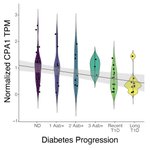
Do enzyme levels actually change preceding T1D? We used scRNAseq to look at acinar enzyme expression levels in donors at risk of developing T1D and with T1D. We found CPA1 levels are significantly altered prior to disease onset, and could act as an early T1D biomarker. 5/🧵

As always, all our code and pipelines are publicly available on Github github.com/Gaulton-Lab/T1D_p… and a friendly reminder that you can explore our scRNAseq of pancreatic islets at isletgenomics.org 6/6

2
93
Ruth Marise retweeted

What do we know of the genetics of beta cell loss in T1D? Thrilled to partner with @kjgaulton & @theparkerlab on this very question in @MolMetab.
Truly a team effort led by @ccrobertson01, @RuthElgamal, #BelleHenry, and supported by @HIRN_CC!
authors.elsevier.com/sd/arti…

Ruth Marise retweeted
🚨We're looking for a new post-doc to join us on the North Coast leading a multidisciplinary project focused on diabetes and disordered proteins. E-mail or DM if interested!
Please share/RT broadly - thank you! #postdoc #fellowship

Ruth Marise retweeted

Our new study by @Fahdqadir and with @kjgaulton highlights major sex differences in human islet cell gene accessibility and expression and reveals female mitochondrial dysfunction in the transition to T2D. biorxiv.org/content/10.1101/…

Ruth Marise retweeted

Often, being an immigrant is to support family back home, save money & vacation time with an hope to visit them, work hard to be good at your job so that you keep your visa, & despite all your achievements, feel guilty that you're not physically present for your family back home.
Ruth Marise retweeted

The Addala Lab at Stanford University School of Medicine is dedicated to research aimed to address disparities in Type 1 diabetes management and outcomes. Follow along to learn more! #type1diabetes #diabetes #equity #stanfordmedicine
Excited to share that this work is out now! Thank you to the reviewers and our browser users for helping to improve our resource. Explore the data for yourself at isletgenomics.org @kjgaulton

An integrated map of #islet cell type-specific gene expression from 192,203 cells from single cell RNA-sequencing of 65 non-diabetic type 1 #diabetes autoantibody+, type 1 diabetic, and type 2 diabetic donors from the Human Pancreas Analysis Program #T1D diabetesjournals.org/diabete…

Ruth Marise retweeted

New in #PLOSBiology, @npburtt @kjgaulton &co present the type 1 #diabetes (#T1D) Knowledge Portal, an open-access resource that aims to help address the challenge of translating #genetic discoveries into mechanistic insight @AMP_CMDKP plos.io/3YrKuQt

ALT The T1DKP provides genetic and genomic data, pre-computed bioinformatics results, and expert-curated resources such as candidate gene lists to the T1D community.
Ruth Marise retweeted

Ever wondered if you could read 100s of metabolites and drugs in parallel using a @illumina or a @10X platform? But metabolites aren’t nucleic acids — how can that work? Check out our new preprint and read on for a thread:
biorxiv.org/content/10.1101/….

Ruth Marise retweeted

1/12 I’m delighted to share the pre-print describing my major post-doc project! Click here: medrxiv.org/content/10.1101/….
Ruth Marise retweeted

Full summary statistics for our UKB-PPP GWAS of 1,463 circulating proteins are now available at synapse.org/#!Synapse:syn513…
This includes full cohort (n=52,363), discovery (n=34,557), & African ancestry (n=931) analyses. More subpopulations (AMR, CSA, MID, EAS) available next week.
Ruth Marise retweeted

Our review on using single cell epigenomics data to understand disease associated variation

Interpreting non-coding disease-associated human variants using single-cell epigenomics go.nature.com/3BsYVcp #Review by @kjgaulton, @seb11pr & Bing Ren
@UCSDMedSchool @UniFreiburg @CEpigenomics @UCSanDiego @Ludwig_Cancer
