
Astroparticle Physicist / Cosmologist Lecturer at UC Irvine Associate Member of the CGWU https://teapawt.org/t.co/XxMCmVMSpi
Mariposa, CA
Joined March 2020
- Tweets105
- Following269
- Followers162
- Likes435


Pinned Tweet
Paper Day! arxiv.org/abs/2405.01620

Ryan Keeley retweeted

I wrote The Attack of the Science Populists for anyone who loves physics and wants to understand the populist attacks being leveled at it.
Read the case. Judge for yourself.
Preorder your copy: hup.harvard.edu/books/978067…
13/13


Ryan Keeley retweeted
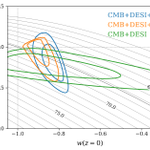
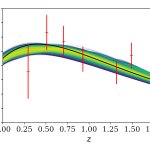
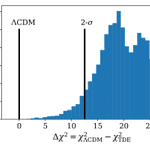
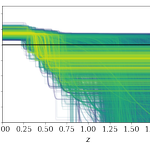
Paper Day! Here I’m testing the DESI preference for evolving DE using a different parametrization, Transitional Dark Energy. The goal of the paper is an in-depth investigation into why the DESI data prefer evolving DE over LCDM arxiv.org/abs/2502.12667
Paper Day! Here I’m testing the DESI preference for evolving DE using a different parametrization, Transitional Dark Energy. The goal of the paper is an in-depth investigation into why the DESI data prefer evolving DE over LCDM arxiv.org/abs/2502.12667
So if the DESI preference for evolving DE is robust, further evidence for it could come in the form of a modified growth history, which would show up as a flattening of fsigma8(z)

1
1
397
Ryan Keeley retweeted

Yes DS9 updates will absolutely end.
This Post is from an account that no longer exists. Learn more
Ryan Keeley retweeted

Our @NASAWebb program data is picture of the month 🤩.
Besides being beautiful, gravitational lenses let us see dark matter halos. The 9 lenses measured by @RyanEKeeley gave us one strongest warm dark matter constraints to date. Stay tuned for results from the full sample!

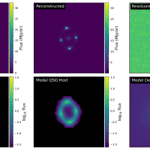
🆕 Webb brings you a jewelled ring! Our ESA/Webb Picture of the Month features the gravitational lensing of a quasar! 🔍 Read more: esawebb.org/images/potm2406a… or 🧵👇

ALT A small image of a galaxy distorted by gravitational lensing into a dim ring. At the top of the ring are three very bright spots with diffraction spikes coming off them, right next to each other: these are copies of a single quasar in the lensed galaxy, duplicated by the gravitational lens. In the centre of the ring, the elliptical galaxy doing the lensing appears as a small blue dot. The background is black and empty.
Ryan Keeley retweeted

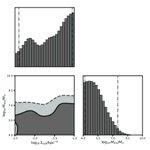
Posterior of mass down to which dark matter halos must exist in new lensing results by @RyanEKeeley @annanierenberg et al. Getting VERY interesting.
arxiv.org/abs/2405.01620

Ryan Keeley retweeted
Paper Day! arxiv.org/abs/2405.01620
We measure the flux ratios of strongly lensed quasars and look for any anomalous flux, flux that would be caused by magnification from low-mass dark matter halos.
1
1
214