

°1985. Husband&father. Finance/economics/operations in the industry. Likes tennis, aviation, travel, psychology, and out of the box politics. Tweets in own name
Joined January 2022
- Tweets2.2K
- Following116
- Followers98
- Likes4.8K





Sebastiaan Lebeer retweeted

Ik geloof stilaan oprecht dat veel mensen liever hun hele maatschappij armer maken, dan dat ze het bestaan van miljonairs moeten tolereren, — zelfs als die miljonairs die hele maatschappij collectief rijker zouden maken. ‘Irrationeel’, zou John Rawls over hen gezegd hebben. Tja…
Sebastiaan Lebeer retweeted

Het verschil tussen een ambtenarenpensioen en een zelfstandigenpensioen is een half miljoen tot meer dan een miljoen euro aan risicoloos kapitaal waard.
Maar dat zal men niet elke dag op de voorpagina zetten of in TikTok-filmpjes.
Sebastiaan Lebeer retweeted

100% of children want ice cream for dinner

Sebastiaan Lebeer retweeted

Leftists care more for the world than their family/friends because it's easier, not because they're altruistic
Caring for your immediate circle is a tangible daily task that requires effort
Caring for "the world" is an abstract virtue signal that needs zero actual output


Sebastiaan Lebeer retweeted

This is such a banger post.
Yes - the left think about problems they can't solve while neglecting everything in their vicinity.. they volunteer local decline and death in the service of grand moral abstracts.

Sebastiaan Lebeer retweeted

Het regeerakkoord van begin 2025 liet max. 1/9e van de sanering uit nieuwe inkomsten komen (een derde van een derde). Het begrotingsakkoord van einde 2025 zat al op ca. 40% nieuwe inkomsten (bron: De Tijd), de tabel van oktober dit jaar legde er nog 2 miljard bovenop.
Zoals ALTIJD waren de nieuwe inkomsten veel sneller gevonden dan de besparingen. Het is de aloude truuk van links in België: "Doe die belastingen eerst, besparingen doen we wel later in de legislatuur." Daarmee koop je dus niks.
Ook nu valt BDW 1 misschien, maar gaan we wel nog met de meerwaardebelasting zitten - onder andere.


Sebastiaan Lebeer retweeted

The answer isn’t getting the right person into power.
The answer is limiting power so that the person doesn’t matter.
Sebastiaan Lebeer retweeted

Solidariteit gebeurt tussen mensen. Opiniestukje:
tijd.be/opinie/algemeen/wie-…
Of op
wouterduyck.be/?p=4206

Sebastiaan Lebeer retweeted
Er is een pijnlijk verschil tussen interindividuele en institutionele solidariteit. Als mensen elkaar helpen in het dagelijks leven, met handelen of financieel, is er eigenlijk enkel dankbaarheid. Apprecieert men alles wat men krijgt. Niemand in geldproblemen krijgt het in zijn hoofd bij giften de gever te minachten, verwijten. Wie geeft voelt er zich goed bij, zoekt en voelt waardering. Zodra je die solidariteit gaat institutionaliseren wordt ze onzichtbaar, abstract. Verdwijnt de mens in de transactie. Wie geeft ziet plots de zieke niet meer. Mededogen verdwijnt. Wie krijgt ziet de opoffering van de gever niet. Plots wordt dankbaarheid afgunst, wil men steeds meer, wordt elke ongelijkheid een probleem. Deze abstractie is dodelijk voor het draagvlak en duurzaamheid ervan. Aan de kant van de ontvanger groeit de frustratie mét de solidariteit (en.wikipedia.org/wiki/Tocque…). Hoe socialer het systeem, hoe meer geklaagd wordt. "sterke schouders moeten bijdragen" (maar de 10% rijksten betalen al 90% van de belastingen. Wat is fair? 101%?) Aan de kant van de gever groeit de frustratie: het is nooit genoeg, en uiteindelijk verdwijnt de wil voor solidariteit zélf. Dat is waarom Vooruit nu met vuur speelt. In plaats van te pronken met het sociaal juweel dat gerealiseerd is (bij de meest sociale en gelijke landen ter wereld), dat te koesteren, en ook de dankbaarheid te uiten, roept men continu dat alles hier verschrikkelijk is, en valt men aan wie solidair is. Vooruit ondergraaft zo wat men probeert te realiseren: duurzame solidariteit. Dat is wat je nu ziet bij die boze ondernemers: die zien wel hun opoffering, niet de dankbaarheid van de individuele solidariteit. Wel de verwijten voor het verschil. Wie miljoenen in de put stort moeten we een zwembad gunnen, niet verwijten. En ervoor zorgen dat er beton op de bodem van de put ligt, in plaats van een bodemloze leegte.
Sebastiaan Lebeer retweeted

Onze overheid geeft in verhouding 80 à 120 miljard euro per jaar (!) meer uit dan de Nederlandse of de Zwitserse. De belastingdruk is bij de hoogste ter wereld. Ik denk dat het klaar als pompwater is wie er over zijn schaduw zou moeten stappen… #begroting
Sebastiaan Lebeer retweeted

Measuring the health of a society based on the gap between the richest and poorest is fundamentally wrong. It is just a convenient way for looters to create resentment, because a gap tells you nothing about whether anyone's life got better.
Run the test. If everyone's real income doubles but the top doubles faster, the gap widens and every person on earth is better off. If the richest lose half their money and nobody else gains a dollar, the gap narrows and not one poor family is helped. A measure that calls the first a failure and the second a success is tracking envy, not wellbeing.
Then look at who we are calling poor. A household below the poverty line in America typically has electricity, running hot water, central heat, a refrigerator, a stove, a microwave, air conditioning, a television, a smartphone and a car. That phone carries the accumulated knowledge of the human race and a map of the planet. A hundred years ago no king had any of it. In 1960 most middle-class families had about half.
That is what a century of production bought, and none of it came from closing a gap. It came from men building things and selling them cheaper than the year before.
The gap gets cited because it never closes and never runs out. A permanent grievance with a permanent remedy attached, which is taking more.

Sebastiaan Lebeer retweeted

Cette vidéo enterre instantanément et sans aucun retour possible la carrière de Jean-Luc Mélenchon.
Elle marque un point de non retour dans son idéologie totalitaire.
Sarah Knafo en quelques phrases démontre toute la perversité d’un homme qui s’est perdu… sans laisser place à la moindre ambiguïté.
Quiconque la verra ne pourra plus jamais y voir autre chose qu’un personnage politique déchu.
Sebastiaan Lebeer retweeted
De "sterkste schouders" is in België een stopwoord geworden om het niet te hoeven hebben over de excessieve overheidsuitgaven, en de illusie te creëren dat een deel van de bevolking steeds meer kan belast worden zonder dat zij het zullen voelen en zonder enige economische schade.
Sebastiaan Lebeer retweeted

Capitalism has a win condition. Socialism does not.
Here's why, explained so simply a 10-year-old could get it.
It starts with a book written in 1944 by an Austrian economist named Friedrich Hayek: The Road to Serfdom.

Capitalism has a win condition. Socialism does not.
Here's why, explained so simply a 10-year-old could get it. It starts with a book written in 1944 by an Austrian economist named Friedrich Hayek: The Road to Serfdom.
Imagine a classroom of 30 kids. One day the teacher says: "From now on, I decide what everyone eats for lunch, which games you play at recess, and who sits next to whom. It's fairer that way."
First problem: the teacher doesn't know what you like. You hate carrots. Your friend is allergic to peanuts. Lucas wants to play football, Emma wants to draw. 30 kids, 30 different wishes. Nobody can know all of that, not even the smartest teacher on Earth. Hayek called this the knowledge problem. The information needed to run an economy is scattered across millions of heads, and it can't be gathered in one office.
Second problem: the kids start fighting. "Why does he get the window seat?" "Why football again?" Before, everyone just chose for themselves. Now every choice is a fight, because every choice is made for everyone.
Third problem: the class can't agree on a plan, so someone says "we need one person in charge who just decides." This is Hayek's key insight. Planning doesn't fail because planners are evil. A plan needs everyone to agree on the same goals, and free people never agree on everything. So the plan needs force to work.
Fourth problem, and it's the scariest one: who wants that job? The kind kid doesn't want it, because the kind kid doesn't want to force 29 people to eat carrots. The job attracts the one who likes giving orders and doesn't mind punishing those who disobey. Hayek wrote a whole chapter on this, called "Why the Worst Get on Top." It doesn't happen by accident. It happens by selection.
Here's the trap. When the person who controls your lunch also controls your job, your home, your shop and your newspaper, they control your whole life. You can't say no, because there's nowhere else to go. Controlling the economy doesn't mean controlling one part of life. It means controlling the means to every goal you have.
That's the road to serfdom. Nobody votes for a dictator. People vote for "someone should fix this," then for "give them more power to fix it," and one day they wake up with no one left to say no to.
The USSR, Maoist China, Cambodia, North Korea, Cuba, Venezuela. These are different countries with different cultures and languages, and the story has the same ending every time. When a script produces the same ending every time, it isn't bad luck. It's the script.
Now capitalism. Back to the classroom. Instead of one teacher deciding everything, every kid can trade. You give me your carrots, I give you my apple, and we both walk away happier. Nobody needs to know what everyone wants, because prices do that job. A price is a message telling millions of strangers what's scarce and what's wanted, with no one in charge.
That's the win condition. In capitalism, you get rich by making something other people freely choose to buy, so your success depends on serving others. In a planned system, you get ahead by pleasing whoever holds power. One rewards usefulness. The other rewards obedience.
And this isn't theory. Two centuries ago, almost every human being was extremely poor. In 1990, about 38% of humanity still lived in extreme poverty. Today it's under 10%. More than a billion people escaped it in a single generation. It happened when China, India, Vietnam and South Korea opened up to markets, trade and private enterprise. The largest reduction in poverty in human history came from letting people trade.
So why do so many people hate capitalism?
Because what they hate usually isn't capitalism.
They hate the bank that got bailed out with their taxes while they lost their house. They hate the giant company that writes the regulations so no startup can compete with it. They hate rent they can't afford because building new homes has been made nearly impossible. They hate the lobbyist who gets a subsidy while the small business owner drowns in paperwork.
Look closely at each one, and you'll find a state handing out privileges. A bailout is not the market. The market would have let the bank fail. A regulation written by incumbents is not competition. It's protection from competition. None of this is capitalism. It's cronyism, which is what happens when businesses stop competing for customers and start competing for politicians.
People see the symptom and blame the wrong cause. They say "capitalism failed" and ask for more state. That gives more power to the same people who created the problem, and it puts us right back on Hayek's road.
The answer to bad capitalism isn't less freedom. It's less privilege. That means fewer bailouts, fewer protected incumbents, fewer permits, and more people allowed to build, compete and trade.
Capitalism has a win condition: make things people want. Socialism has an end condition: someone has to be in charge. And history keeps showing us who ends up in that chair.
Sebastiaan Lebeer retweeted
België en Frankrijk zijn de 2 meest herverdelende landen ter wereld, met daardoor de grootste inkomensgelijkheid maar ook de grootste overheidstekorten en tòch grote sociale onrust.
Er is niet nog méér herverdeling nodig, maar veel meer eigen verantwoordelijkheid.
Sebastiaan Lebeer retweeted
Naïeve multiculturalisten doen vaak alsof de welvaart hier uit de lucht valt. Dat migranten hetzelfde kunnen leven als in land van herkomst en toch zo rijk zijn als hier. Dat onze rijkdom geografisch toeval is. Terwijl het natuurlijk de cultuur, vrijheid, waarden, stabiliteit en onderwijs zijn die die welvaart creëren. Wie dit opgeeft, geeft ook de welvaart op. Welke ondernemer opent vandaag een Parijs winkeltje?


Sebastiaan Lebeer retweeted

Update from France. Where so-called ‘French schoolboys’ who regularly sing songs celebrating the Bataclan massacre (look it up) and sporadically jump on police cars to proclaim that ‘allah’ commands them to murder police (look it up) are currently looting shops and setting buildings on fire. Because as we all know there’s no better way to demonstrate your commitment to learning and self-improvement than engaging in random destruction of property and praising jihadist mass murder.
For all the BBC and co describe this as ‘a protest about books’ etc, the reality is that at its heart it’s a combination of hard left extremism, and imported, deeply hostile intifada-style radicalism. The latter is increasingly central to this type of social unrest across Europe.
Sebastiaan Lebeer retweeted

Gezien @grok op X faalde, even via de echte Grok én Claude gecheckt. TLDR: beide routes komen nagenoeg exact hetzelfde uit: 47,6% VS 47,5% belastingdruk , voor die 0,1% geef je wel je bescherming op die je als parlementair wel hebt.


Sebastiaan Lebeer retweeted

Suppose that once a week, ten men go out for beer and the bill for all ten comes to £100.
If they paid their bill the way we pay our taxes, it would go something like this:
The first four men (the poorest) would pay nothing.
The fifth would pay £1.
The sixth would pay £3.
The seventh would pay £7.
The eighth would pay £12.
The ninth would pay £18.
And the tenth man (the richest) would pay £59.
So, that’s what they decided to do.
The ten men drank in the bar every week and seemed quite happy with the arrangement until, one day, the owner caused them a little problem.
“Since you are all such good customers,” he said, “I’m going to reduce the cost of your weekly beer by £20.”
Drinks for the ten men would now cost just £80.
The group still wanted to pay their bill the way we pay our taxes.
So the first four men were unaffected.
They would still drink for free but what about the other six men?
The paying customers? How could they divide the £20 windfall so that everyone would get his fair share?
They realized that £20 divided by six is £3.33, but if they subtracted that from everybody’s share then not only would the first four men still be drinking for free but the fifth and sixth man would each end up being paid to drink his beer.
So, the bar owner suggested that it would be fairer to reduce each man’s bill by a higher percentage.
They decided to follow the principle of the tax system they had been using and he proceeded to work out the amounts he suggested that each should now pay.
And so, the fifth man, like the first four, now paid nothing (a 100% saving).
The sixth man now paid £2 instead of £3 (a 33% saving).
The seventh man now paid £5 instead of £7 (a 28% saving).
The eighth man now paid £9 instead of £12 (a 25% saving).
The ninth man now paid £14 instead of £18 (a 22% saving).
And the tenth man now paid £49 instead of £59 (a 16% saving).
Each of the last six was better off than before with the first four continuing to drink for free.
But, once outside the bar, the men began to compare their savings. “I only got £1 out of the £20 saving,” declared the sixth man. He pointed to the tenth man, “but he got £10!“
“Yeah, that’s right,” exclaimed the fifth man. “I only saved a £1 too. It’s unfair that he got ten times more benefit than me!”
“That’s true!” shouted the seventh man. “Why should he get £10 back, when I only got £2? The wealthy get all the breaks!”
“Wait a minute,” yelled the first four men in unison, “we didn’t get anything at all. This new tax system exploits the poor!”
The nine men surrounded the tenth and beat him up.
The next week the tenth man didn’t show up for drinks, so the nine sat down and had their beers without him.
But when it came time to pay the bill, they discovered something important – they didn’t have enough money between all of them to pay for even half of the bill!
And that’s how it works.
Tax them too much, attack them for being wealthy and they just might not show up anymore. In fact, they might start drinking overseas, where the atmosphere is somewhat friendlier.
For those who understand, no explanation is needed.
For those who do not understand, no explanation is possible.

Sebastiaan Lebeer retweeted
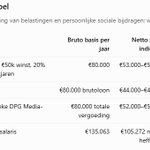
1. Vooruit stelt dat vervennootschappelijking 4,2 - 4,7 miljard euro/jaar kost. Hun studie bevat groteske fouten, die maken dat je eerder uitkomt op 1 mia euro. Die 1 mia euro kan je niet uitwissen door hogere belastingen die meer schade zullen aanrichten dan winst opleveren, maar wel door schijnzelfstandigheid beter te controleren.
2. De grootste fout: wie via een managementvennootschap bestuurder is, wordt vergeleken met een werknemer. Maar een bestuurder is wettelijk zelfstandige, met bijdragen tot een plafond. Alleen al deze fout overschat met meer dan 1 miljard euro hun raming!
3. Tweede grote fout: werkgeversbijdragen worden aangerekend op de totale loonkost in plaats van op het brutoloon: 33% i.p.v. 25%. Zo wordt het bedrag opgeblazen.
4. De '4 onafhankelijke ramingen' gebruiken steeds dezelfde tarieven en verdeelsleutels. Dat ze bij elkaar uitkomen bewijst niets. Erger: raming C veronderstelt 24 miljard € verschoven winst, meer dan de totale winst die raming A vindt (ongeveer 15 miljard euro)!
5. De macrocijfers worden volledig toegeschreven aan "vervennootschappelijking".
De taxshift, de energiecrisis, inflatie, de Vennootschapsbelastingshervorming van 2017 en Pillar 2: niets daarvan wordt als verklaring meegenomen. Liquidatiereserves van gewone KMO's worden ook als 'lek' geteld!
6. Er wordt met geen enkel gedragseffect rekening gehouden: geen substitutie, stopzetting, verhuis naar het buitenland, verliezen of faillissementen. De meest mobiele inkomens worden beschouwd "sitting ducks" te zijn om gepluimd te worden.
7. Alleen vennootschappen met winsten worden meegerekend. De verliezen worden weggelaten.
8. De nota is dus geen betrouwbare basis voor beleid. Wie het echte probleem, schijnzelfstandigheid, wil aanpakken, doet dat gericht, niet met een studie die ideologisch gekleurd is en daardoor de meest elementaire vennootschaps- en fiscale regels compleet verkeerd inschat.
Welke academicus, journalist, politicus... heeft de moed om de feiten te respecteren als het om ondernemers en risiconemers gaat? Gelieve nu recht te staan.