

Interest Rate Trader
India
Joined June 2022
- Tweets2.6K
- Following95
- Followers1.4K
- Likes499




Abhishek retweeted
I don't know how closely you follow poker but if you do, the analogy will make sense.
Back in the day, most successful poker players had reasonably good understanding of odds but they still made decisions based upon gut feel, if you will. But ever since the rise of solvers, more and more smart people have started studying poker through GTO lens. Thye still play explitative poker but GTO continues to be their refrence point. Edges have become smaller for all the successful studied players and it is nigh impossible for feel-based players to make money consistently competing against them. The old pros now have to study as well in order to compete. The Iveys and Negreanus of the world fall into this category of old pros.
In trading, something similar has been happening. It takes a lot longer for new traders to learn the nuances of how to succeed in discretionary trading while cost of infrastructure has gone up. The difference between trading and other sports/games is that one doesn't have the luxury of learning while competing in say, same-age group. In trading, if one has to succeed, he has to learn only by competing against the best of the best who have seemingly unlimited resources at their disposal.

Abhishek retweeted

The @FAAnews issued a nationwide ground stop for all U.S. airports following a communication issue impacting all Air Route Traffic Control Centers. FAA technicians are investigating the issue. We will provide immediate updates as we have them.
If Fed eventually settles on evenly spaced 6 live FOMCs a year (let's say 3rd Wednesday of every odd-numbered month), it will make SOFR 3 mo spread curve go haywire. Adjacent 3mo spreads will not have exposure to similar number of FOMCs.
It will affect only a handful of traders who trade SOFR curve. We are a bunch of masochists anyway.

Fewer Fed meetings, at more evenly spaced intervals, has the clear benefit of giving officials a more consistent flow of data to parse as the debate their rate settings.
But there are trade-offs that will put the onus on Warsh to communicate more openly about how the Fed is approaching those policy decisions and its thinking about the outlook, something he has so far resisted since taking over as chairman

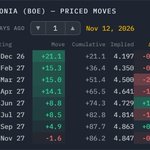
Barring a catastrophe, Dec 25bp hike is practically a done deal. Lots of FOMC members have been indicating that they are leaning toward Jan hike. We still have lots of data between now and Jan meeting.
If market starts pricing 18-19bp for Jan, it could act as a good dovish hedge for hawkish book. Same applies for March meeting.
Breaking News: Warsh's Fed wants extended holidays before and after Christmas. 😉
The Fed's revised schedule for 2027 is notable in that it not only scraps October's policy vote, but the gatherings are spaced out such that there is no longer a December meeting. The Fed will vote on rates Nov. 16-17 and then not again until Jan. 25-26, 2028 federalreserve.gov/monetaryp…

1
11
860


Not that anyone asked, but here is how I see developed STIR markets through the lens of finding value on the curve:
1. SOFR
Great liquidity through blues, and sometimes golds. You can move thousands of lots without any issue.
Whites and reds are where the sharks live. They distort the curve often and won’t let up for weeks, if not months. The latest example was in whites, where a large player was betting on who the next Fed Chair will be and kept the curve distorted for months.
Curve smoothening algos in greens and blues simply don't let the fly curve move smoothly.
2. CORRA
Liquidity is usually poor. Only whites and reds are tradeable in any true sense. Want to bet on greens? Good luck.
The upside is frequent curve distortions. If you are patient, they offer good opportunities.
3. SONIA
Liquidity is better than CORRA but worse than SOFR. Spreads trade decently in greens, and sometimes blues.
Since Brexit, you always have to keep an eye on UK politics and fiscal issues.
As with CORRA, waiting for large distortions and then fading them pays off.
4. Euribor
Great liquidity. Standing order sizes are as good as SOFR.
Unlike SOFR, Euribor doesn’t spike immediately after major data, so you can enter at reasonable prices more often.
All in all, a great market to trade.
5. SARON
Poor liquidity. Very hard to trade when vol is low.
Good for frequent scalps when vol is high enough. But when vol is high, you can’t move any size.
6. Aussie bank bills
Liquidity is fine in whites and reds, but the exchange doesn’t allow GTC orders, which is annoying.
Only a few 3m flies are exchange-quoted, and no 6m flies.
Too many hurdles to trade it actively. It feels like ASX doesn’t even want you to trade it.
Doves in the Fed always think inflation will magically go back to target "next year" without Fed doing anything today.

4
528


Despite fragile Canadian economic data, the shape of the CORRA spread curve makes it hard for flies and double flies to trade meaningfully below 0 for a sustained period. It would take a complete collapse in hike odds across the front 6 months of the curve.
CORRA liquidity is poor even in normal conditions, so kinks tend to form in the curve. They usually smooth out over time.
2
8
1,107
