Sara Lopus (@SaraLopus) header
Sara Lopus (@SaraLopus) profile picture

Cal Poly associate professor | Berkeley-trained demographer | Data aficionado | Craft enthusiast

San Luis Obispo, CA
Joined August 2018
Photo by Sara Lopus (@SaraLopus)Photo by Sara Lopus (@SaraLopus)Photo by Sara Lopus (@SaraLopus)Photo by Sara Lopus (@SaraLopus)Photo by Sara Lopus (@SaraLopus)
Three times, you’ve told me my account is restored, but when I request a ride, it still says I’m a minor. I am stranded, trying to travel in cities with few taxis and no other ride share services. I am a grown adult. Please help.
31
I can't wait to feel this good to cast my vote! (And I'm so delighted that my art-loving kiddo designed one of San Luis Obispo County's winning "I voted" stickers🤩) slocounty.ca.gov/departments…
63
In this blog, @DanielaUrbinaJ, Margaret Frye, & @SaraLopus share insight on educational hypergamy from their study published in #PDRJournal. Read now: bit.ly/4bOcWki
2
8
1,121
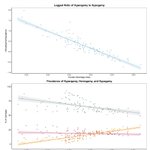
In a #PDRJournal publication with @DanielaUrbinaJ and @frye_maggie, we argue that the methodological choice to exclude homogamy from the denominator has led scholars to overstate the ubiquity of hypergamy decline around the world. onlinelibrary.wiley.com/doi/…
1
4
10
1,505
2/2. At #PAA2024 Friday, @frye_maggie and @SaraLopus present on African birth timing and educational differentiation. Full Abstract below! ⬇️ @UMSociology @UM_PSC Across contexts, more educated women typically have later first births and longer inter-birth intervals. Yet, as educational access has expanded across Africa, the timing of births has remained quite stable. Using data representing 57 birthyears and 34 African countries, we show that these modest aggregate changes in fertility timing mask more dramatic changes within educational groups. Across cohorts of women born since 1940, educational attainment became an increasingly salient predictor of birth timing, as highly-educated women delayed their first births and spaced their subsequent births more over time. The educational differentiation of birth timing also varied across contextual factors (educational access and family planning effort). In recent cohorts, both noschooling and highly-educated women experienced earlier first births in higher-education contexts. However, in all cohorts, highly-educated women spaced their second births more when education and family planning were widely available, suggesting the potential for public investments to lengthen some birth intervals. Friday at 1:30 in the Regency Ballroom...
2
1
2
1,403
⚜️Today at #PAA2023, @frye_maggie @UM_PSC, @danielaurbinaj and @SaraLopus challenge the view that hypergamy has dramatically declines over time and across female educational advantage. An important talk on trends in Latin America:
2
9
1,004
So looking forward to co-hosting this event next week! Join us as we learn from @annalappe about a reimagining of our food system. Full schedule of this year's @CalPolyCLA Social Justice Teach-In here: cla.calpoly.edu/teach-in
Very excited for this Food and Climate Conversation with acclaimed author @annalappe as part of the @CalPolyCLA Social Justice Teach-In! Pre-register at: calpoly.zoom.us/meeting/regi…
1
3
Weather forecasts are a potentially valuable complement to farmers' traditional knowledge. However, climate change disrupts confidence in traditional ways of knowing the weather AND erodes confidence in weather forecasts. New research by @zack_guido & team rdcu.be/cypTV
Kenya’s gender quota rule has institutionalized gender representation on water governance committees, but inequities persist. Representation is not participation, and men continue to hold more key decision-making positions. Corrie Hannah @tomgeog & others authors.elsevier.com/a/1bi0f…
1
1
So happy to work with Corrie on her new paper in @WorldDevJournal. Super interesting implications for the future of gender-equitable governance and the extent to which quotas can get us there.
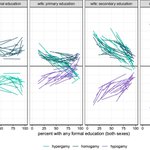
As education spreads across Africa, intra-marital educ pairings become closer to independent sorting. Hypergamy odds fall; hypogamy odds rise. Education plays a weakening role in determining who marries whom. My latest work with @frye_maggie in @JMF_NCFR onlinelibrary.wiley.com/doi/…
2
8
1
16
Ours is the first paper to quantify educational assortative mating across sub-Saharan Africa. Also the first (I think?) to visualize propensity in an easily-interpretable way across a continuous x-axis. Three cheers for data viz & another happy co-authorship with @frye_maggie!
1
4
Within the past week, I saw a great box and whisker plot showing presidential approval ratings, going back decades. Can’t remember where I encountered said plot! Was it fivethirtyeight? Nytimes? Please help me remember where I found it. My lecture slides and I will owe you one!
1
Found it! So good for a lesson on central tendency and spread. fivethirtyeight.com/features…
1
Congrats to PSC faculty Maggie Frye @frye_maggie and co-author Sara Lopus for winning the Article of the Year award from ASA Family Section @ASA_Family for the Demography paper "From Privilege to Prevalence: Contextual Effects of Women’s Schooling on African Marital Timing."
This Post is from an account that no longer exists. Learn more
3
7
So delighted that @frye_maggie and I received this award for our work on marital timing in Africa, identifying indirect "spillover" effects of educational expansion on family formation behaviors, even among women who never attended any school. Thank you, @ASA_Family!
This Post is from an account that no longer exists. Learn more
1
14
Excited to return to Berkeley Demography next Wednesday to present my latest work with @frye_maggie!
This Post is from an account that no longer exists. Learn more
1
10
Thoroughly enjoyed 1st day of @InedFr’s conference on Migration, Environment & Climate. Presented work w/ @tomgeog et al, considering effects of Kenyan internal migration on irrigation viability. Lots of great research. Quite a lot of great crepes/croissants/quiche/eclairs.
1