

Ditch Daylight Saving Time. Permanent Standard Time lets us sleep later for health, mood, safety, education, economy, environment. We’re a 501(c)(4) nonprofit.
- Tweets33K
- Following5.4K
- Followers18K
- Likes90.3K









ALT Title reads “Standard Time is closer to nature”. Three clocks are shown, one for Bismarck mean solar time (set to 12:00), one for Central Standard Time (set to 12:43), one for Central Daylight Time (set to 1:43). Subtitle reads “Alignment to solar time naturally benefits health, safety, education, economy.”


ALT University of Colorado Boulder CU Boulder Today Why permanent standard time is the healthiest choice Published: 8/12/2026 By Lisa Marshall Spring forward. Fall back. For 60 years, most of the U.S. has engaged in this biannual clock-changing ritual, much to the chagrin of critics who have argued that it’s confusing, outdated and dangerous. The Sunshine Protection Act, passed by the U.S. House of Representatives in July, would end this practice, enabling states to stick with daylight saving time (DST) year-round. Another recently introduced proposal, the Sunshine for our Kids Act, calls for the opposite: making standard time—which currently goes from November to March—the permanent national default. This proposal would still allow states to pass laws opting into permanent daylight saving time (pDST). Under permanent standard time (pST), our winters would stay the same. But in the summer, the sun would rise and set earlier. For instance, in Denver, sunrise in June would occur…

ALT “If we take a pure health, safety and well-being perspective, especially for our children, the clear choice based on all the available evidence is permanent standard time,” said Ken Wright, an integrative physiology professor of distinction and director of the Sleep and Chronobiology Lab at CU Boulder. “Permanent daylight saving time, which is being considered the most right now, is the worst choice.” [Photo of Dr Wright]


ALT Two photos from St Augustine, Florida, on October 21. At 6:30am Eastern Daylight Saving Time, the sky is dark. At 6:30am Eastern Standard Time, the sky is light.


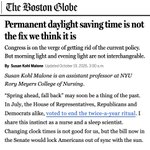
ALT The Boston Globe Permanent daylight saving time is not the fix we think it is Congress is on the verge of getting rid of the current policy. But morning light and evening light are not interchangeable. By Susan Kohl Malone Updated October 19, 2026, 3:00 a.m. Susan Kohl Malone is an assistant professor at NYU Rory Meyers College of Nursing. “Spring ahead, fall back” may soon be a thing of the past. In July, the House of Representatives, Republicans and Democrats alike, voted to end the twice-a-year ritual. I share this instinct as a nurse and a sleep scientist. Changing clock times is not good for us, but the bill now in the Senate would lock Americans out of sync with the sun. The Sunshine Protection Act would make daylight saving time permanent. That sounds wonderful: more light after work and school, longer evenings. But there’s a catch — making daylight saving time permanent does not create a single additional minute of daylight. The sun does not change when it rises and sets…

ALT “Simpsons” meme. First panel: Principal Skinner thinks to himself, “Should I start my day earlier to get more daylight at the end of my day?” Second panel: He concludes, “No, we should spring forward all clocks and force everyone to wake an hour early every day.”