

Science News #Technology, #Chemistry, #Physics, #Medicine, #Astronomy, #Informatics, #Materials, #Geoscience, #LifeScience
Boston, MA
Joined January 2022
- Tweets11K
- Following3.5K
- Followers48.9K
- Likes16.8K






Pinned Tweet
Will academic journals that charge APCs still exist in the future? Why?
46%Yes
42%No
12%Don't care
26 votes • 1 days


Life is short and struggles are temporary.
Life felt dark as an international researcher in the U.S., but I’m finding breaks in the clouds. @ScienceMagazine


Life felt dark as an international researcher in the U.S., but I’m finding breaks in the clouds
science.org/content/article/…

143

The Coming Academic Explosion Points (2027–2030)

Academic Circle Collapse Timeline Prediction
The Coming Academic Explosion Points (2027–2030)
2027: Paper Hyperinflation — Academic Evaluation Systems Begin to Fail
AI-assisted research will shift from an advantage enjoyed by a minority to a standard tool for most scholars. Paper output will keep rising, and peer review will become increasingly unsustainable. Tasks that once took a PhD student several months—literature reviews, code analysis, and parts of theoretical derivations—can now be completed by AI in a few hours. Journals will start limiting the number of submissions, yet universities will still use paper counts, impact factors, and H-indexes to decide who graduates and who gets faculty positions. Academia will face an awkward question on a large scale for the first time: when everyone can efficiently produce papers, what does the number of papers still prove?
2028–2029: Academic Hierarchy Begins to Reshuffle
The real dividing line may no longer be between professors and PhD students, but between those who have access to frontier AI models and computing resources and those who do not. Research efficiency in top laboratories may improve by an order of magnitude, while medium- and small-sized universities continue competing for limited research funding. Some universities will begin experimenting with new promotion systems: instead of looking at dozens of papers, they will require researchers to submit a small number of representative contributions and explain their originality on the spot. Traditional paper-production research positions will face pressure, and PhD training models will also be forced to adjust.
2030: The Traditional Academic System Hits Its Real Breaking Point
If AI can continuously propose hypotheses, complete theoretical derivations, design experiments, and verify results, universities will have to answer a fundamental question again: what exactly is the irreplaceable role of human scientists? Paper quantity may gradually exit the core evaluation system.
Research funding will place greater emphasis on original questions, verifiable breakthroughs, and real-world impact. Research teams in some disciplines may become smaller yet more productive. A professor’s value will no longer be measured mainly by how many PhD students they supervise or how many papers they publish, but by whether they can define important scientific directions.
The greatest irony is that science itself may be entering a golden age, while the traditional academic career system built on top of science may simultaneously experience a crisis.
• 2027: Papers begin to devalue.
• 2028–2029: Research resources and talent are re-stratified.
• 2030: We may have to redefine what it means to be a scientist.
This is not the end of science, but possibly the end of the “Publish or Perish” era.

Young scientists must have the ability to quickly adjust after every miss and keep trying persistently in pursuit of major breakthroughs.


How to develop good research questions
nature.com/articles/s41562-0…

6
952
How To Choose a Good Scientific Problem: without AI

Technology can increase the power of science. Scientific taste determines where that power should be directed.
doi.org/10.59717/j.xinn-nutr…

How To Choose a Good Scientific Problem
cell.com/molecular-cell/full…

7
637
Perhaps the review manuscripts they’ve been receiving have been of really poor quality.
So the editors of the Nature Reviews series felt they had no choice but to write a guide themselves on how to craft a high-quality review.
The importance of stupidity in scientific research

Technology can increase the power of science. Scientific taste determines where that power should be directed.
doi.org/10.59717/j.xinn-nutr…
The importance of stupidity in scientific research
journals.biologists.com/jcs/…

1
4
3,959
How to write an excellent Review article

Technology can increase the power of science. Scientific taste determines where that power should be directed.
doi.org/10.59717/j.xinn-nutr…
How to write an excellent Review article
nature.com/articles/s44222-0…
Low (vs. high) self-concept clarity decreases moral behavior (e.g., donation, volunteering, tax compliance, honesty in an incentivized game)

Unclearly immoral: Low self-concept clarity increases moral disengagement.
psycnet.apa.org/record/2025-…

3
386
Pelacarsen did not result in a lower risk of major adverse cardiovascular events than placebo at a median follow-up of 4.7 years.


From genetic causality to cardiovascular benefit: Translational lessons from Lp(a)HORIZON
doi.org/10.59717/j.xinn-nutr…


Pelacarsen and Cardiovascular Outcomes in Patients with High Lipoprotein(a). @NEJM
nejm.org/doi/full/10.1056/NE…

2
197
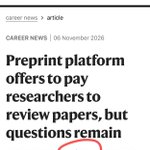
A reviewer can earn US$200 through XSci’s scheme if they deliver their work within five days.
$100 if they do so between five and ten days.

Preprint platform offers to pay researchers to review papers, but questions remain
nature.com/articles/d41586-0…

This is the best paper I've ever read.
Technology can increase the power of science. Scientific taste determines where that power should be directed.
doi.org/10.59717/j.xinn-nutr…
Technology can increase the power of science. Scientific taste determines where that power should be directed.
doi.org/10.59717/j.xinn-nutr…
Beyond technology: Scientific taste and judgment in nutritional science. Part 2
doi.org/10.59717/j.xinn-nutr…

1
16
3,044
Early Bird Registration Deadline: Only 9 days left!
Welcome to the 2026 International Symposium on Energy Frontiers!
@sjtu1896 @HongKongPolyU @Engineering2026 @SpringerNature @isciverse
Conference Link:
events.polyu.edu.hk/2026inte…

🌏 Second Conference Announcement:2026 International Engineering Symposium on Energy Frontiers (Hong Kong, 10–12 December 2026)
Join the global energy research community in Hong Kong on 10–12 December 2026 for the 2026 International Engineering Symposium on Energy Frontiers, jointly organized by Shanghai Jiao Tong University, The Hong Kong Polytechnic University, and ENGINEERING Energy.
The symposium welcomes contributions across six themes:
🔋Advanced Power and Energy Conversion
🌱 Carbon Dioxide Capture, Utilization and Storage
💧Hydrogen Energy and Green Fuels
⚡ Advanced Batteries and Energy Storage
☀️ Renewable Power Generation and New-Type Power Systems
🤖 AI + Energy
🎤Keynote Speakers
· Zhou Shouwei — Academician of the Chinese Academy of Engineering
· Chen Qingquan — The Hong Kong Polytechnic University; Academician of the Chinese Academy of Engineering
· Nigel Brandon — Vice President of Imperial College London; Fellow of the Royal Academy of Engineering (UK)
· Ned Djilali — University of Victoria; Fellow of the Canadian Academy of Engineering
📝 Submit your abstract (Abstract submission deadline: 30 October 2026):
cems.polyu.edu.hk/abstract-s…
🌐Conference website:
events.polyu.edu.hk/2026inte…
We warmly welcome abstract submissions and invite researchers and professionals to attend the symposium.
#EnergyResearch #HydrogenEnergy #EnergyStorage #RenewableEnergy #CarbonCapture #ArtificialIntelligence

Vitamin C (ascorbic acid) for preventing and treating the common cold has been controversial for 70 years.
Can vitamin C reduce the incidence, duration or severity of the common cold?
cochranelibrary.com/cdsr/doi…

The cognitive power of the avian brain
Carrion crows make decisions faster than monkeys and humans @ScienceMagazine

Carrion crows can make ultrafast and accurate decisions.
science.org/doi/10.1126/scie…

1
232