

real FAANG interview breakdowns ,AI Mock,career mentor Building @ScrenaAI_ to make it easier.
new york
Joined March 2026
- Tweets1.2K
- Following1.7K
- Followers1.4K
- Likes470




Pinned Tweet
OpenAI Infra Interview Prep: 5 Concrete Questions Worth Studying
Distributed Clusters and Asynchronous Messaging
Given a root node and an asynchronous messaging interface, how would you count the total number of nodes in a cluster?
Follow-ups: How would you return the entire cluster structure? How would you handle failed messages and retries? How would you avoid counting the same node multiple times?
Implement a Work Queue
Design a work queue that supports reserve, complete, and fail operations.
Consider task state transitions, failure handling, and potential issues when multiple workers try to reserve tasks simultaneously.
Debug a Python Task Scheduler
Read an existing scheduler codebase and identify why tasks aren't executing as expected.
For example, a task might remain stuck in the PENDING state after an exception, or asynchronous jobs might not run as expected. You need to identify the root cause, fix the code, and verify that the fix works.
Design a Video Generation Scheduler
Design a scheduler that handles a large number of video generation tasks with limited computing resources.
How would you handle resource exhaustion? Can high-priority tasks preempt running tasks? How should paused tasks be re-queued? How would you prevent tasks from being lost or executed more than once?
Implement a Key-Value Store with Chunked Storage
Implement basic key-value read and write operations. When a file reaches its size limit, how would you split the data across multiple files?
You also need to consider how to maintain a metadata index, locate the file containing a given piece of data, and handle data updates and reads.
These five problem areas cover distributed communication, work queues, debugging, resource scheduling, and storage systems.
Infra interview prep isn't just about writing code that works. You also need to reason about task failures, resource constraints, concurrent execution, and whether the system can keep working when things go wrong.
A good interview process should assess fit for the new role, not make employees re-prove their worth.

At Apple, changing teams internally means a full interview loop. ~5 hours.
For a lateral move. Same level, same pay.
Imagine re-interviewing to stay at your own company.
I have never seen or heard this to be the case in the industry for any other company.
How would you feel if you had to interview again to change team for the same role?


Is Search, Ads & Recs still a career worth pursuing for the long term?
The business isn't going away anytime soon
Search, advertising, and recommendations remain core businesses for many tech companies. As long as companies need to rank content, reach users, and optimize conversions, these problems won't simply disappear.
LLMs are changing the tech stack
Embeddings, Transformers, and LLM-powered search are reshaping the field. Engineers who can combine traditional ML knowledge with modern model architectures will be better positioned to adapt.
The value of traditional ML experience is diverging
Expertise in retrieval, ranking, experimentation, and large-scale production systems still matters. But if your work is limited to maintaining mature models or tuning established algorithms, your technical edge may gradually weaken.
Business growth doesn't guarantee job growth
Even if Search, Ads & Recs remains profitable, more capable models and AI-assisted development could reduce the effort needed to build and maintain certain systems. The industry can continue growing without a corresponding increase in hiring.
AI could reshape the business itself
AI assistants may change how people search for information, discover products, and interact with ads. If user behavior shifts, traditional search and recommendation businesses will need to adapt to new discovery channels and business models.
Seniority doesn't guarantee job security
Years of experience matter, but architectural decisions, business trade-offs, and complex problem-solving are harder to replace. Domain expertise is truly valuable when it helps you solve problems that others struggle with.
Transferable skills matter more than job titles
Model evaluation, system design, data pipelines, production reliability, and experimentation can all apply across different ML domains. Rather than betting your future on one specialization, build skills that transfer across fields.
What's the real risk to watch out for?
The biggest career risk in Search, Ads & Recs may not be the industry's disappearance, but your skills becoming less scarce while the industry continues to exist. The business can keep growing even as the types and number of people companies need change.
So, is Search, Ads & Recs still worth pursuing long term?
Yes, but not by standing still. The field still has real business value, but the skills it rewards are changing. The best long-term bet isn't on traditional ML or LLMs alone. It's on your ability to adapt, build systems, and solve increasingly complex problems as the technology evolves.
The industry keeps changing what developers are expected to know, and candidates are trying to keep up. We should be testing how people think and learn, not just what they can recall under pressure.

Decent talent is very rare in the market these days.
I was taking an interview today for a person who has 3 YOE. I asked the most basic question someone can ask - "Write a code to make an API call and if it falls then retry it for a maximum of 3 times".
Even for this the candidate took 15 minutes and still getting syntax errors.
This is also an outcome of using AI for everything and then not knowing the very basics. Just because you are using AI, doesn't mean that you can't make an API call.
And all this after the candidate claimed that he is not good at DSA but is good at development🤦🏻

The money is pouring in, but the real question is how much of that investment will translate into actual jobs. For anyone trying to break into AI, knowing what companies are actually looking for matters more than just following the hype.

The AI buildout is now the biggest investment boom in U.S. history.
Financing it will cost $10.3 trillion from 2025 to 2032, an average of 3.63% of U.S. GDP every year, per a new Brookings study.
That's bigger relative to the economy than the canal, railroad, electrification, highway and telecom booms.
Want to Land an AI Engineer Offer in 2026? Stop Focusing Only on Models
From Building Models to Building Systems
AI engineering is moving beyond single-model applications toward more complex systems. Modern AI products often combine multiple models, retrieval systems, external tools, and validation mechanisms into a single workflow. For job seekers, understanding how to build reliable AI systems is becoming just as important as understanding the models themselves.
What Are Companies Really Looking For?
Roles like AI Engineer, Applied AI Engineer, and ML Systems Engineer require much more than calling APIs or writing prompts. Engineers also need to understand orchestration, context management, model routing, latency optimization, and system reliability. The real challenge is making all these components work together under production constraints.
System Design Skills Worth Preparing For
If you're preparing for AI engineering interviews, focus on designing systems that can handle real-world workloads. Practice explaining how you'd manage multi-step workflows, handle failed tool calls, control inference costs, validate model outputs, and balance latency against accuracy. These skills help turn an AI prototype into a production-ready system.
Build Projects That Demonstrate Engineering Judgment
A basic chatbot can show that you know how to use an LLM, but a multi-model orchestration engine can demonstrate much more. Consider building a system with model routing, persistent workflow execution, context management, retries, and structured output validation. More importantly, be ready to explain why you chose each component, what could go wrong, and how you'd optimize the architecture as traffic grows.
Prepare for the Interview Questions That Actually Matter
Knowing the terminology is only the first step. Interviewers may ask you to design an AI workflow from scratch, debug a failing pipeline, or explain trade-offs between model quality, cost, and reliability. Reviewing real interview experiences and practicing targeted system design questions can help you prepare more effectively for what companies actually test.
I've seen some posts criticizing this new format. For people with dyslexia, reading large blocks of unfamiliar code under time pressure can be really tough.
That said, AI is becoming a bigger part of our daily work. Being able to read existing code and catch AI mistakes is becoming a critical skill.

Goodbye to LeetCode? Google just updated its interview process. AI is now a part of it.
They have introduced a new round called Code Comprehension.
The idea behind this round is to drop the candidates into a 200-500-line codebase with Gemini available for use.
This round evaluates:
- Can you read someone else's code
- Are you able to debug independently before utilizing AI
- Can you catch when Gemini is wrong

Maybe the gap isn't that new grads aren't AI-native. It's that most of their education and internships still train them to build software the pre-AI way. You can't expect people to develop new habits if they rarely get the chance to use these tools in real workflows.

From a current CTO at a larger company hiring new grads, who I talked with about the state of college students:
"Everyone says how new grads are 'AI-native' but we don't see this. They're usually not familiar with AI coding tools, have not used them much, and are much more familiar with the pre-AI way of building software.
And many of those who did internships did it at 'traditional' companies where they also didn't use these tools."
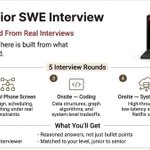
Preparing for a Senior / Staff technical interview? Here's a quick look at the 2026 interview difficulty.
The following summarizes interview patterns from 40+ tech companies in 2026, covering Coding, System Design, and Behavioral interviews.
Coding
Difficulty: Most questions are around Medium, with relatively few true Hard problems. For Infra roles, distributed systems and multithreading/concurrency questions are also common.
Focus: It's not just about getting the problem solved. You should be able to explain your approach clearly before coding, write readable code with clean naming, and handle edge cases and debugging. You should also be able to explain why you chose a particular data structure or algorithm and when that approach is appropriate.
Example: Knowing that a Hash Table is O(1) isn't enough. You should also consider worst-case behavior, tail latency, memory overhead, cache locality, data size, and access patterns, and explain why the solution makes sense for the specific scenario.
System Design
Difficulty: Common topics include Distributed KV Stores, File Stores, and Object Stores. The problems themselves may not be unfamiliar, but Senior / Staff interviews generally go deeper into design decisions and trade-offs.
Focus: Start by clarifying the requirements and constraints, then choose the architecture and components based on factors such as data scale, read/write patterns, latency, consistency, availability, throughput, and durability. Be prepared to explain the trade-offs between different approaches.
Example: Don't simply apply a "standard answer." Change the data scale, read/write ratio, latency requirements, or consistency requirements, and the right architecture may change completely.
Behavioral
Difficulty: The questions themselves are usually not particularly difficult, but Senior / Staff candidates are expected to demonstrate deeper experience and stronger engineering judgment.
Focus: Show real ownership, collaboration, project leadership, and the ability to handle failures. When discussing a failure, explain how you contained the impact, found the root cause, fixed the problem, and then used testing, monitoring, processes, or tooling to prevent similar issues from happening again.
At the Senior / Staff level, interviews aren't just about whether you can solve the problem: Coding evaluates problem-solving, System Design evaluates engineering judgment, and Behavioral evaluates ownership and your ability to drive things forward.