

EVP Power, Lancium, Balancing Energy, 20+ Years of Energy Trading & Optimization
Calgary
Joined March 2011
- Tweets1.8K
- Following527
- Followers6.8K
- Likes4.9K





A master class in communicating data center realities

Most Albertans have probably seen the headlines about companies wanting to invest in and build AI data centres in Alberta.
Many Albertans are excited about that, but others have legitimate questions.
Here are the answers to 6 common questions on everything from power to water to land use and how these investments will financially benefit our province now and in the future.
Shaun Connell retweeted

Back-of-envelope numbers for 1 gigawatt data center:
All-in Capex: ~$50 bn
Enterprise revenue generated: ~$25-30 bn/year
Electricity cost: $1-2 bn/year
~2 year payback.
The boom is real.
Lancium has been the leader in power orchestration and flexible load management since our founding in 2017. We are passionate about ensuring that large loads are assets to the grid that enhance system reliability
As we scale our Lancium Clean Campuses and expanded resource orchestration model, our decision to license IP to ERCOT for zero cost reflects our commitment to enabling this system-level benefit and alignment with ERCOT on strategies to achieve the load growth opportunity and challenge at hand.
lnkd.in/gTDmF9xi
ercot.com/services/programs/…

DM me if you are interested and qualified to step into the following leadership role with Lancium, at the forefront of two transformative industries—energy and AI.
Reporting directly to me, the VP of Power Operations will lead retail and wholesale power operations for a multi-GW portfolio of ultra-large generative AI customers at our cutting-edge Lancium Campuses in West Texas.
Referrals are welcome as well!
linkedin.com/jobs/view/41128…
Even better than a new phone book. The new 2024 Utility Scale Solar report is here!


The 2024 edition of @BerkeleyLab’s Utility-Scale Solar report is out. Empirical plant-level data from US projects over 5 MW. Trends in deployment, technology, capital and operating costs, capacity factors, prices and value, through 2023. All at utilityscalesolar.lbl.gov/<THREAD>

👀

This week, NERC initiated the Large Loads Task Force (LLTF) to address the reliability impacts of emerging large loads on the bulk power system and prepare for the unique risks that they present. Learn more: ow.ly/4KGf50TJQMy.
Learn more: ow.ly/4KGf50TJQMy.

Shaun Connell retweeted

NERC published #ITCS Part 1, providing current total transfer capability between neighboring Transmission Planning Regions in North America. The analysis provides input to Part 2, which will recommend technically prudent additions to transfer capability.
ow.ly/9s3U50T7U3m

Shaun Connell retweeted

I am thrilled to announce Crusoe Energy Systems' plan to build an initial 200 MW AI data center and future expansion across our 1.2 GW Lancium Clean Campus. Our gratitude extends to Crusoe for our strengthened relationship.
businesswire.com/news/home/2…

Exciting times ahead!
“Crusoe to Build Initial 200 MW AI Data Center With Plans to Expand at 1.2 GW Lancium Clean Campus”
Lancium’s end-to-end solutions include land acquisition, load & renewables interconnects, site engineering & power orchestration
businesswire.com/news/home/2…
I wonder what installed capacity for solar and batteries will look like in 2030??
Solar over/under 100GWs?
Storage over/under 50GWs?

Looks like Texas could have more installed solar generation capacity than wind generation capacity next year (all projects w/ interconnection agreement).
H/T @joshdr83 who inspired me to look into @ERCOT_ISO's latest resource capacity trend data ercot.com/gridinfo/resource

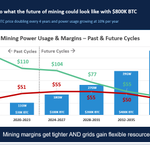
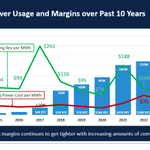
Here are a few slides that I presented last November at the Texas Blockchain summit... as global bitcoin mining competitions increase over time, margins should continue to compress to the point were avg rev/MWh is is only slightly higher than avg cost/MWh
In this future of compressed margins, some of the most profitable miners will have ultra-low power costs and/or be highly flexible in how they interact with the grid (e.g., curtailing during high-priced hours and/or providing DR services). Additionally, they may figure out additional revenue streams tied to mining.


👀 worth paying attention to this narrative shift

ERCOT CEO Pablo Vegas and others gave shocking testimony today in the Senate Committee on Business & Commerce that within only six years (that’s only three legislative sessions), our power grid needs will grow from about 85,000 to 150,000 megawatts. That is much higher than the 110,000 megawatts they previously projected. The 110,000 megawatts was already a big increase, which is why the Senate pushed our incentive plan to build more dispatchable power last session. 150,000 megawatts is almost double the megawatts we now have on the grid.
Later testimony said the growth is due to the increases in population, normal business growth, and Artificial Intelligence (AI). However, crypto miners and data centers will be responsible for over 50% of the added growth. We need to take a close look at those two industries. They produce very few jobs compared to the incredible demands they place on our grid. Crypto mining may actually make more money selling electricity back to the grid than from their crypto mining operations.
Texans will ultimately pay the price. I’m more interested in building the grid to service customers in their homes, apartments, and normal businesses and keeping costs as low as possible for them instead of for very niche industries that have massive power demands and produce few jobs. We want data centers, but it can’t be the Wild Wild West of data centers and crypto miners crashing our grid and turning the lights off.
The Senators asked why this had not been disclosed before today. #txlege
Way to go Ben! That’s a huge accomplishment for you and the Luxor team

2+ years ago I was planning to go back to school.
Instead, @ethan_vera called with an idea - building compute derivatives for 21st century commodity producers.
Today, after receiving regulatory approval, the world's first compute futures contract is live!


Great looking panel!

@AndrewBurchwell ❤️ of @OHBlockchain on the world stage along with @lee_bratcher ,@Crypto_Mags ,@BitcoinPierre , and @Dennis_Porter_ at Empower conference by @DWildcatters

Congrats @LuxorTechnology !

Excited to announce the launch of Hashrate Futures. The first compute and #Bitcoin mining related instrument to be listed as a derivative contract in the US.
luxor.tech/news/corporate-ne…

Shaun Connell retweeted

Excited to announce the launch of Hashrate Futures. The first compute and #Bitcoin mining related instrument to be listed as a derivative contract in the US.
luxor.tech/news/corporate-ne…
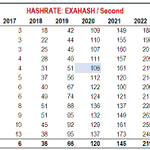
Punchline - Assuming btc price doesn't rally between now & the halving (~90 days), mining revenue will 30% lower than the absolute lows of 2023. There will be massive pain
Over the past 4 months, bitcoin price has appreciated by ~67% and avg btc fee per block has done a 5X (from ~0.2 btc/block to 1 btc/block).
Even with these massive tailwinds, bitcoin mining revenue per EH has only gone up by ~30%.
Why only 30% when price and fee's are up so much more?
B/c Hashrate grew by 26% during this same period
This table shows historical mining revenue per Exahash. The blue shaded boxes represent halving months.

