

I bomme, as a bombyll bee dothe.
Joined February 2014
- Tweets6.3K
- Following2.5K
- Followers622
- Likes10K




there is a sweetspot for host nest size. at the low end, nests of single digit workers can not support the cuckoo anymore after she killed most of them, while large nests of maybe 30+ workers will likely kill her first

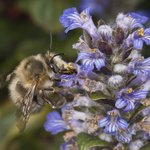
Bee of the day #322 is a female Southern Cuckoo bumble
bee, Bombus vestalis, nectaring on Caryopteris flowers. Seeing these females late into the season means they're not queens, rather "gynes" (whether this one is mated already is unknown).
As with other bumble bees, she will find a nice underground burrow to enter diapause, that process whereby she "hibernates" through the winter until next spring, where she emerges in search of a host nest to take over. (their hosts are the buff-tailed bumble bee, B. terrestris)
I wonder if this Vestal bumble bee ( along with other cuckoo bees) are genetically programmed to emerge later in the season, since if they emerge too early, there are no suitably-established nests for them to take over.
Consider that a host queen needs around ~ 1 month to build the nest, lay the first batch of brood, take care of them until they emerge, it would be more efficient for the cuckoo to emerge in mid/late spring to maximise the chances of taking over a healthy nest, in saying that, there's a counterargument: the bigger the nest/target, the more chance for the cuckoo to be spotted/killed/kicked out by the host's queen or workers... tradeoffs!
📷Nick Hollands, Kent


Low fat sweaty cat 🐬/acc retweeted

how the fuck you know frogs have "simple" consciousness?

New interview of me on possible AI consciousness, including the "Leapfrog Hypothesis", according to which the first conscious AIs will have sophisticated consciousness rather than simple "frog-like" experiences:
youtube.com/watch?v=bcWw91Ql…
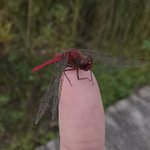
i fished this dragonfly out of a broken spider web and it started biting me, which i choose to interpret as thank you kisses. pain index: about the same as an asian ladybeetle

their architecture makes the nectar easily accessible, so they are very popular with many pollinators, regardless of tongue morphology


i dont know why this ruffles so many feathers, all moral reasoning is fake anyways, just add a log term or something if you dont like the conclusion


Low fat sweaty cat 🐬/acc retweeted

Bees exchange info about direction & distance through the waggle dance. To measure dist, they use a visual “odometer” based on optical flow (how fast the surrounding scenery streams past their compound eyes as they fly).
Fascinating results from the patterned-tunnel experiment:


you have to show the thing they do with their butts when you talk about leafcutter bees

It's the shame the bee is so deep into the sunflowers, you can't see the large jaw that defines a "leafcutter" bee
Bee of the Day #330 is Megachile policaris, a rather common North American native bee with a generalist foraging habit - sunflowers, daisies, asters... any open flower really
Look at the underside of her abdomen, those thick hairs are scopae, which she uses for carrying pollen back to her nest*. As pollen accumulates on her body from foraging, she uses her legs to brush it to her body, where the pollen adheres to the hairs on the underside of her abdomen (under a microscope, pollen is very sharp and pointy, which will get stuck on other sharp and pointy things, like bee hairs).
Once fully loaded (or she's "satisfied") the female flies back to the nest, brushes it off using her legs and begins the brood-provision-making process
* The other forms of pollen transport are in hind leg baskets, as in honey bees, and internal pollen transport, like some masked bees in Australia
📷Roy Beckemeyer, Kansas


honeybees also have broadened tarsi on the 3rd leg for collecting pollen, while most solitary bees, including ivy bees, have dense hairbrushes instead

Some bee species can look very similar but be completely different behaviourally. 🐝
The Ivy Bee and the Honeybee are good examples of this. If you’re not looking closely you might not realise they are different.
They are around the same size, and you can see a lot of both species foraging together on the ivy at this time of the year (see the second image).
The best ways to tell them apart are that the Ivy Bee has very clear sharp bands of bright yellow on its abdomen. The Honeybee has hairy eyes while the Ivy Bee has smooth.
Honeybees live in colonies with queens and workers. The one pictured here is a sterile female worker who will be collecting pollen to provision the queen’s brood. Thousands of other workers will be out collecting pollen for the same brood. These workers do not reproduce themselves.
In contrast, Ivy Bees are solitary, don’t live in colonies, and don’t have queens or workers. The bee pictured here is a female who is independently collecting pollen for her own brood. She has no help in this process, even from the male she mated with.


i went to the cemetery and observed some kind of honey bee gathering. some of the bees crawled all over me, but they behaved and did not sting me


there are spring themed bees since many species only fly for a few months or weeks. my most strongly spring associated bee is the hairy footed flower bee which has a very distinct hover like flight

This Post is from a suspended account. Learn more
colletes is the most beautiful and adorable genus of bees, C. hederae, the ivy bee is one the last bees to emerge in september and one of the few that visits ivy, but it is not specialzed on it


Low fat sweaty cat 🐬/acc retweeted

Bee of the day #324 is Xylocopa (Lestis) sp., an Australian metallic carpenter bee foraging on a Grevillea. I've covered her cousins before, for Xylocopa is a worldwide genus of large carpenter bees. Zoom in, see her metallic-green sheen
How did this colour come about, you ask?
It's not a pigment that's painted, nor is it green hairs, rather the bee's exoskeleton ("cuticle") is layered with materials of different refractive properties (think chitin & melanin-rich regions)
As light hits the bee, it bounces off the multiple surfaces and the reflected waves reinforce one another ("constructive interference"), and some wavelengths are suppressed, resulting in metallic green/blue/bronze appearance
The harder ask is "why did these colours come about". I don't know, so I'm going to deduce it's to do with signalling - the colours act as a mate-recognition signal so that other carpenters know which bee belongs to their own species
For comparison, I am including linking carpenter bees below
📷Gerard Nicol, New South Wales

Low fat sweaty cat 🐬/acc retweeted

#サカガミハキリバチ
ツツジの葉を切り取る。
特に柔らかそうな葉を選ぶわけでもない。
というか、若葉がある季節ではない。
バラ、ツルガ、ヤマト、キヌゲなど多くの同属多種が、巣に搬入する前にどこかにとまって葉が軟化する時間ととるが、この蜂は切り取ったら巣に直行していた。


different bees have modified different mouth parts independently, so bees as a whole dont really have a universal, shared proboscis morphology. i think this ismost striking when you compare the tongues of apids and halictids


A bee's mouth has two specialised functions: chewing (wax, wood, resins) and lapping (honey, nectar as you see here). They are made up of six main parts:
1) Labrum: an "upper lip" that helps seal the oral cavity and guide food inwards
2) Mandibles: the paired jaws for cutting/gripping/moulding and so on - the larger bee below is a Lithurges sp. (Family Megachilidae), so she uses them for biting leaves, handling borod, defence, amongst others
3) Maxillae: a paired structure that sit lateral to the labium, containng a galeae that forms the "outer sheath" of the proboscis, which is a used for liquid feeding
4) Labium (which I often confuse with labrum): the central part of the proboscis contain the "tongue" (formally: "glossa"), which is extended into the nectar below by our Lithurges
5) The labial palps, which are more like accessory organs alongside the glossa that provide sensory feedback & structural support
6) Hypopharynx: another tongue-like internal structure that is associated with opening of salivary ducts and food manipulation
So what is our large bee doing here? As she feeds on nectar, it is the galeae, labial palps & glossa that work together to suck up the fluid. Odds are she repeatedly protrudes and retracts it, causing the nectar to adheres to the proboscis' hairy surface before being drawn inward by the mouthparts' pumping apparatus (well, that's how it happens in the European honey bees Apis mellifera anyway)
For completeness, the two out-of-focus bees may be the social stingless bees, Tetragonula carbonaria
This was bee of the day #322
📷Lisa Warman, Central Queensland

golden sweat bee cleaning his absurdly long antennae. although actually a bit on the short end for this family

this was a challenging read for me. thinking in patterns is very useful to me, morpho spaces, genotype spaces etc. but i find the idea of seperate reality of patterns hard to swallow. thus the success of patterns is a gaping hole in my worldview. more meandering thoughts below

Here it is - the official, revised, peer-reviewed version of my Platonic Space paper. mdpi.com/2409-9287/11/5/161 Of all the many unpopular positions I’ve taken over the decades - bitter controversies around the origin of left-right asymmetry in embryogenesis, bioelectricity and genetics, diverse intelligence, etc., this one has by far generated the most pushback: serious (grateful for those!) and energetic attempts to move me to other views, pleas to just drop it and not talk about it (for several different reasons), nasty emails and accusations, impacts on reviews of papers that have nothing to do with this, etc. Kind of amazing to me how incendiary this is. What can I say... Our job is to call it as we see it, and right now for me, this is it. Apologies to collaborators and colleagues for any shrapnel! Time will tell if this pans out or not; I've placed my bets. And btw, if you think this stuff is weird and uncomfortable, just wait… There’s much more on the way. The knob turns slowly but as long as the data keep coming, I'm going to say what I think it all means and follow it to the next steps it enables. Buckle up!

so the surprise of xenobots stems from a lack of understanding of the physical properties of the system, not from a pattern introgressing