

Institutional-grade on-chain capital markets. Tokenized private market access, structured products, and risk-defined DeFi.
Decentralized
Joined August 2018
- Tweets2.1K
- Following222
- Followers25.9K
- Likes464





Pinned Tweet
Singular Perpetuals now Live! Trade 9 major cryptos with up to 50x leverage. 🌐
✅ Low Liquidation Risk with quality price feeds
✅ Save on trading costs with minimal spreads
✅ Easy swaps via a simple interface
Elevate your trading at singulardex.com . Experience efficiency & security in every trade!
#SingularPerpetuals #BTC #ETH #AVAX #SOL #singulardex
1. The Binance incident is confirmed, but the root cause is not. @Reuters reported on November 1 that Binance had resumed Bitcoin withdrawals and replaced approximately 95% of stolen assets. The exchange has also allocated approximately $6.34 billion to cover losses. Its investigation continues.

4. A self-custodial DEX can eliminate the need for a centralized operator to hold customers’ deposited assets, but it cannot eliminate smart-contract exploits, malicious approvals, compromised interfaces or vulnerable vault infrastructure.
5. The FBI announces that North Korea was behind the $6.3 billion hack of Binance, now the largest hack in history. North Korean hackers were previously accused by the FBI of some of the biggest crypto hacks. This includes the $1.5 billion Bybit attack last year and the 2022 theft of $620 million in cryptocurrency. North Korea is now responsible for both the first and second largest crypto hacks in history.
What if options trading didn’t need a centralized exchange? 👀
No gatekeepers. Just onchain markets.
SingularDEX Options. Beta loading. ⚡
Describe the future of decentralized options in ONE word.
We’ll go first: Permissionless.
Your turn 👇


Tokenized equities grew 483% this year. Total value reached $3.8B in the week of October 5, up from $654M in the week of January 5. Commodities and bonds came on-chain first, but in 2026 equities have taken the spotlight among RWA assets. New issuers drove much of the growth. Ondo still leads at $1B, but its share fell from 56% to 26%. Binance launched bStocks in June and now sits at $905M (24%). Robinhood launched in July and went from $20M to $170M. xStocks grew from $187M to $954M and holds second place at 25%.

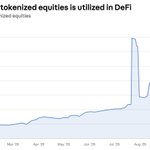
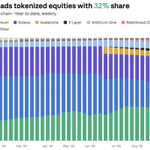
The bigger question is whether these assets are actually used on-chain, and the numbers say yes. Weekly transfer volume grew 41.8x between the weeks of Jan 5 and Oct 5, from $420M to $17.5B, against 5.8x for market cap, so each dollar of market cap now moves about seven times as often. Weekly spot DEX volume grew from $45.8M to $2.54B, 55x, and peaked at $7.26B in the week of August 31. Trading has also spread beyond Solana, which carried 99.8% of volume in January. In October, Solana held 31%, Robinhood Chain 26%, BNB Chain 25% and Base 18%.

Capital is being put to work in DeFi too. Active TVL in tokenized equities grew from $15.5M to $313M, about 20x, or from about 2% to about 8% of market cap, with $33.2M added in the last 30 days. Lending markets hold $51.3M and spot DEX pools hold $77.9M, and the top ten protocols hold 89% of the total. Still, at $3.8B this is just 0.005% of the estimated $75T US equity market, so there is a lot of room left.

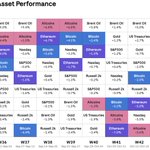
BTC fell 2.43% to about $80.5k, its third straight weekly decline, and tested $80k for the third time in three weeks. US spot ETFs lost $636M on Thursday, the largest daily outflow since June, as the Nasdaq fell 2.6%. Oil has replaced AI financing as the market’s main worry, with Brent up 5.66% to $116.72.

BTC rose with the AI rebound on Wednesday and fell with the chip selloff on Thursday, and ETF flows are now following the Nasdaq, turning two-sided after a stronger run of inflows. The equity market now carries both the wealth and the leverage. Household equity holdings rose $9.7T in Q2, margin debt hit a record $1.5T in June, and about 85% of leveraged ETF assets sit in tech, AI and semiconductors, the trade that sold off Thursday. A selloff there cuts wealth and forces deleveraging, which makes crypto more reflexive. With the Fed having hiked in September and CPI at 3.7%, an unwind meets fewer backstops. Assuming higher lows from here just because of the four-year cycle looks naive.
The stance is cautious, not bearish, until the FOMC and PCE are cleared and $82.5k is reclaimed. A dovish hold followed by a hotter PCE on Thursday would leave the Fed behind inflation and likely trigger an AI-led selloff that includes BTC. A surprise hike, which is unlikely, would clear the December overhang and could spark a relief bounce. Key dates: FOMC Wed Oct 28, Q3 GDP and September PCE Thu Oct 29, monthly options expiry Fri Oct 30, and the midterms Tue Nov 3.
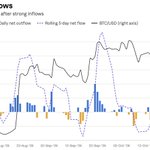
ETF investors don’t buy the dip. They sell into it. Over the ETF era, spot Bitcoin ETFs saw net outflows in 7 of 8 sell-offs of 15% or more, and net inflows in all 9 rallies. They bought on the day of the peak at 7 of 8 tops and sold on the day of the low at 7 of 8 bottoms. The two most recent sell-offs brought the heaviest selling yet: -$6.9B (Oct 2025 to Feb 2026) and -$8.2B (May to June 2026).

Some popular signals don’t hold up. IBIT’s flows predict price no better than the rest of the complex (0.08 correlation with the next day’s return). Big inflows on quiet days show no edge since 2025. Big outflows on quiet days preceded weaker 20-day returns, but that rests on 12 cases across just seven periods. Part of the flow is also the CME basis trade: hedge funds hedged roughly a fifth of ETF flow, and their net CME short has fallen from about 116k BTC in Dec 2024 to about 29k now. Today’s flows are a cleaner read of real demand than in 2024.

Takeaway:
Institutional money through ETFs hasn’t made Bitcoin safer in a sell-off. It has added a large group of investors who behave like momentum traders. ETF flows confirm moves, they don’t predict them. As always, the sample is small (8 sell-offs) and correlation isn’t causation, so treat this as a pattern, not proof.