

Sustainable Development at CU SIPA prepares scholars to undertake serious research and policy assessments to further the goal of sustainable development.
New York, NY
Joined June 2015
- Tweets1.6K
- Following274
- Followers933
- Likes421



Pinned Tweet
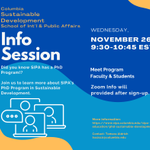
Please join us for an info session on Wednesday, November 25, 2026, from 9:30-10:45 EST, for @ColumbiaSIPA's PhD program in sustainable development.
This will be an opportunity to learn about the program, including admissions info, courses, faculty, funding, and more, as well as hear from faculty and current students. Sign Up: tinyurl.com/3efbcdru

Research by @ColumbiaSIPA PhD alum @sandraguilarg ('21), et al, finds that climate change increases the amount of intimate partner violence (IPV), through its disruptive impact on household livelihoods, among other channels.

1/3 New @UNUWIDER working paper with @AndreaSalazarD5: “Dry Spells, Work, and Gendered Violence in Mexico.”
We study a less visible cost of climate change: increased intimate partner violence following rainfall deficits.
wider.unu.edu/publication/dr…


Research by @ColumbiaSIPA PhD alum, et al, examines
lithium and development imaginaries in mining-dependent Peru and asks: "What are these imaginaries? What narratives underpin them? Who articulates and shares them, and from where? What forms of state (in)action are envisioned in relation to them?" sciencedirect.com/science/ar…

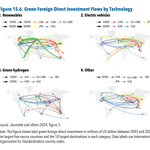
Research by @ColumbiaSIPA PhD alum Alice Zhang, Sandra Baquié, et al, finds that "the Asia and Pacific region is a powerhouse for global growth and critical to the global green transition. The energy transition is equally important for the region’s long-term growth and economic resilience." imf.org/-/media/files/public…

SIPA SusDev retweeted

I enjoyed doing this interview with probably good!
probablygood.org/interviews/…

Congrats to @ColumbiaSIPA PhD Student Eugene Tan on the successful defense of his dissertation "Network Games, Production, and Resources: Essays on Energy, Climate, and Development." Many thanks to his committee members: Scott Barrett, @danbjork, @EricVerhoogen, Geoff Heal & @GGowrisankaran.
We wish you the best of luck @UCalgary Econ!

Check out this interview with @ColumbiaSIPA PhD student Fanyu Wang, @columbiaclimate faculty @YiyuanZhou, and SIPA faculty Doug Almond on the negative impact of the US State Department’s international air quality monitoring program coming to an end March 2025.
sipa.columbia.edu/news/colum…

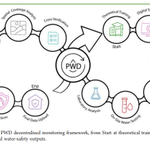
Research by @ColumbiaSIPA PhD alum Ram Fishman (2011), et al: People’s Water Data: Design and Validation of a Scalable Decentralized Framework for Monitoring Drinking Water Safety. pubs.acs.org/asrmcd/article-…

Listen to Jeff Shrader, @ColumbiaSIPA faculty, discuss his recent research examineing inequalities in forecast accuracy among countries across the globe on @ResourcesMag. resources.org/resources-radi…

Research by @ColumbiaSIPA PhD alum Florian Grosset-Touba and David Qihang Wu finds rural industrial workers, in Hawassa City, Ethiopia, who establish new network ties have the potential to help insure risks of living in an expensive city, which potentially has implications on workers turnover and migration decisions in the future.
theigc.org/sites/default/fil…

Research by @ColumbiaSIPA PhD student Fanyu Wang, @columbiaclimate faculty @YiyuanZhou, SIPA faculty, Doug Almond, and Hong Kong University faculty Allen Huang, finds proportional increases in pollution following the shutdown of air quality monitoring at embassies and consulates across the world. pnas.org/doi/abs/10.1073/pna… @PNASNews


Air pollution in dozens of cities around the world rose after U.S. embassies and consulates stopped monitoring air quality readings last year, according to a new study. wapo.st/3VuFUDk

Check out this interview with @ColumbiaSIPA PhD student, Cameron Scalera, whose research explores the true cost of AI data centers sipa.columbia.edu/news/new-s…

SIPA SusDev retweeted

NPR: Air pollution spiked after the Trump administration stopped embassy monitoring ift.tt/mWgjw2K

SIPA SusDev retweeted

The important interaction between trade and climate policy has sharpened the case for a coalition of countries that commit to price industrial emissions at home and use border adjustments to apply a carbon price to imports from nonmembers, argues a new #SciencePolicyArticle.
The authors propose a coalition that initially targets four emissions-intensive industries—iron and steel, aluminum, cement, and nitrogen fertilizers—which together account for roughly 20% of global greenhouse gas emissions. scim.ag/3VikObb

Research by @ColumbiaSIPA alum @kyle_c_meng, et al, explores "the important interaction between trade and climate policy and the need for a coalition of countries that commit to price industrial emissions at home and use border adjustments to apply a carbon price to imports from nonmembers."

The important interaction between trade and climate policy has sharpened the case for a coalition of countries that commit to price industrial emissions at home and use border adjustments to apply a carbon price to imports from nonmembers, argues a new #SciencePolicyArticle.
The authors propose a coalition that initially targets four emissions-intensive industries—iron and steel, aluminum, cement, and nitrogen fertilizers—which together account for roughly 20% of global greenhouse gas emissions. scim.ag/3VikObb
Research by @ColumbiaSIPA alum Aaron Baum, at al, finds that increased engagement of Care Teams with Medicaid enrollees with uncontrolled diabetes showed a 0.30–percentage point reduction in mean HbA1c. @DiabetesCareADA
diabetesjournals.org/docm-ca…

Research by @ColumbiaSIPA PhD Alum Aaron Baum, et al, finds that the administrative burdens, the time, effort, and stress of navigating bureaucratic requirements, impede Medicaid beneficiaries access to health care. @JAMAHealthForum
jamanetwork.com/journals/jam…
