

Official account | Taking UPSC Preparation to the Grassroots https://teapawt.org/t.co/mWcQ8A0zVs https://teapawt.org/t.co/T0QhuptAU9 Punjab Kesri, Sector 25, Chandigarh
Sector 25 Chandigarh
Joined February 2015
- Tweets12.8K
- Following25
- Followers60.4K
- Likes5.3K






𝗖𝗼𝗿𝗲 𝗧𝗵𝗲𝗺𝗲
Operationalizing bottom up, largely budget neutral internal police reforms at the police station level, via the Indian Police Foundation’s Change Manual with Azim Premji Foundation, to shift reform from statutory and judicial deadlock to everyday citizen service and personnel welfare.
𝗗𝗶𝗮𝗴𝗻𝗼𝘀𝘁𝗶𝗰𝘀
Trust Deficit & Burnout
IPF surveys across 15 police stations in Punjab, Telangana, and Tamil Nadu show citizens avoid stations due to delayed FIRs, fear of harassment, and zero inquiry updates, while personnel face excessive workloads and inadequate weekly rest.
𝗕𝗼𝘁𝘁𝗹𝗲𝗻𝗲𝗰𝗸𝘀
Operational, Digital & Welfare Gaps
Converting BNSS e complaints into signed FIRs remains slow, while stations lack basic amenities like rest rooms and weekly offs, IO transport and contingency funds, and devices for apps like e Sakshya.
𝗪𝗮𝘆 𝗙𝗼𝗿𝘄𝗮𝗿𝗱
(𝗜𝗣𝗙’𝘀 𝟰-𝗣𝗶𝗹𝗹𝗮𝗿 𝗖𝗵𝗮𝗻𝗴𝗲 𝗠𝗮𝗻𝘂𝗮𝗹 - 𝗣𝗵𝗮𝘀𝗲𝗱 𝗥𝗼𝗹𝗹𝗼𝘂𝘁 𝗦𝘁𝗮𝗿𝘁𝗶𝗻𝗴 𝗶𝗻 𝗣𝘂𝗻𝗷𝗮𝗯)
FIR & Outreach
Deploy entry point Visitor Management Systems, help desks, QR codes, women’s night safety escorts, taxi panic buttons, body worn cameras, and youth skill training and beat engagement.
Accountability & Welfare
Mandate DySP arrest scrutiny, videographed searches, free legal aid intimation, and remote lock up monitoring, alongside weekly offs, IO allowances and tablets, a police e academy, and empowering constables in investigations.

15
428
𝗖𝗼𝗿𝗲 𝗧𝗵𝗲𝗺𝗲
Transitioning National Highway expansion into a circular-economy, low-carbon model via industrial by-products, bio-materials, water conservation, and digital tolling en route to Viksit Bharat 2047.
𝗗𝗶𝗮𝗴𝗻𝗼𝘀𝘁𝗶𝗰𝘀
𝗖𝗶𝗿𝗰𝘂𝗹𝗮𝗿 𝗠𝗮𝘁𝗲𝗿𝗶𝗮𝗹 𝗦𝘂𝗯𝘀𝘁𝗶𝘁𝘂𝘁𝗶𝗼𝗻:
Since 2024, NHAI reused 15.6 crore tonnes of material led by 1,532 lakh tonnes of fly/pond ash, 10.7 lakh tonnes of Reclaimed Asphalt Pavement, 18.30 lakh tonnes of C&D waste, steel slag (cutting Mumbai–Goa pavement thickness by 28%), waste plastic, molasses bio-bitumen, and 59.2 km of bamboo crash barriers.
𝗘𝗰𝗼𝗹𝗼𝗴𝘆, 𝗪𝗮𝘁𝗲𝗿 & 𝗗𝗶𝗴𝗶𝘁𝗮𝗹 𝗧𝗼𝗹𝗹𝗶𝗻𝗴:
NHAI laid 854.5 km of jute/coir geotextiles, built 398 Amrit Sarovars, reused 21.41 lakh kL of treated sewage water, planted ~594.71 lakh saplings, and installed 19,258 solar panels. FASTag cut toll wait times from 12.2 min to 40 sec, saving 56 crore litres of fuel and 14.99+ lakh tonnes of CO2-eq annually (more than ₹74,405 crore in benefits).
𝗕𝗼𝘁𝘁𝗹𝗲𝗻𝗲𝗰𝗸𝘀
𝗣𝗶𝗹𝗼𝘁-𝘁𝗼-𝗦𝗰𝗮𝗹𝗲 & 𝗤𝘂𝗮𝗹𝗶𝘁𝘆 𝗚𝗮𝗽𝘀:
Scaling non-ash alternatives is constrained by waste processing supply chains, strict safety/engineering durability norms, commercial viability, and maintenance gaps.
𝗪𝗮𝘆 𝗙𝗼𝗿𝘄𝗮𝗿𝗱
𝗘𝗰𝗼𝘀𝘆𝘀𝘁𝗲𝗺 𝗦𝗰𝗮𝗹𝗶𝗻𝗴 & 𝟮𝟬𝟰𝟳 𝗡𝗲𝘁-𝗭𝗲𝗿𝗼 𝗥𝗼𝗮𝗱𝗺𝗮𝗽:
Mainstream green materials across all contractors using revised IRC codes, Data Lake tracking, quality assurance, lifecycle costing, and a binding NHAI carbon neutrality roadmap for 2047.

𝗖𝗼𝗿𝗲 𝗧𝗵𝗲𝗺𝗲
Operationalizing COP31’s (Antalya) target to raise electricity’s share in total energy consumption to 35% by 2035 alongside tripling global renewable capacity by 2030 by scaling solar deployment to 6 TW (6,000 GW) via the International Solar Alliance (ISA).
𝗗𝗶𝗮𝗴𝗻𝗼𝘀𝘁𝗶𝗰𝘀
𝗦𝗼𝗹𝗮𝗿 𝗦𝗰𝗮𝗹𝗲-𝗨𝗽 & 𝗗𝘂𝗮𝗹 𝗨𝘁𝗶𝗹𝗶𝘁𝘆:
Global solar capacity surged 15-fold from ~200 GW (2015) to 3,000 GW (adding the last 1,000 GW in just 19 months). Across 130 member countries, ISA proves solar + storage cuts fossil-fuel import bills while building resilience across 18 SIDS and African markets (irrigation, clean fishing boats, disaster-resilient grids).
𝗕𝗼𝘁𝘁𝗹𝗲𝗻𝗲𝗰𝗸𝘀
𝗕𝗮𝗻𝗸𝗮𝗯𝗶𝗹𝗶𝘁𝘆, 𝗚𝗿𝗶𝗱 & 𝗦𝗸𝗶𝗹𝗹 𝗚𝗮𝗽𝘀:
Developing economies lack local currency financing, investment-ready project pipelines, flexible digitized grids, storage, and skilled domestic technicians/engineers to sustain multi-decade assets.
𝗪𝗮𝘆 𝗙𝗼𝗿𝘄𝗮𝗿𝗱
𝗖𝗹𝗶𝗺𝗮𝘁𝗲 𝗜𝗺𝗽𝗹𝗲𝗺𝗲𝗻𝘁𝗮𝘁𝗶𝗼𝗻 𝗕𝗿𝗶𝗱𝗴𝗲 & 𝗜𝗦𝗔 𝗦𝗛𝗜𝗡𝗘:
Leverage COP31’s Climate Implementation Bridge to match existing finance/tech with national priorities, and scale ISA SHINE (India’s solar Global Capability Centre) to drive bankable projects, grid modernization, AI learning tools, and South–South technical training.

35
558
𝗖𝗼𝗿𝗲 𝗧𝗵𝗲𝗺𝗲
Integrating unpaid housework and care work metrics into the Periodic Labour Force Survey (PLFS) (MoSPI initiative) to decode constraints on female labour force participation (FLFP), narrow gender pay gaps, and guide care-economy policies
𝗗𝗶𝗮𝗴𝗻𝗼𝘀𝘁𝗶𝗰𝘀
𝗖𝗮𝗿𝗲 𝗕𝘂𝗿𝗱𝗲𝗻 & 𝗜𝗻𝗳𝗼𝗿𝗺𝗮𝗹𝗶𝘇𝗮𝘁𝗶𝗼𝗻:
While rural FLFP has risen, urban FLFP remains low as unpaid domestic and care responsibilities push women with young children out of work or into home-based, informal, flexible-hour roles, widening gender pay gaps.
𝗦𝗶𝗹𝗼𝗲𝗱 𝗗𝗮𝘁𝗮𝘀𝗲𝘁𝘀:
The Labour Force Survey (LFS) and Time Use Survey (TUS) are non-comparable, forcing reliance on crude proxies (like household child counts) to link time poverty with employment.
𝗕𝗼𝘁𝘁𝗹𝗲𝗻𝗲𝗰𝗸𝘀
𝗖𝗹𝗮𝘀𝘀𝗶𝗳𝗶𝗰𝗮𝘁𝗶𝗼𝗻 𝗚𝗮𝗽𝘀 & 𝗦𝘂𝗿𝘃𝗲𝘆 𝗕𝗹𝗶𝗻𝗱 𝗦𝗽𝗼𝘁𝘀:
TUS restricts NIC-2008 data to two digits without occupational codes, while LFS omits questions on care constraints faced by employed women and undercounts peripheral/subsistence workers.
𝗪𝗮𝘆 𝗙𝗼𝗿𝘄𝗮𝗿𝗱
𝗨𝗻𝗶𝗳𝗶𝗲𝗱 𝗣𝗟𝗙𝗦 𝗜𝗻𝘁𝗲𝗴𝗿𝗮𝘁𝗶𝗼𝗻 & 𝗩𝗮𝗹𝘂𝗮𝘁𝗶𝗼𝗻:
Embed unpaid care-work questions directly into regular PLFS rounds to link care burdens with occupational choices and wages, capture subsistence workers, and support economic valuation of unpaid work for targeted workplace and childcare reforms.

𝗖𝗼𝗿𝗲 𝗧𝗵𝗲𝗺𝗲
Shifting Indian agriculture from the output-centric Green Revolution to an ecologically sustainable, farmer-centric Evergreen Revolution anchored in M.S. Swaminathan’s vision and the National Commission on Farmers (NCF) to counter climate and geopolitical shocks.
𝗗𝗶𝗮𝗴𝗻𝗼𝘀𝘁𝗶𝗰𝘀
𝗖𝗹𝗶𝗺𝗮𝘁𝗲 & 𝗜𝗻𝗽𝘂𝘁 𝗦𝗵𝗼𝗰𝗸𝘀
Monsoonal rainfall stood at 87% of LPA and 178 major reservoirs fell to 68.6% capacity (Oct 15, 2026) amid a strengthening El Niño, while global supply pressures forced a 64% hike in Nutrient-Based Subsidy (NBS) (₹62,370.02 crore) for Rabi 2026–27.
𝗕𝗼𝘁𝘁𝗹𝗲𝗻𝗲𝗰𝗸𝘀
𝗨𝗻𝗳𝘂𝗹𝗳𝗶𝗹𝗹𝗲𝗱 𝗡𝗖𝗙 𝗠𝗮𝗻𝗱𝗮𝘁𝗲 & 𝗢𝘂𝘁𝗽𝘂𝘁 𝗕𝗶𝗮𝘀:
Two decades after the Swaminathan Commission (2004–2006), core income and resource-access reforms remain incomplete, while policy prioritizes grain volume over nutrition and ecological resilience.
𝗪𝗮𝘆 𝗙𝗼𝗿𝘄𝗮𝗿𝗱
𝗖𝗹𝗶𝗺𝗮𝘁𝗲-𝗥𝗲𝘀𝗶𝗹𝗶𝗲𝗻𝘁 𝗔𝗴𝗿𝗼-𝗘𝗰𝗼𝗹𝗼𝗴𝘆:
Promote short-duration, drought/heat-tolerant local seeds, crop diversification, soil health, and PMKSY ('Per Drop More Crop') micro-irrigation while centering farmer viability and nutrition.

𝗖𝗼𝗿𝗲 𝗧𝗵𝗲𝗺𝗲
Navigating the rising backlash against AI data centres balancing data sovereignty and digital infrastructure growth with environmental sustainability, local resource equity, and regulation.
𝗗𝗶𝗮𝗴𝗻𝗼𝘀𝘁𝗶𝗰𝘀
Capacity Surge vs. Sovereignty Gap:
India’s operational capacity grew from 0.375 GW (2020) to 1.575 GW (2026) (projected 8 GW by 2030, MeitY), led by Mumbai (790 MW) and Chennai (305 MW).
Despite generating ~20% of global data, India hosts only ~3% of global data centres (Economic Survey 2025–26), driving localization to cut latency and secure data sovereignty.
Resource Intensity:
An AI data centre consumes as much power as 100,000 households (up to 20x more for mega-facilities, IEA), while a 150 MW frontier facility requires $5+ billion in capex and $500 million/year to run.
𝗕𝗼𝘁𝘁𝗹𝗲𝗻𝗲𝗰𝗸𝘀
Asymmetric Cost–Benefit & NIMBYism:
Benefits accrue to distant users while water and power strain hits locals fueling protests (including legal challenges to the $15 billion Adani–Google campus in Visakhapatnam over reservoir catchment and wildlife clearances) despite modest permanent jobs (~100+).
Regulatory Vacuum:
Without a national policy, competing state incentives risk an environmental "race to the bottom".
𝗪𝗮𝘆 𝗙𝗼𝗿𝘄𝗮𝗿𝗱
National Green Framework & Compute Efficiency:
Establish a national data centre policy mandating renewable power, water-efficient closed-loop/direct-to-chip cooling, and transparent environmental clearances, while promoting smaller, task-specific AI models and decentralized compute (Economic Survey 2025–26).

𝗖𝗼𝗿𝗲 𝗧𝗵𝗲𝗺𝗲
Shifting disaster financing from reactive relief toward integrated risk assessment credit continuity and preventive mitigation to shield the rural economy and state finances from rainfall shocks
𝗗𝗶𝗮𝗴𝗻𝗼𝘀𝘁𝗶𝗰𝘀
Rainfall Output and Credit Shock 2026:
A 12.6% monsoon deficit contracted kharif by 1.2M ha and rabi by 11.3% or 2.28M ha risking ~26 million tonnes in output losses across ~13.5 million ha in 754 districts.
While aggregate farm credit impact is 2.8% SBI Climate Credit Exposure Index flags acute stress in Karnataka and Tamil Nadu
𝗕𝗼𝘁𝘁𝗹𝗲𝗻𝗲𝗰𝗸𝘀
State Fiscal Gap vs 16th FC Corpus
Against the 16th Finance Commission: ₹2.04 trillion SDRF and SDMF corpus for 2026 to 31 drought allocations for five key exposed states at ~₹13,776 crore fall far short of their estimated ~₹32,775 crore fiscal burden while blanket farm loan waivers strain state budgets and erode credit discipline
𝗪𝗮𝘆 𝗙𝗼𝗿𝘄𝗮𝗿𝗱
Credit Restructuring and Risk Mapped Mitigation:
Replace loan waivers with extended bank repayment tenures with state interest co sharing and pair district level economic and credit risk mapping with SDMF backed preventive budgeting

𝗖𝗼𝗿𝗲 𝗧𝗵𝗲𝗺𝗲
Overhauling India’s 2006 National Urban Transport Policy (NUTP) toward an integrated, multimodal, city-led urban mobility framework to resolve congestion, pollution, and oil import burdens en route to a $30-trillion economy by 2047.
𝗞𝗲𝘆 𝗗𝗶𝗮𝗴𝗻𝗼𝘀𝘁𝗶𝗰𝘀
Two-Wheeler Motorisation & Oil Surge:
Registered vehicles jumped from 90 million (2006) to 413 million (2026) driven by two-wheelers, which grew from 2.6 million (1981) to 316 million (2025) (76% of the fleet) pushing India’s oil import bill up 10-fold to ₹11.7 lakh crore (2024–25).
Metro Capex Skew vs. Low Ridership:
Despite spending ₹4.5 lakh crore on 1,095 km of metro rail across 26 cities, combined ridership remains under 7 million/day.
𝗞𝗲𝘆 𝗕𝗼𝘁𝘁𝗹𝗲𝗻𝗲𝗰𝗸𝘀
Standalone Engineering & Missing Last-Mile:
Metros are built as isolated engineering projects prioritizing construction convenience over land-use and last-mile integration, while cities lack unified transport authorities (like TfL or Singapore's LTA) and quality bus fleets to attract 2W commuters.
𝗪𝗮𝘆 𝗙𝗼𝗿𝘄𝗮𝗿𝗱
Unified Authorities, Premium Buses & EVs:
Establish empowered city-level transport bodies, integrate mass transit with last-mile/land-use planning, deploy premium bus services to shift 2W riders, set ambitious EV targets, and leverage private sector operational efficiency.

𝗖𝗼𝗿𝗲 𝗧𝗵𝗲𝗺𝗲
Establishing an updated official poverty line using 2022–23 HCES data, as divergent yardsticks produce estimates ranging from ~5% to >26% and mask economic insecurity.
𝗗𝗶𝗮𝗴𝗻𝗼𝘀𝘁𝗶𝗰𝘀
Consumption Divergence (2022–23):
World Bank lines (2021 PPP) show 2.6% poverty at $3/day versus ~16.1% at $4.20/day; domestically, inflation-adjusted Tendulkar lines (SBI Research) yield 7.2% rural / 4.6% urban, while reconstructed Rangarajan lines (Sethu et al.) reach 26.4%.
Structural & MPI Reality:
NITI Aayog’s MPI fell to 14.96% (2019–21) (projected 11.28% in 2022–23), yet 80% of Indians lived below $8.30/day (2023) and 30% lacked basic sanitation.
𝗕𝗼𝘁𝘁𝗹𝗲𝗻𝗲𝗰𝗸𝘀
Benchmark Vacuum & Yardstick Flaws:
Non-publication of the 2017–18 survey and no updated official line since Tendulkar (2009) and Rangarajan (2014) left policy unanchored, while low extreme-poverty lines mask inequality.
𝗪𝗮𝘆 𝗙𝗼𝗿𝘄𝗮𝗿𝗱
Dual-Metric Framework:
Use 2022–23 HCES data to set a unified official poverty line for decent living standards, paired with survey-backed MPI tracking (health, education, sanitation, water, housing).

𝗖𝗼𝗿𝗲 𝗧𝗵𝗲𝗺𝗲
Shifting global AI governance from narrow technical safety to systemic macro-risks financial fragility, power concentration, and geopolitical weaponization while positioning India to champion a human-centric AI order.
𝗞𝗲𝘆 𝗗𝗶𝗮𝗴𝗻𝗼𝘀𝘁𝗶𝗰𝘀
Capital & Debt Surge (2026):
In the first nine months of 2026, AI absorbed ~83% of US venture capital ($427 billion), while AI-linked debt jumped to $466 billion (Morgan Stanley) and data-centre borrowing hit $680 billion through October (US Fed), with 87% of Fed contacts flagging AI financial risks.
Geopolitical Fragmentation:
Escalating US–China tech restrictions, export controls, and espionage probes are splitting the world into competing technology blocs.
𝗞𝗲𝘆 𝗕𝗼𝘁𝘁𝗹𝗲𝗻𝗲𝗰𝗸𝘀
Circular Financing & Monopoly Power:
Chipmakers and cloud providers fund customers buying their compute creating self-reinforcing debt loops while extreme concentration among a few firms weakens accountability and subordinates safety to speed.
Zero-Sum Tech Rivalry:
Treating AI as a zero-sum geopolitical race blocks common safety standards and forces smaller nations into strategic dependencies.
𝗪𝗮𝘆 𝗙𝗼𝗿𝘄𝗮𝗿𝗱
Human-Centric & Distributed Governance:
Address financial leverage, concentration, and geopolitics as interconnected risks shifting focus from raw compute races to human agency, independent accountability, and India-led Global South inclusion.

𝗖𝗼𝗿𝗲 𝗧𝗵𝗲𝗺𝗲
Repositioning water and sanitation as preventive public health infrastructure using AI-enabled wastewater surveillance to eliminate infectious diseases (polio, Neglected Tropical Diseases) and accelerate SDG 6 ahead of the 2026 UN Water Conference (Abu Dhabi).
𝗗𝗶𝗮𝗴𝗻𝗼𝘀𝘁𝗶𝗰𝘀
WASH Deficit & Disease Burden:
Globally, 2.1 billion people lacked safely managed drinking water and 3.4 billion lacked safely managed sanitation (WHO/UNICEF, 2024), while unsafe WASH caused at least 1.4 million preventable deaths (2019).
Surveillance Precedents:
Contaminated water sustains poliovirus transmission (>99% reduction since 1988, yet facing last-mile hurdles).
Models like Abu Dhabi’s AI wastewater surveillance and the EU Wastewater Surveillance Dashboard (2025) detect pathogens before clinical outbreaks occur.
𝗕𝗼𝘁𝘁𝗹𝗲𝗻𝗲𝗰𝗸𝘀
Institutional Silos & Last-Mile Gaps:
Health and water policies lack integrated investment, leaving marginalized, low-access communities most exposed to waterborne transmission.
𝗪𝗮𝘆 𝗙𝗼𝗿𝘄𝗮𝗿𝗱
Predictive Water-Health Systems:
Scale AI-enabled wastewater monitoring to shift governance from reactive outbreak response to anticipatory disease prevention.
Cross-Sectoral Financing:
Bridge health-water silos via public-private-philanthropic partnerships (modeled on the Reaching the Last Mile Fund) at the 2026 UN Water Conference.

𝗖𝗼𝗿𝗲 𝗧𝗵𝗲𝗺𝗲
Leveraging India’s negotiating capital at COP31 to secure a quantified minimum annual public grant commitment from developed nations, anchored in Article 9.4 of the Paris Agreement and Common But Differentiated Responsibilities (CBDR).
𝗗𝗶𝗮𝗴𝗻𝗼𝘀𝘁𝗶𝗰𝘀
NCQG & Debt Burden:
Scaling climate finance to $300 billion annually by 2035 faces US political headwinds and European fiscal constraints.
Meanwhile, loans made up 67% of public climate finance in 2024 vs. 29% in grants (OECD), worsening sovereign debt distress for vulnerable nations.
𝗕𝗼𝘁𝘁𝗹𝗲𝗻𝗲𝗰𝗸𝘀
Adaptation Finance Deficit:
Commercial private capital seeks returns and cannot fund public-good adaptation (e.g., early warning systems).
Multilateral Grant Dilution:
Green Climate Fund (GCF) proposals to lift aggregate loan caps and count guarantees as grant-equivalent inflate replenishment numbers without increasing actual cash grants.
𝗪𝗮𝘆 𝗙𝗼𝗿𝘄𝗮𝗿𝗱
Ring-Fenced Grant Floor:
Demand a quantified annual public grant target prioritized for adaptation in vulnerable countries, counting only actual grant disbursements.
Global South Coalition:
Build developing-nation coalitions continuing India’s leadership since 1990 to enforce CBDR and Article 9.4.

𝗖𝗼𝗿𝗲 𝗧𝗵𝗲𝗺𝗲
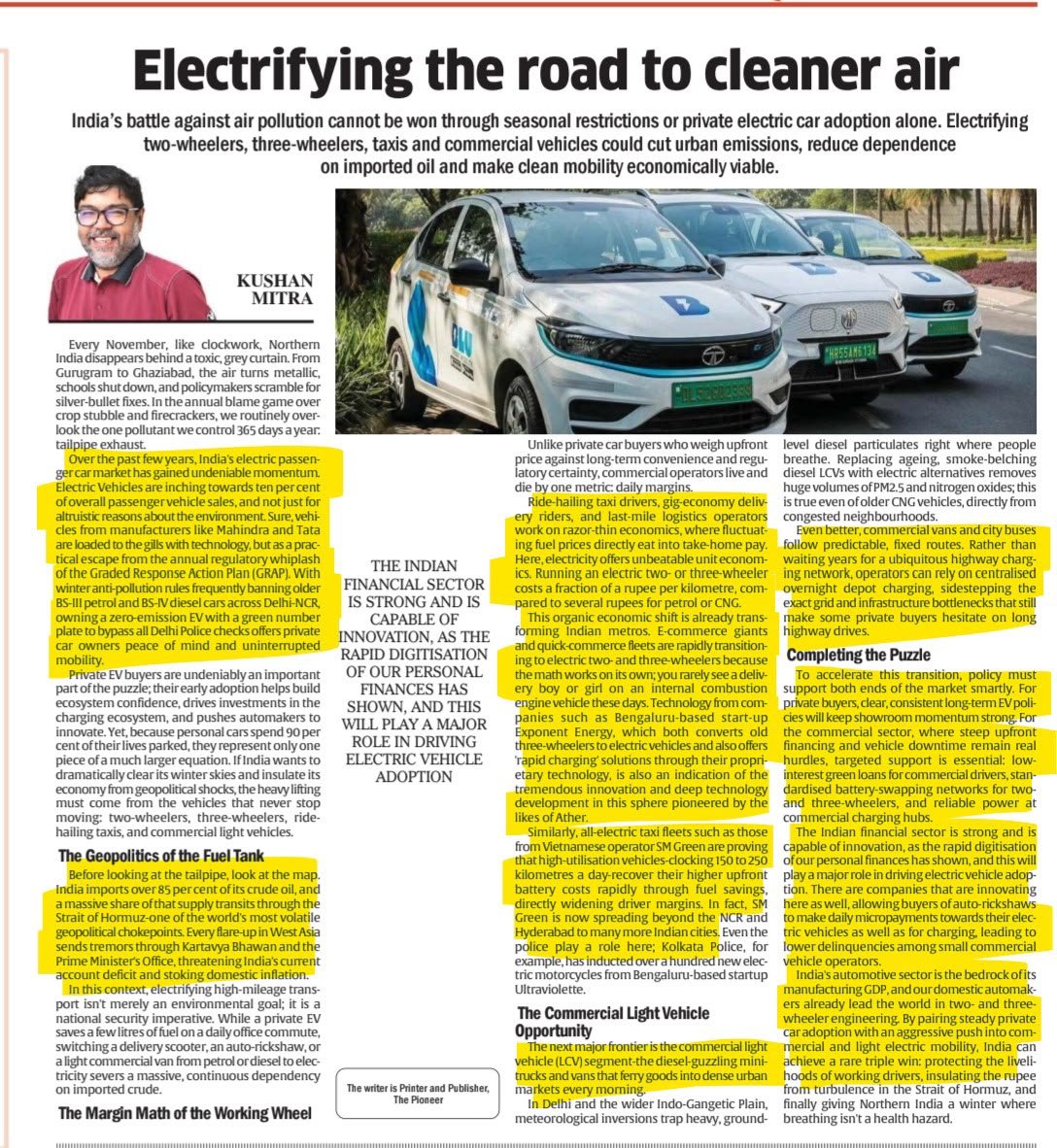
Prioritizing high-utilization commercial EVs (e-2Ws, e-3Ws, taxis, LCVs) over private cars to curb year-round urban emissions, cut crude oil imports, and achieve viable unit economics.
𝗗𝗶𝗮𝗴𝗻𝗼𝘀𝘁𝗶𝗰𝘀
Fleet Leverage & Economics:
Private cars stay parked ~90% of the time, whereas commercial fleets clock 150–250 km/day, rapidly recovering battery costs via lower per-km running expenses.
Energy & Air Quality Imperative:
Electrifying commercial fleets insulates India (>85% crude oil import-dependent via the Strait of Hormuz) from geopolitical shocks while curbing ground-level diesel LCV particulates.
𝗕𝗼𝘁𝘁𝗹𝗲𝗻𝗲𝗰𝗸𝘀
Financial & Operational Hurdles:
Steep upfront vehicle costs, revenue loss from charging downtime, unreliable commercial grids, and non-standardized battery swapping deter small operators.
𝗪𝗮𝘆 𝗙𝗼𝗿𝘄𝗮𝗿𝗱
Targeted Policy & Fintech:
Pair PM E-DRIVE (₹11,900 crore outlay extended till March 2028) with low-interest green loans, daily digital micropayments, and standardized battery swapping.
Depot Charging:
Leverage fixed urban LCV/bus routes for centralized overnight depot charging alongside domestic 2W/3W manufacturing strength.
𝗖𝗼𝗿𝗲 𝗧𝗵𝗲𝗺𝗲
Scaling India’s Self-Help Group (SHG) movement from micro-credit to women-led rural entrepreneurship under the Lakhpati Didi initiative (annual household income ≥ ₹1 lakh).
𝗗𝗶𝗮𝗴𝗻𝗼𝘀𝘁𝗶𝗰𝘀
Reach & Targets:
Built on DAY-NRLM (~100 million women across 9.2 million SHGs), it achieved 30 million Lakhpati Didis by February 2026 and raised the target to 60 million by March 2029.
Impact:
An IIM Ahmedabad study (Nov 2025–March 2026 across 17 States/UTs) confirmed gains in income, savings, livelihood diversification, and women's decision-making.
𝗕𝗼𝘁𝘁𝗹𝗲𝗻𝗲𝗰𝗸𝘀
Market & Income Fragility:
Seasonal farm fluctuations and uncertain markets mean credit alone does not ensure profitability.
Tracking & Capacity Gaps:
Measuring sustained income across informal activities is difficult amid uneven state institutional capacities.
𝗪𝗮𝘆 𝗙𝗼𝗿𝘄𝗮𝗿𝗱
Five-Enabler Convergence:
Integrate productive assets, skills, finance, markets, and technology through district-level departmental convergence.
Income Durability:
Strengthen producer collectives, market linkages, and decentralized mentoring via SRLMs and Community Resource Persons (CRPs).

𝗖𝗼𝗿𝗲 𝗧𝗵𝗲𝗺𝗲
Resolving India’s rice export paradox by shifting from volume-driven cultivation to a "volume-to-value" model (more crop per drop, higher income per tonne, and lower carbon/water intensity).
𝗗𝗶𝗮𝗴𝗻𝗼𝘀𝘁𝗶𝗰𝘀
Export Paradox (APEDA 2025–26):
India commands 30–35% of global rice exports (154.02 MT production).
However, non-Basmati exports (15.04 MT; $5.86 bn) are more than double Basmati volumes (6.52 MT; $5.67 bn) yet earn only marginally more due to sharp unit-value disparity (~$388/tonne vs. ~$870/tonne).
𝗕𝗼𝘁𝘁𝗹𝗲𝗻𝗲𝗰𝗸𝘀
Virtual-Water Depletion:
Groundwater-fed (blue water) non-Basmati exports accelerate aquifer stress across Punjab, Haryana, western UP, and eastern/southern states.
High GHG Footprint:
Continuous field flooding, excessive nitrogen fertilizer use, energy-intensive pumping, and stubble burning amplify methane and carbon emissions.
𝗪𝗮𝘆 𝗙𝗼𝗿𝘄𝗮𝗿𝗱
Agro-Climatic Alignment & Smart Agronomy:
Incentivize crop diversification in water-stressed zones and scale Alternate Wetting and Drying (AWD) and Direct-Seeded Rice (DSR) tailored to local soils.
Value-Chain & Composite Metrics:
Boost unit export value via GI tags, branding, and traceability, while tracking policy success through water-carbon-value metrics (export value per cubic metre of blue water and emissions per kg).

𝗖𝗼𝗿𝗲 𝗧𝗵𝗲𝗺𝗲 (𝗚𝗦-𝗜𝗜𝗜 𝗘𝗰𝗼𝗻𝗼𝗺𝘆 & 𝗘𝗻𝘃𝗶𝗿𝗼𝗻𝗺𝗲𝗻𝘁 / 𝗚𝗦-𝗜𝗩 𝗘𝘁𝗵𝗶𝗰𝘀)
Critiquing "disaster capitalism" and flawed GDP accounting where ecological destruction and post-disaster rebuilding inflate growth while depleting natural capital and deepening climate inequality ahead of COP31 in Türkiye.
𝗗𝗶𝗮𝗴𝗻𝗼𝘀𝘁𝗶𝗰𝘀
Carbon Inequality (Oxfam's Disaster Divide, Oct 27, 2026):
The richest 0.1% (~8 million people) emit more carbon than the poorest 44% (~3.5 billion people) combined, while India’s per capita CO2 emissions (~2.1 tonnes) remain far below the US (~13.4 tonnes).
Disaster-Recovery Market:
Projected to grow from $70 billion to $92 billion annually by 2029, with major asset managers (BlackRock, Vanguard) invested in 92% of the 217 firms on Oxfam's Destroy & Rebuild Index.
𝗕𝗼𝘁𝘁𝗹𝗲𝗻𝗲𝗰𝗸𝘀
Flawed GDP Accounting:
Post-disaster rebuilding boosts GDP without net wealth creation, treating natural capital depletion (e.g., melting Himalayan glaciers) as income while socialising ecological externalities.
Debt-Driven Climate Finance:
Vulnerable developing nations face recurring cycles of climate shocks and debt rather than grant-based adaptation support.
𝗪𝗮𝘆 𝗙𝗼𝗿𝘄𝗮𝗿𝗱
Green Accounting & Polluter Accountability:
Reform national metrics for natural capital depreciation, internalize corporate externalities, and ensure grant-based adaptation finance at COP31.
Sufficiency over Overconsumption:
Distinguish basic developmental needs from luxury overconsumption, anchoring policy in ecological stewardship and intergenerational equity.

𝗖𝗼𝗿𝗲 𝗧𝗵𝗲𝗺𝗲 (𝗚𝗦-𝗜𝗜 𝗣𝗼𝗹𝗶𝘁𝘆 & 𝗦𝗼𝗰𝗶𝗮𝗹 𝗝𝘂𝘀𝘁𝗶𝗰𝗲)
Re-evaluating the two-child electoral bar in Panchayati Raj Institutions (PRIs) amid below-replacement fertility, reproductive autonomy (Article 21), and grassroots gender equity.
𝗗𝗶𝗮𝗴𝗻𝗼𝘀𝘁𝗶𝗰𝘀
Judicial Relook:
On Nov 4, 2026 (Mangala Bhimrao Ingle case), the Supreme Court referred its 2003 Javed v. State of Haryana ruling to a larger bench, holding that population-control laws "have now lost their significance" under the doctrine of changed circumstances.
Demographic Shift:
India’s Total Fertility Rate fell from 3.0 (2003) to 1.9 (2024 SRS) below the 2.1 replacement level shifting concerns toward an ageing population and shrinking workforce.
𝗕𝗼𝘁𝘁𝗹𝗲𝗻𝗲𝗰𝗸𝘀
Grassroots Asymmetry:
Restricting only PRI candidates while exempting MLAs and MPs undercuts the 73rd Constitutional Amendment’s 33% women's quota.
Coercion & Agency Deficit:
Unequal marital power and son-preference deny women reproductive control, causing the norm to weaken marginalized women (2009 Ministry study) and trigger forced abortions, desertion, and paternity denial.
𝗪𝗮𝘆 𝗙𝗼𝗿𝘄𝗮𝗿𝗱
Rights-Based Jurisprudence:
Anchor the larger bench's ruling in reproductive autonomy (Article 21) and repeal punitive PRI caps across the remaining six states.
Social Policy over Coercion:
Address son-preference through maternal healthcare and behavioral reform rather than exclusionary grassroots filters.

𝗖𝗼𝗿𝗲 𝗧𝗵𝗲𝗺𝗲 (𝗚𝗦-𝗜𝗜 𝗦𝗼𝗰𝗶𝗮𝗹 𝗝𝘂𝘀𝘁𝗶𝗰𝗲)
Scaling Eklavya Model Residential Schools (EMRS) to build tribal human capital for Viksit Bharat 2047, spotlighted on Janjatiya Gaurav Diwas.
𝗗𝗶𝗮𝗴𝗻𝗼𝘀𝘁𝗶𝗰𝘀
Reach & Equity:
Targeting every block with >50% ST population and ≥20,000 tribals (440 new schools). Enrolment stands at 1,72,953 students (with 50% seats reserved for girls, who outnumber boys).
Funding:
Capital outlays of ₹37.8–48 crore per school and ₹1,47,356/student annual recurring expenditure (since FY2026–27).
𝗕𝗼𝘁𝘁𝗹𝗲𝗻𝗲𝗰𝗸𝘀
Foundational Deficits:
First-generation learners struggle with baseline competencies and language barriers when shifting to formal English instruction.
Implementation Lag:
Legacy EMRS phases suffered from uneven remote infrastructure and management gaps.
𝗪𝗮𝘆 𝗙𝗼𝗿𝘄𝗮𝗿𝗱
Dual Governance:
NESTS sets centralized national standards while District Collector-led committees oversee local execution.
Pedagogical Support:
Institutionalize 65-day bridge courses for Class VI entrants and bilingual instruction in early grades before transitioning to English under EMRS 2.0/3.0.

𝗖𝗼𝗿𝗲 𝗧𝗵𝗲𝗺𝗲
Transitioning from piecemeal EV incentives to a coordinated National Transport Policy and National Clean Mobility Mission linking public procurement, grid readiness, and lifecycle emissions.
𝗗𝗶𝗮𝗴𝗻𝗼𝘀𝘁𝗶𝗰𝘀
Demand-Side Leverage:
Under the November 10, 2026 Department of Expenditure Office Memorandum, EVs are the default choice for central government staff cars with a ₹20 lakh Net Dealer Price ceiling (vs. ₹10 lakh for ICE vehicles).
Siloed Adoption:
EV uptake remains skewed toward 2–3 wheelers, while ministries pursue unaligned electrification and charging timelines.
𝗕𝗼𝘁𝘁𝗹𝗲𝗻𝗲𝗰𝗸𝘀
Grid-Charger Disconnect:
Procuring fleet EVs without matching charging infrastructure and distribution capacity undermines financial viability.
TCO Blind Spots:
Focusing solely on upfront price ceilings ignores Total Cost of Ownership (utilization, tariffs, maintenance, residual value).
𝗪𝗮𝘆 𝗙𝗼𝗿𝘄𝗮𝗿𝗱
Triphasic Roadmap:
Build charging/grid readiness via government fleets (2026–29), scale e-buses/commercial freight via risk-sharing (2029–35), and pivot to lifecycle "green mobility" (2035–47).
National Clean Mobility Mission:
Create an apex body to align ministries, states, and industry, backed by annual monitoring and periodic reviews in 2029 and 2035.

𝗖𝗼𝗿𝗲 𝗧𝗵𝗲𝗺𝗲
Combating India's Non-Communicable Disease (NCD) surge a threat to Viksit Bharat 2047's demographic dividend by shifting from curative care to preventive health, nutritional literacy, and lifestyle governance (World Diabetes Day 2026: "Early Action on Diabetes").
𝗗𝗶𝗮𝗴𝗻𝗼𝘀𝘁𝗶𝗰𝘀
Epidemiological Burden:
101 million Indians have diabetes and 136 million have prediabetes (ICMR-INDIAB), affecting 1 in 3 urban adults, while 12-year-olds now develop fatty liver conditions once seen at 60.
Dietary Regression:
Fibre-rich millets (ragi, bajra) and whole grains have been replaced by polished white rice, maida, refined sugar, and ultra-processed foods.
𝗕𝗼𝘁𝘁𝗹𝗲𝗻𝗲𝗰𝗸𝘀
Obesogenic Environment & Marketing:
High salt/sugar/oil intake and sedentary routines combine with unchecked junk-food advertising targeting children.
Reactive Healthcare:
Public health remains overly focused on late-stage disease management rather than early detection and behavioral prevention.
𝗪𝗮𝘆 𝗙𝗼𝗿𝘄𝗮𝗿𝗱
Universal Screening:
Mandate universal screening for all Indians over 30 and every child with obesity via Ayushman Arogya Mandirs and NP-NCD.
Regulatory & Behavioral Nudges:
Ban junk-food ads aimed at children, embed nutrition education in schools, and promote millets (Shree Anna), meal-sequencing, and post-meal walking.
