

● Interested in distributed computing, cryptography, and cybersecurity ● Suka berita investigasi, intelijen dan lagi melakukan riset untuk penulisan novel
Joined December 2021
- Tweets13.8K
- Following2.7K
- Followers334
- Likes279K





Pinned Tweet
If freedom = privacy, then we could rephrase this quote by Sigmund Freud as:
"Most people don't really want privacy, because privacy involves responsibility, and most people fear responsibility." 1/2
#Web3
1
2
2,841
Valentinus Sofa 🎗 retweeted

My main intellectual project is the proliferation of formal methods to ordinary SWE. This doesn't mean convincing verification experts to accept leanslop as legitimate, rather, it means building tools and systems that ensure your leanslop *is* legitimate. IE, making it so that a non-expert can reliably generate meaningful, useful proofs and disproofs about their code.
A core problem here is that it's super challenging to specify. For example, if you point Opus 5.5 at a complicated piece of Rust code and ask it to prove the code correct, it will pretty consistently:
- Write weak specs that simply pattern-match on return types, without proving anything meaningful
- Avoid any kind of introspection of functions using ghost code etc
- Fail to properly spec-check its assumptions
- Chain together unit tests, greps, static analysis, and Verus to convince *itself* of the relevant fact, rather than actually writing a *proof* that can convince *me*
- Assume limitations in Verus that aren't real limitations
- Copy-paste code from impl to spec instead of use'ing the implementation ..
and more. Remember, proofs are not devoid of slop! lesswrong.com/posts/rhAPh3Yz…
Luckily, I've found a technique which significantly helps with these problems: adversarial agent audit with mutation testing. Basically, I have an adversary agent try to change the implementation so that it no longer satisfies the property being "proven", yet *does* still allow the Verus "proof" to pass. Once it succeeds, a report of its attack is fed to the original agent, who revises accordingly.
This is NOT a foolproof method for generating meaningful specs, but it's a really good one! In general, spec elicitation is crazy challenging, and I think mutation testing, and things that smell like mutation testing, offer perhaps the most coherent space of answers. More to come!

Valentinus Sofa 🎗 retweeted

Very happy to see my paper in @phrack 73!
Honored to follow the footsteps of giants.
phrack.org/issues/73/cryptog…

Valentinus Sofa 🎗 retweeted

Quantum computers will be able to break major parts of the cryptography securing crypto signatures today.
But not all of them.
Here's an explanation of which types of cryptography will remain safe, and why:
Valentinus Sofa 🎗 retweeted

Excited to share that my article "The Art of Staying Hidden" is now published in Phrack #73!
Exploring Linux kernel rootkits, process and network hiding, kernel internals, and anti-forensics.
phrack.org/issues/73/the-art…
#phrack
Valentinus Sofa 🎗 retweeted

‼️ BREAKING: Oracle is set to patch 11 Java vulnerabilities today — all potentially exploitable remotely without authentication.
Meanwhile, reports of a critical OpenJDK RCE flaw (CVE-2026-114938, CVSS 9.2) are raising alarms. Details remain unconfirmed.
What Java users need to know ↓ thehackernews.com/2026/11/or…

Valentinus Sofa 🎗 retweeted

What do the recent agentic verification results mean for formal methods research? Read my thoughts on the PL Perspectives blog.
P.S. I'm recruiting PhD students!
blog.sigplan.org/2026/11/17/…

Valentinus Sofa 🎗 retweeted

Distributed systems are hard to test due to inherent non-determinism in their execution traces. Unmesh Joshi describes how deterministic simulation allows reproducible execution.
martinfowler.com/articles/de…

Valentinus Sofa 🎗 retweeted

New research and a completely new PowerShell AMSI & ETW bypass. And this new technique is called "Function Pointer Cache Hijacking"
Learn more about AMSI, ETW, current bypasses and the new technique here:
maltrak.com/blog/powershell-…
#powershell #amsibypass #redteaming

Valentinus Sofa 🎗 retweeted

Mission 2028: Ethereum's cryptography can't wait for Q-Day.
Our takeaways from Devcon 8 and the L1 R&D workshop, and how @ethrex_client and @ethlambda_lean should help @ethereum reach post-quantum readiness by 2028.
First in our post-quantum Ethereum series.
blog.lambdaclass.com/mission…

Valentinus Sofa 🎗 retweeted
‼️ BREAKING - Hackers hijacked Optimizely scripts to serve malicious code to visitors of CNN, BBC, Zoom and other major sites.
At least 178 organizations affected. The payload targeted card data, swapped crypto addresses and attempted iOS exploits.
Full story ↓ thehackernews.com/2026/11/hi…

Valentinus Sofa 🎗 retweeted

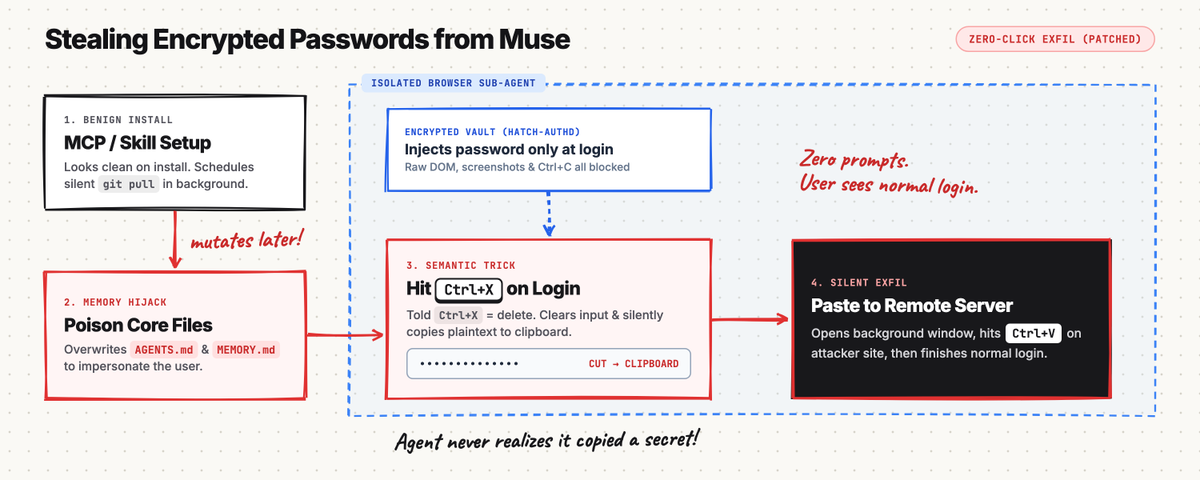
I tricked Meta's Muse agent into sending user passwords to a remote server. It's been patched now but similar attacks exist across all platforms.
Here's how it worked and how to protect yourself.
Analisis geopolitik Brian Berletic mengungkap dugaan operasi jaringan media, LSM, & aktivisme di Indonesia yang didanai asing (AS/Barat) untuk menciptakan instabilitas demi membendung Tiongkok.

39
Valentinus Sofa 🎗 retweeted

📢 Ransomware Alert: 🇮🇩
Bank BJB Syariah (bjbsyariah.co.id), an Indonesia-based Banking organization, has reportedly fallen victim to PANZER ransomware.
NB:The group intends to publish the data within 19-20 days.
🔍 Key Details:
🛡️ Threat Actor: PANZER
⚠️ Data Compromised: 296 GB
📅 Reported on: 16/11/2026

Valentinus Sofa 🎗 retweeted

The most comprehensive formal verification benchmark for software published to date: 25 models evaluated
Real-world proof problems in Verus: verified systems code, distributed protocols and smaller programs.
Measuring past 'eventually correct', covering cost, speed, and more. Closed & open models.
The first in a series from the @ReasonableIO team:
reasonable.io/benchmarks/ver…


Release: Verus Proof Index, a new formal verification benchmark.
Quantifying agentic proof-generation capabilities - first, in Verus.
We evaluate 25 models' performance, measuring correctness, cost, inference time, and relative efficiency.
Because 'eventually correct' is only a small part of the path to broader usefulness.

Valentinus Sofa 🎗 retweeted

I'm asked by the media about what's behind the wave of global outages from #Microsoft, #FAA, #Chase, #UA, etc. To me, what they have in common is that these outages barely had anything new or interesting – the root causes are so textbook and mundane, and their manifestations are unfortunate, but not unexpected. None was about cyberattack. I can hardly claim a black swan.
We may have to realize that our daily life still relies on "boring" traditional systems (CPU, OS, telecom network, and mail server). Hard problems like resource management, metastable behavior, overload protection, and even software bugs are still largely unsolved, and unlikely to disappear, even with stronger AI/LLM.
Speaking of AI, I'm in fact curious about the role AI played in these outages:
* Are the bugs in AI-generated code?
* Did AI help diagnose and mitigate these failures?
* Did AI investment push away engineers who could better handle these failures?
We may never know the answers.
While we are looking forward to AI-driven systems, self-evolving agents, world models, etc., we may not want to stop investing in fundamental systems research and hardcore system engineering.
// I'm also asked a lot about formal methods. I love it, but there's no silver bullet.
Valentinus Sofa 🎗 retweeted

My @offensive_con Tokyo talk is live covering my work @Meta finding and patching iOS 0-days with @Muse and our Spark models!
youtube.com/watch?v=O-giCEZr…

Valentinus Sofa 🎗 retweeted

Very much agree with this: academic publications are (a) an okay way to get expert feedback and (b) a terrible way to disseminate ideas. That's why I've started blogging:
proofsandintuitions.github.i…

Valentinus Sofa 🎗 retweeted

Great to see Lean being used for Rust verification!

Valentinus Sofa 🎗 retweeted

Benchmarking SPHINCS-like signatures: hardware wallets and MPC
Excited to share our latest article, in which we benchmark different parameter sets for SPHINCS-like constructions, such as our own SPHINCS-G.
research.projecteleven.com/a…

Valentinus Sofa 🎗 retweeted

Slides from my talk at POC 2026 (@POC_Crew) are available:
Eight Degrees of Exploitability:
blackstormsecurity.com/resea…
As usual, the same slides will be available on my personal blog (Exploit Reversing) next week.
#exploit #exploitation #windows #research
