Math isn't hard—it's hilarious. Your daily dose of fast math tricks, calculus guides, and geometry paradoxes. Let's solve for Z. Can your logic survive?

Joined June 2016
The intercept form y = mx + b offers a linear trajectory on an integer coordinate lattice. Yet, this rational rise-over-run heuristic fails under irrational limits. What analytical logic preserves plotting precision when m belongs to an irrational domain?
1
25
121
5,062
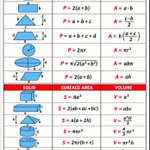
This geometry chart looks absolute until you dissect the elliptic perimeter metric. Why does it fail?
1
4
32
969
The trap hides within utilizing elementary Euler approximations for the elliptic perimeter instead of actual complete elliptic integrals. Plane math masks this boundary singularity on paper. How do you enforce absolute rigor in structural reference models?
127
Every advanced technology architecture ultimately reduces to pure abstract mathematical matrices. Which entity can break this absolute control?
1
671
The trap hides within treating arithmetic functions as independent layers. From cryptographic algorithms to deep neural networks, the entire digital field is bound by strict topological axioms. Does mathematical logic possess an absolute ceiling?
76
Math Test: Most people rush this calculation and fall straight into a simple exponent trap. Can your basic arithmetic logic resolve this algebraic division in under 5 seconds? What exact operational step prevents this fraction from collapsing into zero?
6
6
1,292
Most profiles overthink this baseline exponent reduction. The correct answer is A (25). Subtracting the exponents yields (x + 1) - (x - 1) = 2. Therefore, 5² evaluates strictly to 25. Did your mathematical reasoning survive this layout?
134
Only 5% get this right because simple high school geometry layout easily triggers overthinking. Look closely at the vector constraints and orthogonal points. What is the exact value of R without falling for the visual triangle trap? Comment your answer 👇
4
9
1,372
Cast your vote below to verify your spatial intuition: A) R = 4 B) R = 3 C) R = 5 D) Impossible geometry constraints Which path did your logic take first?
2
205
If your immediate reflex was to apply the Pythagorean theorem and reply with 3, you officially let the visual diagram deceive you. Save this geometry test to challenge your peers before the comments prove your intuition wrong. ✍
159
Cast your vote below to challenge your arithmetic logic: A) It works for all numbers B) Pure numerical coincidence C) Only works for square roots D) Valid algebraic theorem What did your mathematical intuition select first?
1
1
156
Try applying this exact digit-sum logic to the square root of 144 or 100. Save this video to challenge your peers before the comments prove you wrong. Why do these coincidental anomalies deceive so many smart profiles?
1
110
This radical root shortcut looks like magic, but it is a massive numerical trap. Most profiles blindly trust these patterns without checking formal arithmetic limits. Which exact number immediately proves this digit-sum rule is completely fake?
2
2
30
1,746
Cast your vote below to verify your mental math precision: A) 25 B) 1 C) 5²ˣ D) Indeterminate without x Which path did your intuition take first?
2
134
If your immediate intuition led you to 1 or 5²ˣ, you officially let the algebraic variables confuse you. Save this logic test to challenge your peers before the comments prove you wrong. Why do you think variables cause so many profiles to fail this basic rule?
103
Most people blindly avoid formal calculus because simple high school algebra feels safe. Why does defining a basic slope via derivatives trigger an immediate cognitive crisis for students?
3
1
1
5
1,307
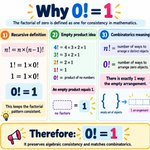
Most people blindly assume zero multiplication always yields zero and misinterpret this foundation. Save this cheat sheet before the comments prove your basic intuition wrong. Why does 0! = 1 make absolute sense to you?
9
1
77
2,006
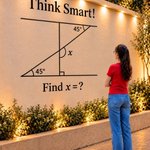
Euclidean plane boundaries seem straightforward, yet structural projections easily deceive geometric intuition. Look closely at the intersecting lines and orthogonal constraints. What exact sequential deduction proves the value of x here?
4
1
19
1,366
Geometric intuition failed if you rushed into parallel line assumptions. The structural solution is A (135 degrees). The interior base angle equals 180 - (90 + 45) = 45. Along the vertical transversal, the supplementary angle scales perfectly to 180 - 45 = 135.
117
The exact point where school definitions of imaginary numbers clash with rigorous field theory. Why does the choice of a principal branch cut always create an existential crisis for students?
1
3
1,297
Drop your geometric verification below: A) x = 135 degrees B) x = 45 degrees C) x = 145 degrees D) Insufficient parallel data
1
137
Did you assume the horizontal lines are perfectly parallel to find the supplementary angles? Intuition suggests an absolute matrix symmetry, but formal plane logic requires verifying the base vertex first.
102