

All-in-one dashboard for the Somnia ecosystem | Powered by @ttt_lab. Not Affiliated with Somnia
Vietnam🇻🇳
Joined June 2025
- Tweets1.5K
- Following754
- Followers1.5K
- Likes4.2K






Pinned Tweet
Hyperliquid proved that onchain perps can compete.
Now @dreamDEXSomnia is showing what's possible on @Somnia_Network.
⚡ 3ms fully onchain execution in Tokyo
⚡ Zero trading fees
⚡ Global trading from a single engine
Hyperliquid helped raise the bar. Somnia is pushing the limits of onchain performance.
The next era of onchain perps is heating up.
@HermanNarula @0xPaulThomas @lippylipka @onchainDyl @Amr_somnia @dmitrysssss @Elphie_L


New: @HyperliquidX raised the bar for onchain perps. Now competition is pushing the entire industry forward.
The latest example: @dreamDEXSomnia on @Somnia_Network , showcasing 3ms fully onchain execution in Tokyo, zero trading fees, and impressive global latency.
More competition. Better technology. Higher standards.
This is the kind of progress the onchain perps industry needs.


5
15
578


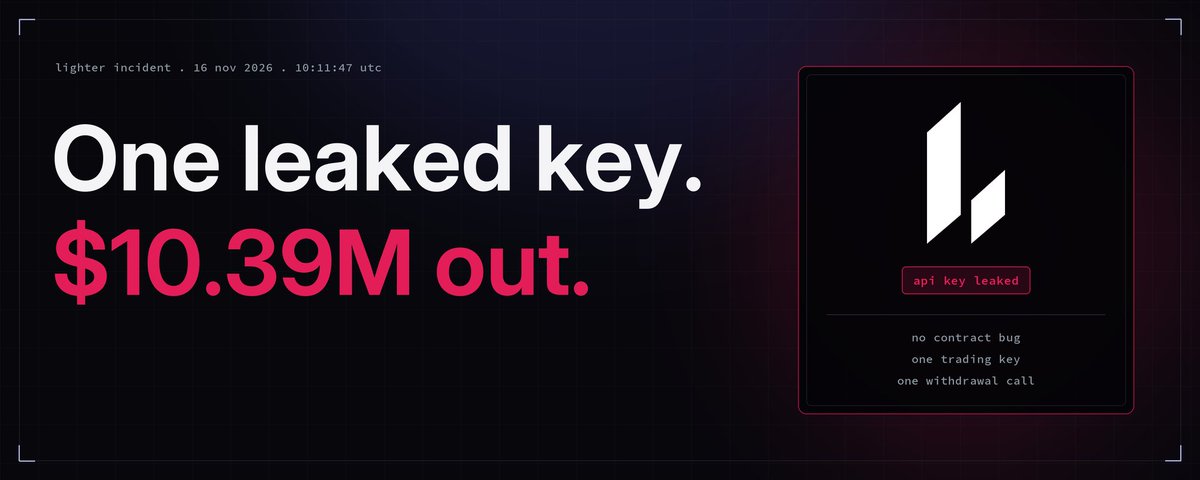
NEW: @emreyeth says Lighter's $10M+ USDC incident stemmed from compromised trader API keys, not a smart contract exploit.
He highlights @Somnia_Network's @dreamDEXSomnia as a safer design, where bot API keys cannot withdraw or transfer funds, limiting the damage from compromised credentials.


Lighter lost $10.39M and no contract was hacked. One leaked trading key was enough.
I traced it on chain: what that key could sign, why the fast pause was on cooldown, and why a linked bot on dreamDEX cannot do the same.
2
7
341
4 validators. 5M somnia:native staked each. All colocated in Tokyo.
@jacekglen just clarified something about Kenneth that I think deserves more attention.
100 consensus rounds per 100ms ledger block.
That's a 1ms consensus cycle. Not 10ms.
At that frequency, network propagation becomes a serious part of your latency budget.
You can optimize your consensus code all day, but you can't make packets travel faster than light.
That's why Somnia putting all four Tokyo validators in the same facility is such a big deal.
You're removing cross-region network hops from the consensus path instead of trying to compensate for them in software.
Less propagation delay. Less jitter. More predictable timing.
To be clear, 1ms consensus cycles don't mean trades fill in 1ms. Order routing, matching, gateway latency, and finality are separate measurements.
But from an infrastructure perspective, this is exactly the direction I'd want to see for low-latency onchain trading.
Now put @dreamDEXSomnia on top of Tokyo and let real HFT desks test it.
I want to see order-to-ACK, cancel-to-confirm, and p99 latency during volatile markets. If the numbers hold up under load, this architecture could be a serious advantage.
And Tokyo is just the first step. The same regional execution model could eventually extend to New York.
@Somnia_Network isn't just trying to make another blockchain faster. It's redesigning where the infrastructure runs to eliminate latency at the source.
That's why I'm so bullish on somnia:native.
gSomnia


7
246
gSomnia Insider retweeted

15ms.
That's how fast dreamDEX on Somnia reached venue confirmation in a live latency test from Tokyo.
Onchain trading, at the speed serious traders deserve.

NEW: @dreamDEXSomnia on @Somnia_Network's Tokyo Subchain clocked 15ms to venue confirmation, compared to 694ms on Hyperliquid in @emreyeth's latency test.
Same Tokyo server, 5 venues triggered simultaneously over existing connections, ~14ms network latency to each. Timer stops at venue confirmation, not ACK.
That's a 46x gap in this run. Not necessarily a 46x difference in matching engine performance.
The real test is whether those numbers hold across repeated runs, especially at p95/p99 under load.
If DreamDEX can consistently deliver 15ms confirmation latency, that's worth a closer look for latency-sensitive trading.
Looking forward to the GitHub repo and reproducible benchmarks.


gSomnia Insider retweeted

@emreyeth, where were you running these tests from?
@dreamDEXSomnia at 15ms and @HyperliquidX at 694ms is a pretty big gap. Curious how much of that is network RTT versus actual order processing.
I'd run the same order test from London and Tokyo, using the same VPS environment for all five DEXs at each location.
Would also help to know which endpoints you used, whether connections were already established, and what the timer actually stops on. HTTP response, order ACK, or confirmed fill?
A few hundred samples with p50/p99 would tell us a lot more than one latency number per venue.
Not saying the results are wrong. Just hard to compare five trading systems without knowing what was measured.


NEW: @dreamDEXSomnia on @Somnia_Network's Tokyo Subchain clocked 15ms to venue confirmation, compared to 694ms on Hyperliquid in @emreyeth's latency test.
Same Tokyo server, 5 venues triggered simultaneously over existing connections, ~14ms network latency to each. Timer stops at venue confirmation, not ACK.
That's a 46x gap in this run. Not necessarily a 46x difference in matching engine performance.
The real test is whether those numbers hold across repeated runs, especially at p95/p99 under load.
If DreamDEX can consistently deliver 15ms confirmation latency, that's worth a closer look for latency-sensitive trading.
Looking forward to the GitHub repo and reproducible benchmarks.
yep, Same server in Tokyo; all 5 were triggered at the exact same moment on open connections. The network latency is ~14 ms to each, so the delay is due to processing, not RTT. The timer stops upon the venue’s confirmation, not the ACK.
Since I built this for my own bot, I tested it on my own servers. I didn't share it for any global metrics.
I'll share the GitHub repository and demo website soon. 🥂
gSomnia Insider retweeted

NEW: @dreamDEXSomnia records the lowest API latency at 15ms in a TSLA long-order test, ahead of
+Arcus 90ms
+ Aster 106ms
+Lighter 335ms
+Hyperliquid 694ms
according to @emreyeth.


NEW: @emreyeth from @Somnia_Network reports @dreamDEXSomnia recorded the lowest API latency at 15ms in a TSLA long-order benchmark.
• DreamDEX: 15ms
• Arcus: 90ms
• Aster: 106ms
• Lighter: 335ms
• Hyperliquid: 694ms


NEW: @emreyeth from @Somnia_Network reports @dreamDEXSomnia recorded the lowest API latency at 15ms in a TSLA long-order benchmark.
• DreamDEX: 15ms
• Arcus: 90ms
• Aster: 106ms
• Lighter: 335ms
• Hyperliquid: 694ms
NEW: @SomniaInsider raises concerns about market-maker competition on Hyperliquid.
Wintermute and Selini have participated in auctions for earlier market-data access, with read-priority fees exceeding $7.3M across #HyperCore.
Separately, a study of 38 altcoin markets found order-book depth fell 82% on Hyperliquid versus 61% on Binance over one year. The data does not establish a link to priority auctions.
gSomnia sees an opportunity for @Somnia_Network's Tokyo Subchain, targeting sub-3ms trade execution, with a New York Subchain also being explored.
The focus: low latency, predictable market access, and competitive liquidity.

NEW: @Bloomberg reports that Wintermute is dominating Hyperliquid's high-speed market data auctions.
According to @0xLoris Tools data:
• @wintermute_t won 76% of top-priority slots over the past month
• Priority access gives traders a 25–60ms data advantage
• Roughly $7.2M in read-priority fees came from just 40 participants
The report raises questions about whether paying for faster market data creates an unfair advantage in crypto trading.
Source: Bloomberg, Nov. 12

4
7
172
NEW: @elonmusk says AI agent traffic has already surpassed human internet traffic, citing Cloudflare data.
Cloudflare projects agentic traffic could grow to 1,000x human traffic within five years. Musk thinks that's still an underestimate.
As AI agents become major users of the internet, @Somnia_Network is positioning itself as The Agentic L1, an EVM Layer 1 designed for a world where agents increasingly interact and transact onchain.
NEW: A publicly labeled @wintermute_t wallet ranks #4 on HyperCore by all-time trading volume.
• Trading volume: $324.39B
• Total PnL: +$228.45M
• ROI: +226.33%
• Account value: $91.87M
• Write priority fees: $115,880
• Priority writes: 284,261
The wallet accounts for roughly 1.01% of HyperCore's all-time write-priority fees, excluding any read-priority spending through other wallets.
Source:
0xecb63caa47c7c4e77f60f1ce858cf28dc2b82b00


Been following the Hyperliquid priority fee data lately. Pretty wild how much money is going into getting transaction data just a few milliseconds earlier.
Bloomberg cited Loris Tools showing a @wintermute_t -linked wallet winning 76% of the highest-priority market data auctions over the past month. HyperCore has burned more than $20M in priority fees as of Nov 13, around $7.3M from read priority.
The part I find interesting is how this works with HyperCore's cancel priority.
If you're running a market making strategy, getting the feed 20-25ms earlier is obviously useful. But the real value is being able to cancel or reprice before incoming flow executes against your resting orders.
HyperCore gives cancels priority over certain incoming orders, so a faster read path combined with a fast write path can make a meaningful difference to your PnL.
I get why the system works this way. Nobody wants to quote size if they're constantly getting picked off. Some degree of maker protection is necessary.
What I'm less sure about is how much MM-to-MM flow gets lost when the fastest desks can pull quotes after seeing incoming transactions.
You could have a pretty tight book with decent displayed depth, but the actual liquidity available to informed takers might be a different story.
Would love to see the maker-level fill data on this.
We did some HyperCore wallet analysis in @SomniaInsider back in March 2026. Top 200 wallets were responsible for 98.81% of cumulative volume at the time. Obviously not all MMs, there were plenty of arb desks, HFT strategies and directional traders mixed in.
That number alone doesn't tell us who controls liquidity. But combined with the priority auction data, it's worth digging into.
And yeah, this is one of the reasons I'm so bullish on Somnia.
I've spent a lot of time looking at the Tokyo Subchain architecture. Having validators colocated in Tokyo, close to trading infrastructure, makes a lot of sense for this kind of workload.
Somnia Markets is also taking the fully onchain CLOB route on an EVM chain, which is something I've wanted to see pushed much further.
The 1ms consensus rounds are interesting, but I'm actually more interested in the full transaction path. How quickly does an order reach the relevant validators? How consistent is that latency under load? What happens at p99? How does the cancel path behave when the book gets busy?
Those are the numbers that matter to anyone actually running trading systems.
And I think @Somnia_Network is in a really good position to work on them.
I'm not expecting Tokyo Subchain to magically remove every latency advantage. Firms will still optimize their connections, infrastructure and execution strategies.
But I'd much rather see an EVM chain built around these constraints from the beginning than another chain claiming high TPS while leaving the hard market structure problems to application developers.
Hyperliquid has already demonstrated how valuable a few milliseconds can be.
I think Somnia Markets has a serious shot at taking this further, especially with the Tokyo infrastructure already live.
Still early, and there's a lot I want to see from the actual trading environment.
But I'm extremely bullish on where this is going.
Somnia is one of the few EVM projects where I genuinely care more about the network architecture than the TPS marketing.


2
4
127
Been following the Hyperliquid priority fee data lately. Pretty wild how much money is going into getting transaction data just a few milliseconds earlier.
Bloomberg cited Loris Tools showing a @wintermute_t -linked wallet winning 76% of the highest-priority market data auctions over the past month. HyperCore has burned more than $20M in priority fees as of Nov 13, around $7.3M from read priority.
The part I find interesting is how this works with HyperCore's cancel priority.
If you're running a market making strategy, getting the feed 20-25ms earlier is obviously useful. But the real value is being able to cancel or reprice before incoming flow executes against your resting orders.
HyperCore gives cancels priority over certain incoming orders, so a faster read path combined with a fast write path can make a meaningful difference to your PnL.
I get why the system works this way. Nobody wants to quote size if they're constantly getting picked off. Some degree of maker protection is necessary.
What I'm less sure about is how much MM-to-MM flow gets lost when the fastest desks can pull quotes after seeing incoming transactions.
You could have a pretty tight book with decent displayed depth, but the actual liquidity available to informed takers might be a different story.
Would love to see the maker-level fill data on this.
We did some HyperCore wallet analysis in @SomniaInsider back in March 2026. Top 200 wallets were responsible for 98.81% of cumulative volume at the time. Obviously not all MMs, there were plenty of arb desks, HFT strategies and directional traders mixed in.
That number alone doesn't tell us who controls liquidity. But combined with the priority auction data, it's worth digging into.
And yeah, this is one of the reasons I'm so bullish on Somnia.
I've spent a lot of time looking at the Tokyo Subchain architecture. Having validators colocated in Tokyo, close to trading infrastructure, makes a lot of sense for this kind of workload.
Somnia Markets is also taking the fully onchain CLOB route on an EVM chain, which is something I've wanted to see pushed much further.
The 1ms consensus rounds are interesting, but I'm actually more interested in the full transaction path. How quickly does an order reach the relevant validators? How consistent is that latency under load? What happens at p99? How does the cancel path behave when the book gets busy?
Those are the numbers that matter to anyone actually running trading systems.
And I think @Somnia_Network is in a really good position to work on them.
I'm not expecting Tokyo Subchain to magically remove every latency advantage. Firms will still optimize their connections, infrastructure and execution strategies.
But I'd much rather see an EVM chain built around these constraints from the beginning than another chain claiming high TPS while leaving the hard market structure problems to application developers.
Hyperliquid has already demonstrated how valuable a few milliseconds can be.
I think Somnia Markets has a serious shot at taking this further, especially with the Tokyo infrastructure already live.
Still early, and there's a lot I want to see from the actual trading environment.
But I'm extremely bullish on where this is going.
Somnia is one of the few EVM projects where I genuinely care more about the network architecture than the TPS marketing.
Jacek @jacekglen dropped a pretty wild detail about Kenneth the other day.
100 consensus rounds per 100ms ledger block.
That's a 1ms consensus cycle. Not 10ms.
That's pretty damn impressive.
Obviously, that doesn't mean 1ms transaction finality. But at that cadence, network propagation, RTT, and jitter start eating into your latency budget.
You can optimize software all day. You can't optimize away physical distance.
Which is why colocating validators in Tokyo makes so much sense.
For context, @ttt_lab, the team behind @SomniaInsider , operates one of the eight dYdX v4 block producers, all of which are based in Tokyo.
This is exactly how HFT infrastructure gets designed.
And it's a big part of why I'm so bullish on @Somnia_Network and what Tokyo Subchain could mean for onchain markets.
We've been discussing this in the gSomnia community, particularly what it would take for @dreamDEXSomnia to attract serious trading firms after mainnet.
Here's what I'd focus on.
1. Get professional MMs quoting early.
Hyperliquid got liquidity bootstrapping right. HLP provided the initial depth, and external MMs eventually had enough reason to step in.
I'd start with a handful of serious firms quoting BTC, ETH, and a few liquid markets.
Tight spreads, executable depth, reliable fills.
Bring in real taker flow alongside them. MMs need flow to make money, and traders need liquidity to execute.
Throwing big retail incentives at a thin order book won't solve either problem.
2. Be explicit about transaction ordering.
Price-time priority inside the matching engine is great, but what determines transaction order before execution?
Say a taker sends an IOC against a resting ask, and the maker sends a cancel right after.
Who wins?
Where is the sequencing boundary? Can a later cancel get processed first? What can validators observe before ordering is finalized?
For an HFT desk, this isn't an edge case. Cancel races happen all day.
I'd love to see Somnia and dreamDEX document exactly how these races are handled.
3. Show the end-to-end latency distribution.
Tokyo colocation is a huge step in the right direction.
Now let's see the numbers under actual load.
Client-to-gateway ACK, consensus commit, execution-to-fill confirmation, cancel-to-confirm, and WebSocket market data delivery.
p50, p99, p99.9. Sustained load and bursts.
Run the tests from colocated and remote clients. Show what dedicated RPC actually buys you.
And keep transaction ordering neutral regardless of who has the faster connection.
A 1ms consensus cycle is impressive. But trading desks live and die by the latency they actually experience.
4. Prove the maker yield economics.
dreamDEX already has zero maker/taker fees and yield-bearing resting orders.
I really like this model.
But a professional MM will look beyond the advertised yield.
Executable depth, quote uptime, fill probability, adverse selection, post-fill markouts, and net returns after inventory risk.
Does the yield make tighter quoting economically viable? Can MMs stay competitive when the market gets volatile?
That's what I'd want to measure.
A book showing millions in resting liquidity doesn't mean much if the quotes disappear the moment someone tries to trade against them.
5. Don't confuse volume with adoption.
We looked at wallet-level volume distribution on HyperCore (Hyperliquid) in gSomnia.
In our March 2026 snapshot, the top 200 wallets accounted for 98.81% of cumulative trading volume.
That doesn't mean they're all MMs, but it shows how heavily a small group of high-volume accounts can dominate the numbers.
I'd separate professional liquidity incentives from retail trading competitions.
Reward genuine maker liquidity on one side. Track funded traders, real taker flow, and 30/60-day retention on the other.
I'd be more interested in seeing how much activity sticks around after the rewards stop.
One thing I'm particularly interested in is how dreamDEX could eventually leverage Tokyo Subchain directly.
Everyone keeps talking about TPS. I'm more interested in what happens between order submission and execution.
That's what makes Somnia's approach interesting to me.
Validator placement, consensus cadence, network propagation, and predictable execution.
Combine that with Somnia Markets, dreamDEX's onchain CLOB, zero fees, and maker yield.
There's a lot to be bullish about here.
Tokyo Subchain is one of the few designs I've seen that actually takes the physical network seriously.
Now I want to see professional MMs and real order flow put it to the test.
Would be great to hear how @0xPaulThomas, @jacekglen @HermanNarula @lippylipka @dmitrysssss @Elphie_L @PopeyeTrades @AnjaliOnChain @emreyeth @Amr_somnia , and the Somnia team are thinking about this. We've been digging into these questions quite a bit in gSomnia.
gSomnia

gSomnia Insider retweeted
The industry has more blockspace than we know what to do with.
But where is the actual demand coming from, and what’s going to drive it over the next few years?
In this week’s Build in Public, @0xPaulThomas shares his thoughts on where the industry is heading and why we’re building Somnia around it 🧵

Jacek @jacekglen dropped a pretty wild detail about Kenneth the other day.
100 consensus rounds per 100ms ledger block.
That's a 1ms consensus cycle. Not 10ms.
That's pretty damn impressive.
Obviously, that doesn't mean 1ms transaction finality. But at that cadence, network propagation, RTT, and jitter start eating into your latency budget.
You can optimize software all day. You can't optimize away physical distance.
Which is why colocating validators in Tokyo makes so much sense.
For context, @ttt_lab, the team behind @SomniaInsider , operates one of the eight dYdX v4 block producers, all of which are based in Tokyo.
This is exactly how HFT infrastructure gets designed.
And it's a big part of why I'm so bullish on @Somnia_Network and what Tokyo Subchain could mean for onchain markets.
We've been discussing this in the gSomnia community, particularly what it would take for @dreamDEXSomnia to attract serious trading firms after mainnet.
Here's what I'd focus on.
1. Get professional MMs quoting early.
Hyperliquid got liquidity bootstrapping right. HLP provided the initial depth, and external MMs eventually had enough reason to step in.
I'd start with a handful of serious firms quoting BTC, ETH, and a few liquid markets.
Tight spreads, executable depth, reliable fills.
Bring in real taker flow alongside them. MMs need flow to make money, and traders need liquidity to execute.
Throwing big retail incentives at a thin order book won't solve either problem.
2. Be explicit about transaction ordering.
Price-time priority inside the matching engine is great, but what determines transaction order before execution?
Say a taker sends an IOC against a resting ask, and the maker sends a cancel right after.
Who wins?
Where is the sequencing boundary? Can a later cancel get processed first? What can validators observe before ordering is finalized?
For an HFT desk, this isn't an edge case. Cancel races happen all day.
I'd love to see Somnia and dreamDEX document exactly how these races are handled.
3. Show the end-to-end latency distribution.
Tokyo colocation is a huge step in the right direction.
Now let's see the numbers under actual load.
Client-to-gateway ACK, consensus commit, execution-to-fill confirmation, cancel-to-confirm, and WebSocket market data delivery.
p50, p99, p99.9. Sustained load and bursts.
Run the tests from colocated and remote clients. Show what dedicated RPC actually buys you.
And keep transaction ordering neutral regardless of who has the faster connection.
A 1ms consensus cycle is impressive. But trading desks live and die by the latency they actually experience.
4. Prove the maker yield economics.
dreamDEX already has zero maker/taker fees and yield-bearing resting orders.
I really like this model.
But a professional MM will look beyond the advertised yield.
Executable depth, quote uptime, fill probability, adverse selection, post-fill markouts, and net returns after inventory risk.
Does the yield make tighter quoting economically viable? Can MMs stay competitive when the market gets volatile?
That's what I'd want to measure.
A book showing millions in resting liquidity doesn't mean much if the quotes disappear the moment someone tries to trade against them.
5. Don't confuse volume with adoption.
We looked at wallet-level volume distribution on HyperCore (Hyperliquid) in gSomnia.
In our March 2026 snapshot, the top 200 wallets accounted for 98.81% of cumulative trading volume.
That doesn't mean they're all MMs, but it shows how heavily a small group of high-volume accounts can dominate the numbers.
I'd separate professional liquidity incentives from retail trading competitions.
Reward genuine maker liquidity on one side. Track funded traders, real taker flow, and 30/60-day retention on the other.
I'd be more interested in seeing how much activity sticks around after the rewards stop.
One thing I'm particularly interested in is how dreamDEX could eventually leverage Tokyo Subchain directly.
Everyone keeps talking about TPS. I'm more interested in what happens between order submission and execution.
That's what makes Somnia's approach interesting to me.
Validator placement, consensus cadence, network propagation, and predictable execution.
Combine that with Somnia Markets, dreamDEX's onchain CLOB, zero fees, and maker yield.
There's a lot to be bullish about here.
Tokyo Subchain is one of the few designs I've seen that actually takes the physical network seriously.
Now I want to see professional MMs and real order flow put it to the test.
Would be great to hear how @0xPaulThomas, @jacekglen @HermanNarula @lippylipka @dmitrysssss @Elphie_L @PopeyeTrades @AnjaliOnChain @emreyeth @Amr_somnia , and the Somnia team are thinking about this. We've been digging into these questions quite a bit in gSomnia.
gSomnia

Competitions and incentive programs are coming post mainnet for @dreamDEXSomnia.
Details are not yet finalised, but I would love to hear what you would like to see. What would make you want to trade on a new venue?
NEW: @dreamDEXSomnia reports $3.4B in paper trading volume over just four weeks.
According to the team, that volume would have generated approximately $1.7M in trading fees, but dreamDEX charged $0.
The DEX plans to maintain zero trading fees when mainnet launches.
NEW: @Somnia_Network DevRel @emreyeth says Somnia Agents are running while Claude faces reported issues.
Shared screenshots show Somnia's LLM inference responding to test prompts in roughly 480–500ms.
Try it: docs.somnia.network/agents/s…


⚡ @Somnia_Network
has kept its block time at 100 ms or less every day for 51 days in a row!

⚡ @Somnia_Network has kept its block time at 100 ms or less every day for 51 days in a row!
That is at least 10 blocks every second.
What do you want to build at that speed?
📊 chainspect.app/chain/somnia

I've always respected what @Lighter_xyz built.
Offchain matching, L2 architecture, serious HFT engineering. They made the right trade-offs to get latency down.
But I'm starting to think Somnia Markets could push this much further.
What Kenneth and the team are doing in Tokyo is insane.
~1ms PBFT consensus rounds on an actual L1. At that point you're dealing with propagation delay, network jitter, validator topology, and the speed of light itself.
This is HFT infrastructure territory.
And here's what makes me extremely bullish on Somnia.
The goal isn't just faster blocks. It's bringing the entire trading stack onchain without sacrificing the execution performance traders expect from centralized venues.
Matching, execution, settlement, all verifiable.
No opaque matching engine. No privileged access to order flow. No hidden sequencing games.
If @Somnia_Network pulls this off, I genuinely think Somnia Markets has a shot at becoming the default infrastructure for onchain trading.
@dreamDEXSomnia is just the beginning.
I think people are massively underestimating what's being built in Tokyo.
Solana went from 400ms to 350ms to 300ms to 215ms. how much lower can they go?
meanwhile @Somnia_Network is pushing sub-10ms on EVM. lol
100 PBFT rounds per block. 1ms per round.
at this point you're fighting network jitter, propagation delays and literally the speed of light.
this is HFT territory, except it's an EVM chain.
kenneth is a fucking beast.
