

Cosmically Spiritual | Saganist
- Tweets3.2K
- Following55
- Followers3.7K
- Likes12.4K


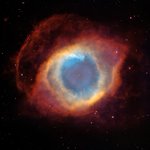


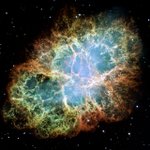


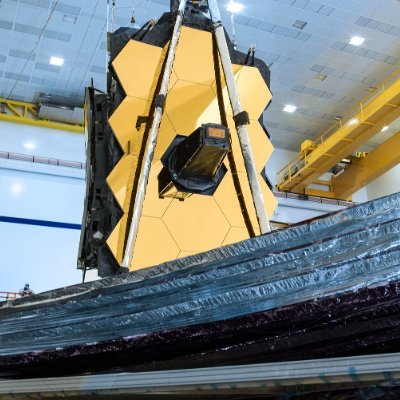

ALT This image of the Ring Nebula, taken by Webb’s Near-Infrared Camera, appears as a distorted doughnut. The nebula’s inner cavity hosts shades of blue and green, while the detailed ring transitions through shades of orange in the inner regions and pink in the outer region. The ring’s inner region has distinct filament elements. Stars litter the scene, with a particularly prominent star with 8 long spikes in the top right corner.

ALT The background is mostly dark. At the center is a dark orange-brown circle, surrounded by several blazing bright, thick, horizontal whiteish rings. This is Saturn and its rings. There are three tiny dots in the image—one to the upper left of the planet, one to the direct left of the planet, and the lower left of the planet. These are three of Saturn’s moons: Dione, Enceladus, and Tethys, respectively. There is a slightly darker tint at the northern and southern poles of the planet. The rings surrounding Saturn are mostly broad, with a few singular narrow gaps between the broader rings. There is an innermost, thicker ring, and next to that is a brighter, wider ring. Traveling farther outward, there is a small dark gap before another thicker ring. In the thicker ring, there is a narrow faint band. There is then an outermost, faintest, thinnest ring.


ALT This Hubble image shows a portion of the Andromeda Galaxy. Several distant stars dot the image, and some glow blue.


ALT In this Webb image, Neptune resembles a pearl with rings that look like ethereal concentric ovals around it. There are 2 thinner, crisper rings and 2 broader, fainter rings. A few extremely bright patches on the lower half of Neptune represent methane ice clouds. Six tiny white dots, which are six of Neptune’s 14 moons, are scattered among the rings. The background of the image is black.


ALT The background of space is black. Thousands of galaxies appear all across the view. Their shapes and colors vary. Some are various shades of orange, others are white. Most stars appear blue, and are sometimes as large as more distant galaxies that appear next to them. A very bright star is just above and left of center. It has eight bright blue, long diffraction spikes. Between 4 o’clock and 6 o’clock in its spikes are several very bright galaxies. A group of three are in the middle, and two are closer to 4 o’clock. These galaxies are part of the galaxy cluster SMACS 0723, and they are warping the appearances of galaxies seen around them. Long orange arcs appear at left and right toward the center.
