

Founder & CEO @ Mindbeam | AI scientist solving the puzzle of intelligence and consciousness | Forbes 30 under 30
New York, USA
Joined May 2015
- Tweets434
- Following2.4K
- Followers831
- Likes695






Pinned Tweet
I am thrilled to formally introduce Mindbeam as we emerge from stealth.
We have built the fastest AI training framework to date, achieving groundbreaking performance benchmarks and an 86% reduction in energy
consumption.
This milestone reflects our core mission to accelerate the future of AI while significantly reducing the environmental impact of large-scale model training.
We are proud to be working closely with the amazing team at @awscloud to deploy this amazing product to thousands of customers across AI research labs and Fortune 100 Enterprises.
Our flagship product, Litespark, is now available on the AWS Marketplace. Visit mindbeam.ai to learn more.


🚀 BREAKING: We just revolutionized AI pre-training
We are excited to come out of stealth and launch our revolutionary product: Litespark, a language model framework which utilizes advanced algorithms to speed up training and inference workloads for generative AI applications.
Litespark reduces training time from months to days.
With just 16 H100s, you can train your own billion-parameter foundation model from scratch in 26 hours. Fortune 100 companies are already transforming their AI workflows with our breakthrough framework on AWS.

Nii Osae retweeted

As the need to optimize low level systems and kernel designs increases, modern frontier open source language models write CUDA routinely. The strongest engineering question is: can a model read a PyTorch module and write a raw CUDA kernel that computes the same forward pass within a fixed numerical tolerance while remaining architecture agnostic?
To address this problem, Mindbeam in collaboration with @NVIDIAAI , is thrilled to launch a post-trained version of the frontier model Nemotron 3.5 Super VL 120B-A12B.
The outcome is a powerful open-weights model Litespark Nemotron 3.5 Super VL that excels in CUDA code across various levels of KernelBench. On single operations in the Level 1 evaluation, the post-trained model passes 83.9% of problems, up from 72.7% before adaptation: a gain of 11.2% points from fine-tuning. Results are even stronger in the Level 2 evaluation where the model's performance improved from 22.8% to 82.1%, outperforming GPT 5.6 Sol's accuracy of 57%.
This achievement marks a significant milestone for us, bolstering our vision of solving the hardest engineering problems in AI infrastructure.
Learn more: mindbeam.ai/research/litespa…

Our collaboration with @NVIDIAAI has been amazing! Looking forward to many more to come.
Today, we are thrilled to announce that Mindbeam has collaborated with @NVIDIAAI to optimise the speed and efficiency of open source models.
We post-trained NVIDIA’s Nemotron 3.5 Super VL to translate PyTorch modules directly into raw CUDA kernels, moving KernelBench Level 2 accuracy from 22.8% to 82.1% and outperforming GPT 5.6 Sol's 57%.
To ensure the serving layer keeps pace, the Litespark Inference Engine delivers Day-0 support, with 962 tokens per second per user on just two NVIDIA H200 GPUs, delivering a 6.9x improvement over vLLM.
Generating performance-critical systems code is only half the battle; running it efficiently in production is the other. We are proud to be building both sides of that equation alongside NVIDIA.
Learn more: mindbeam.ai/research/mindbea…

Our support for the AI developer ecosystem is growing rapidly. This is bolstered by Litespark’s compatibility across multiple hardware types and accelerators. The @Arm Developer team has reviewed Litespark-Inference and added it to their official developer documentation guide, recognising its speedup gains and memory efficiency. This is the first step in a broader vision to democratise AI and compute efficiency for the ecosystem.
Learn more: learn.arm.com/learning-paths…

Today, we are announcing our latest research in applied AI for drug discovery.
We have incorporated our technology into drug discovery research to develop novel pain therapeutics with enhanced efficacy and superior safety profiles compared to acetaminophen.
In the U.S. alone, patients consume an estimated 25 billion doses of acetaminophen annually. Yet, this massive reliance comes with a steep cost, as acetaminophen over-dependence remains the leading cause of acute liver failure nationwide.
Through our in silico work, we are accelerating the discovery and design of novel, next-generation therapeutics to solve this problem. Using generative AI, we’ve developed safer alternatives to acetaminophen, providing a safer option for vulnerable populations long threatened by the risk of liver toxicity.
This breakthrough marks a clear path forward for low-risk pain management. By successfully developing therapeutic candidates for one of drug discovery’s most intractable targets, the TRPV1 receptor, we are laying the foundation for a robust pipeline with many more AI-designed therapeutics to come.
Learn more about our work here: mindbeam.ai/research/discove…
Extraordinary performance for best in class AI inference 🚀🚀🚀
Today, we are excited to unveil Litespark Inference: our ultra-fast matmul-free inference framework for ternary (1.58 bit) language models.
The inference demand in the era of agentic AI is increasing dramatically and this compelled us to build an inference framework with high-thoughput, low-latency and significant reduction in memory usage.
The results speak for themselves: over 90x throughput speedup on @intel and @AMD along with 1,900 tokens per second running Bonsai 1.7B on @awscloud Inferentia2.
Litespark Inference supports a wide range of hardware types including consumer CPUs running on @Arm for low-latency agentic workflows and applications.
We are also releasing an open-source repository for local LLM deployment.
Github: github.com/Mindbeam-AI/Lites…
Paper: arxiv.org/abs/2605.06485
Blog: mindbeam.ai/research/litespa…

1
2
170
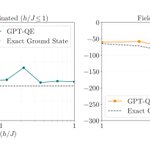
We are thrilled to share our latest innovation, SpinGQE, a generative quantum eingensolver for spin hamiltonians.
Ground state search is fundamental to quantum computing but VQE suffers from barren plateaus and limited expressivity.
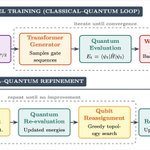
In our solution, we reframe circuit design as generative modelling where a transformer learns distributions over quantum circuits by matching logits to energies at each gate subsequence.
Paper: arxiv.org/abs/2603.24298
Code: github.com/Mindbeam-AI/SpinG…

Watch a quantum circuit evolve from rough sketch to precision instrument. The AI generates an initial circuit (left), continuous optimization tunes the angles (middle), then smart rewiring unlocks the right connections (right)—dropping energy from -22 to -64 (near-perfect!).

1
1
100

Nii Osae retweeted
Announcing our Litespark Technical Report! 🚀
Mindbeam Litespark boosts LLM training up to 6x faster & cuts energy use by 83%.
Works with any transformer architecture. Smarter, greener AI is here.
Dive into the details: arxiv.org/abs/2510.02483

Nii Osae retweeted
🚀 Proud moment alert! AWS Startups just spotlighted our founder, Nii Osae, sharing how enterprise teams can turbocharge pre-training models by 6x, reducing training time from months to days.
Check out how Mindbeam Litespark transforms AI development—now available on the AWS Marketplace. Get started: bit.ly/litespark

💡 @MindbeamAI helps Fortune 500 companies pre-train LLMs on #AWS. We caught up with Nii Osae, the company’s Founder & CEO, at the AWS NYC Summit to learn more about the future of #AI infrastructure.
Find us at AWS Summit LA to connect. 🚀 go.aws/45TUAyC
We are bringing unprecedented AI training speed to enterprises on @awscloud 🚀
💡 @MindbeamAI helps Fortune 500 companies pre-train LLMs on #AWS. We caught up with Nii Osae, the company’s Founder & CEO, at the AWS NYC Summit to learn more about the future of #AI infrastructure.
Find us at AWS Summit LA to connect. 🚀 go.aws/45TUAyC
Super excited to share @MindbeamAI Litespark record-breaking benchmarks!
With Litespark, you can train a 3 billion-parameter model with 16 H200 GPUs in less than 2 days, reducing training costs from millions of dollars to under $20K.
Bigger models experience improved performance up to 6x in training speed!
This marks an inflection point in AI model training and we are happy to share this with the world. 🚀🚀🚀

Nii Osae retweeted

The arrival of the first AGI will not be the world-shattering event most people expect. Instead, it will go entirely unnoticed by the general public.
This will be the sign of true AGI

The first AGI system will be much worse than previous AI systems at pretty much everything -- except for tests that focus on measuring general intelligence (e.g. ARC).
Like a baby, it will be generally intelligent -- able to learn efficiently and adapt -- but will lack any specialized competence.
However, it will be able to learn using much less data, and the capabilities it picks up will generalize much more strongly to the variability and unpredictability of the real world. As a result, after a few years, it will beat previous AI systems at absolutely everything -- including many problems that were completely out of reach before.
2
777
Nii Osae retweeted

Comprehensive and deeply insightful, "A History of Bodies, Brains, and Minds" provides a brief history of life, the brain, and cognition, from the earliest living beings to our own species. #SfN24 #OpenAccess bit.ly/4eKvi7L

ALT Person holding a book titled "A History of Bodies, Brains, and Minds: The Evolution of Life and Consciousness" by Francisco Aboitiz.
Nii Osae retweeted
In quantum mechanics, the observer effect boils down to the idea that the world state is lazily evaluated (i.e. you only compute something when the result is causally needed to evaluate something else). This makes the many-world interpretation very icky: MWI requires "compute" and "storage" in the below-world substrate to be free and in infinite supply. But the entire point of lazy evaluation is to save compute and storage!
Basically: if the universe has made the design choice of lazy evaluation, it implies that whatever resources it runs on must cost something, which in turn rules out the infinitely resource-hungry many-world design choice.
Nii Osae retweeted
Interesting work on reviving RNNs. arxiv.org/abs/2410.01201 -- in general the fact that there are many recent architectures coming from different directions that roughly match Transformers is proof that architectures aren't fundamentally important in the curve-fitting paradigm (aka deep learning)
Curve-fitting is about embedding a dataset on a curve. The critical factor is the dataset, not the specific hard-coded bells and whistles that constrain the curve's shape. As long as your curve is sufficiently expressive all architectures will converge to the same performance in the large-data regime.
