

Computer scientist working on AI safeguards, incidents, & gov research. Assistant professor @Kennedy_School @Harvard. https://xitter.cf/t.co/r76TGxSVMb
Cambridge, Massachusetts, USA
Joined March 2016
- Tweets3K
- Following3.8K
- Followers9.1K
- Likes7.2K





Pinned Tweet
🧵🧵🧵 What if we are on the verge of a "Cyber Cambrian"?
(Plus personal updates on my thinking about risk.)
Cas (Stephen Casper) retweeted

Cas is my brilliant new colleague and really specifies what an AI mass casualty event might look like. As readers of mine know, I view the idea of rogue AI behavior as a fiction and would hold AI developers and the AI titans criminally responsible. 1/

🚨New paper (possibly the most important one I have written yet).
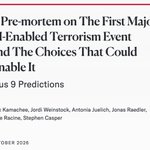
We think that as early as 2027 or 2028, there might be a major AI-enabled terrorism event. We conducted a pre-mortem, made 9 falsifiable predictions, and wrote 2 concrete scenarios.
Led by @KamacheeMax.


I spoke recently at a FAR AI event on the incident-driven nature of AI politics and how we might be currently experiencing a "governance overhang."
youtube.com/watch?app=deskto…
The paper is now on SSRN:
papers.ssrn.com/sol3/papers.…
🚨New paper (possibly the most important one I have written yet).
We think that as early as 2027 or 2028, there might be a major AI-enabled terrorism event. We conducted a pre-mortem, made 9 falsifiable predictions, and wrote 2 concrete scenarios.
Led by @KamacheeMax.
Cas (Stephen Casper) retweeted

Misuse by malicious actors is a risk with any powerful technology; but in the case of AI, the consequences could be catastrophic.
Very interesting analysis by @StephenLCasper on how AI developers' decisions can influence cyber, bio, and chemical terrorism risks.
🚨New paper (possibly the most important one I have written yet).
We think that as early as 2027 or 2028, there might be a major AI-enabled terrorism event. We conducted a pre-mortem, made 9 falsifiable predictions, and wrote 2 concrete scenarios.
Led by @KamacheeMax.
Cas (Stephen Casper) retweeted

It is important to re-state that the threats are not hypothetical, and that we must take action to mitigate the risks of AI-enabled terrorism.
🚨New paper (possibly the most important one I have written yet).
We think that as early as 2027 or 2028, there might be a major AI-enabled terrorism event. We conducted a pre-mortem, made 9 falsifiable predictions, and wrote 2 concrete scenarios.
Led by @KamacheeMax.
Cas (Stephen Casper) retweeted

I had an early look at this paper, and I do heartily recommend it. Really well done.
🚨New paper (possibly the most important one I have written yet).
We think that as early as 2027 or 2028, there might be a major AI-enabled terrorism event. We conducted a pre-mortem, made 9 falsifiable predictions, and wrote 2 concrete scenarios.
Led by @KamacheeMax.
🚨New paper (possibly the most important one I have written yet).
We think that as early as 2027 or 2028, there might be a major AI-enabled terrorism event. We conducted a pre-mortem, made 9 falsifiable predictions, and wrote 2 concrete scenarios.
Led by @KamacheeMax.
And a piece by the Harvard Gazette: news.harvard.edu/gazette/sto…

Props to @KamacheeMax for the extraordinary talent, persistence, and vision in leading this paper.
And a big thanks to other coauthors: Jordi Weinstock, @AntoniaJuelich, Jonas Raedler, & Elise Racine.
Work done at @MATSprogram and @BelferCenter at @Kennedy_School.
Cas (Stephen Casper) retweeted

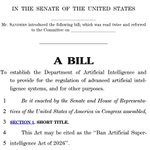
Recently, a draft leaked of federal bill text being circulated by Anthropic. The bill does have some good elements, many of which have been seen before in state legislation (for example in Massachusetts) that Anthropic also supported in the past. I previously wrote about many of those elements here: xitter.cf/Thomas_Woodside/status….
Overall, however, this bill would be bad if passed into law, and I believe that circulating it has been counterproductive for federal AI safety discussions. I wish that Anthropic were embracing something closer to our policy suggestions here: secureaiproject.org/californ….
Here are my concerns about the bill’s content in more detail:
1. No minimum safety standards: The bill does not authorize any agency to create minimum safety standards requiring AI developers to implement any practice. This should be an important component of any federal framework; otherwise, all decisions are made purely by ad hoc court orders, which is not a good way to ensure safety. It does allow the agency to designate (but not create) security (not safety) standards.
2. Weak “blocking orders:” the government can only block a model if a risk is imminent, and the bar for showing that is high. There are many procedural requirements, such as the requirement that the agency head personally certify a lot of the filing, that would make it challenging to use this blocking power. In my view, an agency should be able to issue orders that take effect immediately if there is an imminent need for action (an imminent need for action differs from an imminent risk because it would include instances when an action is necessary soon to stop a risk, even if the harm itself would occur at an indeterminate point in the future). The agency should not have to wait for a court in such cases, although a court should of course be able to review quickly.
3. Evaluator shopping: We’ve previously said that at least some evaluators need to be selected by the government, not just chosen by the companies they are evaluating. This bill doesn’t even provide an accreditation system for evaluators, much less government selection. Instead, it provides only a rating system, which developers can feel free to ignore, except once the agency is doing a blocking order proceeding.
4. No “pacing:” This bill doesn’t go far enough in terms of pacing. If Anthropic does not embrace robust minimum standards, we think it’s especially important that something like compute-pacing be included. See our pacing proposal here: secureaiproject.org/californ….
5. No embedded evaluators: There isn’t a requirement that evaluators be embedded at AI companies or that they continuously assess risk. They do have a requirement to produce rapid reports in certain circumstances, but without a duty to actually constantly assess whether they actually should produce a rapid report, it’s unclear whether they’ll do so.
6. No dispute resolution process: If an evaluator lacks information that it needs from a developer and the developer refuses to provide it, there isn’t a clear process to resolve the dispute. For example, there could be a process that permits the agency to order the information handed over, with a court review if a party disagrees. At present, the agency has to bring an action for a violation, which is very time consuming and would likely only happen in egregious cases.
7. Weak incident reporting: The definition of what is required to be reported is written very narrowly. It would not even cover incidents like Hugging Face unless they cause $250,000+ in damages (only the number of such incidents would have to be reported annually).
8. No preventing coercive control of government/secret loyalties: The bill doesn’t have provisions aimed at preventing insiders at AI companies from using powerful AI systems to coercively take control of government or otherwise provide themselves with significant advances.
10. No reporting of AI R&D automation: While covered as a risk factor, there are no reporting requirements to allow the public to understand how AI is being used to automate AI research and development unless the developer assesses this poses another “enumerated risk.”
To be clear, I don’t think it’s necessary for every draft bill to have all of the above policies in it. That would be an unrealistic standard. It’s possible to have narrow, tight bills focused on particular problems that make a solid contribution to the discourse. That said, not everything in this bill is executed well, such as the blocking orders.
More importantly, because it includes preemption, floating a bill this weak will likely have a detrimental effect on the political discourse. When a bill includes state preemption, it must be interpreted as the proposer’s view of what is “worth” that preemption. This is how everyone in DC will interpret it, so the proposer needs to propose it in that light. Anthropic is seen by many as being in favor of strong regulation (and state regulation), and portrays themselves that way. Their bill draft could give the false impression that this is what strong regulation looks like, anchoring future discussions and negotiations in a very suboptimal place. I do not think that the policy Anthropic has put forward is worth preempting all state frontier AI disclosure, evaluation, incident reporting, and possibly (the drafting seems to contain an error) model blocking laws.
Anthropic representatives have said they circulated this in part because “it’s important to get early feedback from policymakers.” However, in my view, floating language like this signals to policymakers that Anthropic is prepared to support it as is. And as is, it is a bad bill.

I just read Anthropic's draft for a federal bill that was leaked a few days ago. You've probably seen other people say similar things, but I will add my voice to say that it's pretty bad.
In addition to being textbook regulatory capture by watering down key proposals of existing legislative drafts, the most striking thing of all is Anthropic's gall in doing one thing with their mouth and another with their hands. It was just a few weeks ago that Dario Amodei publicly called for embedded auditors and pacing the frontier. At the same time, however, Anthropic has privately been lobbying for slightly weakening access provisions for auditors and greatly weakening the federal government's ability to issue emergency orders to AI companies (both relative to the FRONTIER Act draft).
There's no two ways to put it. This is a tremendously dishonest attempt at regulatory capture.

Cas (Stephen Casper) retweeted

A huge part of Anthropic’s founding logic was that if a safety-motivated company was at the frontier, it could use its megaphone to lobby the rest of the world toward caution. Now the dress rehearsal stage of AI policy is over. The new test is “how hard should it be for the government to block us from deploying, including internally, an unacceptably dangerous model?” Turns out in the grand 26 (Jack Clark says it’s likely full RSI will be possible one year from now), Anthropic has been planning to approach the U.S. Congress with the answer “it should be even harder than it currently is”

Charlie's analysis is right but he is nicer than I am - I found myself viscerally angry at multiple points reading this bill. There are some good and sensible parts, but overall this legislation is not remotely close to meeting the moment and I overall think passing it would make us less protected against catastrophic risks than we are under existing law.
Two parts that stand out as particularly infuriating when taken together:
1. Some of the preemption provisions are remarkably far reaching and consequential, and in addition to preempting legislation like SB 53 would also remove general powers that state courts have to enjoin defendants and protect the public. Most outrageously, it has a provision that looks like its intended to stops states from enforcing laws or judicial decrees that "suspend the development, deployment, or internal use of an AI model" to protect their citizens from imminent catastrophic harms. Such powers to block and suspend model deployments would then only reside with the federal government.
2. The federal governments powers to restrict the development, deployment, or internal use of a frontier model has to meet an absurdly high bar.
First, there needs to be an imminent risk of a catastrophic harm (meaning killing more than 50 people or causing more than a billion dollars in damage). But thats not enough! The agency head needs to make a detailed determination with no deference given to show why no alternative would prevent the imminent catastrophe. Next the court is also explicitly told to consider the harms to the developer and other harms from restricting the model, but no considerations in the other direction.
This is absurd! For all of its warning about the potential for AI to cause a catastrophe that kills literally everyone on the planet, Anthropic's proposed federal law likely makes it harder than under existing law for a court to get an order blocking or restricting the development of frontier models? WTF??
There are also a bunch of others things that I would like to see improved - the substantive details of the auditing section and the potential for rule-making on substantive safety standards both come to mind - but I think these stand out as particularly indefensible.

Thanks for this discussion with @Kennedy_School!

AI overhang, which is when AI capabilities have far surpassed the ways in which people typically use the tools, has the potential to be a "recipe for disruption," according to HKS professor and computer scientist @StephenLCasper.
However, there are options to avoid the overhang by regulating the supply chain.