

Steve is a Foundation Prof Emeritus of Psychology at UNR. He originated & co-developed Acceptance and Commitment Therapy & Relational Frame Theory.
Reno, NV
Joined November 2011
- Tweets811
- Following26
- Followers19.9K
- Likes21




This distinction is one of the more important practical ideas from behavioral science, and it has direct implications for why so many well-intentioned behavior change efforts fail.
Rule-governed behavior is driven by verbal rules, "if I do X, Y will happen," often learned from others or constructed by our own minds. Contingency-shaped behavior is driven by direct contact with the actual outcomes of what we do. The former is flexible and rapid-learning; the latter is grounded and accurate. The trouble comes when the rules we follow no longer match the contingencies we're actually living in, and yet we keep following them anyway.
For example, a rule like "showing vulnerability leads to rejection" may have been learned accurately in childhood. But in adulthood, with a different partner, a different context, and different relationships available, it may be completely inaccurate. And yet the behavior is still being governed by the old rule, not by what the current context is actually offering.
#psychologicalflexibility
#ACT
#ACTtherapy

I've said for years that ACT is not a technique you apply to other people from a safe distance. It asks something of the person doing the work, too. Your willingness to go into difficult territory with a client is grounded, at least in part, in your own relationship with difficult territory.
#psychological flexibility
#ACT
#ACTtherapy

One more reminder:
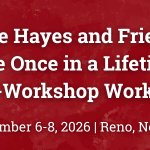
I’m re-filming for my online course, ACT in Practice, and you’re invited. From Friday, November 6 to Sunday, November 8, cameras will be rolling so you can see how these courses get made. Some footage will be wonderful, and some will be permanent outtakes. You’ll be there for both.
It’s a “non-workshop” with no CE credits, which frees us to try things I’ve never tried in front of an audience. There’s no ticket price either. Instead, make a values-based contribution to the Institute for Better Health, a nonprofit that puts evidence-based tools into the hands of people who need them.
This event can’t be attended remotely, so join us in Reno and save your seat: stevenchayes.me/4z0BKCp

Almost everyone I've ever worked with carries some version of this, including therapists, including me. So the first thing I'd say is: you're in very good company.
Here's the move I find most useful: rather than asking whether the belief is true, ask what it does. Does holding onto it tightly help you build the relationships you want? Does it help you do the work that matters to you, live in the way you actually want to live?
Almost always the answer is no. You don't have to resolve whether it's accurate to decide that you're not going to let it run your behavior. That's a different question, and it's one you actually have some agency over, starting right now.
What's been sitting with you? If it's a question, leave it in the comments.
#psychologicalflexibility
#ACT
#ACTtherapy

This one is subtle, and it matters a lot for anyone trying to change their behavior or understand why they keep doing something they don't want to keep doing.
Reason-giving is the process of constructing verbal explanations for why you can't, won't, or shouldn't do something differently. The reasons often feel completely true, and sometimes they are partially true. But in ACT, we're less interested in whether the reasons are accurate and more interested in whether following them is workable. In many cases, the very act of generating reasons for not changing becomes the mechanism that keeps change from happening.
Here's a direct example: "I would go back to school, but I'm too old, I'm too busy, and I'd probably fail anyway." Each of those reasons can be interrogated, but that's usually not the most useful move. The more productive question is: are those reasons worth the life you're giving up by following them?
#psychologicalflexibility
#ACT
#ACTtherapy

I sometimes use the image of tending a garden. You choose a spot, knowing it isn't perfect, and you commit to working that ground. The act of choosing, and then showing up, is what makes it yours. Waiting for the perfect conditions is its own kind of choice, with its own costs.
#psychologicalflexibility
#ACT
#ACTtherapy

Less than four weeks left!
I'm re-filming for my online course, ACT in Practice, and you're invited to join.
From Friday November 6th to Sunday November 8th, cameras will be rolling, so you'll see how these courses get made. Some footage will be wonderful, and some will be permanent outtakes. You'll be there for both.
It's a "non-workshop" because there are no CE credits, and that frees us up to try things I've never tried in front of an audience. It's still going to be work, but also a lot of fun.
There's also no ticket price. Instead, make a values-based contribution to the Institute for Better Health, a nonprofit that puts evidence-based tools into the hands of people who need them.
Note: This event can't be attended remotely. We're about four weeks out, so if you want to join, make sure to act soon!
Click here to save your seat: stevenchayes.me/4z0BKCp
There's a reason I call it once in a lifetime: I'm 78 years old, and how long can I keep doing crazy stuff like this? Come to Reno and let's have some fun.

Letting people in requires tolerating a specific kind of vulnerability: the possibility that you will be seen and found wanting, or that you will be hurt. For most people, that possibility is uncomfortable enough that staying at a safe distance feels like the rational choice. The trouble is that the protection and the intimacy are incompatible.
You can't have real closeness and guarantee against being hurt at the same time. The question isn't how to want vulnerability more. It's whether what you care about in the relationship is worth moving toward it anyway. For most people who ask this question, the answer is yes. The willingness comes from holding that yes clearly, not from the discomfort going away.
Leave your question below. I might answer it next.
#psychologicalflexibility
#ACT
#ACTtherapy

I'm in a story in the latest issue of Meditation Magazine (the issue is on happiness and is being released to honor Thich Nhat Hanh’s 100 birthday).
The story was based on a live discussion on the features of happiness with Kevin Ellerton, (the editor of the magazine), Richie Davison (an expert in the neurobiology of mindfulness meditation), Emiliana Simon-Thomas (head of the Greater Good Science Center at UC Berkeley), Swami Sarvapriyananda, (a well known Buddhist teacher in New York), and myself.
The entire issue is available online for free, so if you'd like to have a look, you can find it here (beginning on page 51): happiness.meditationmag.com

Only four weeks away!
I'm rebuilding my online course ACT in Practice, which means three days of filming, and I'd much rather do that in a room full of people than alone with a lens!
All of it happens with a camera crew rolling, so you'll see how the sausage is made for these courses. Some of what we film will be wonderful. Some of it will be permanent outtakes. You'll be there for both.
We'll start on November 6th, so if you want to join make sure to register soon!
Click here to save your seat → stevenchayes.me/4z0BKCp
There's a reason we're calling it once in a lifetime. I’m 78 freakin’ years old and how long can I do such crazy stuff? Come to Reno, and let’s have some fun!

I recently joined the Inner Pioneers podcast with Dmitrij Achelrod, where we talked about psychological flexibility and mental resilience. You can check out the full episode here: evolute-institute.com/inner-…

Most people recognize procrastination as avoidance. Fewer people recognize this one, and yet it's just as costly, and often harder to see in yourself.
Avoidant persistence is the pattern of working very hard at something, not because it genuinely matters to you, but because stopping would mean facing what's underneath the busyness. It's workaholism, overcommitment, compulsive productivity, all in service of not feeling something. The person looks highly motivated from the outside; internally, the driving force is escape.
An example is a clinician who fills every hour of their schedule, volunteers for every committee, and is constantly exhausted but can't slow down. When I explore this pattern carefully with people, I often find that the busyness is doing the work of keeping something at bay, grief, emptiness, fear of irrelevance. The stopping is what they're actually afraid of.
#psychologicalflexibility
#ACT
#ACTtherapy

We ran a study with college students, randomly assigning some to do values writing before goal-setting. The difference in outcomes was striking, and the mechanism wasn't motivation in the conventional sense. Goals rooted in what you actually care about work differently than goals rooted in what others expect of you.
#psychologicalflexibility
#ACT
#ACTtherapy

This sounds like a philosophy department term, and it partly is, but it has very practical implications for how we think about behavior, suffering, and change.
Functional contextualism is the philosophical foundation of ACT. It holds that the meaning and function of any event, including a thought, a feeling, or a behavior, can only be understood in its context. Nothing means the same thing in all situations. The same behavior can be healthy in one context and harmful in another. The same thought can be empowering in one context and paralyzing in another. So rather than asking "is this thought true?" we ask "what does this thought do, in this context, for this person, in the service of this life?"
For example, "I'm not good enough" is not a thought to be evaluated for accuracy. It's a thought to be evaluated for function. Is holding it tightly moving this person toward the life they want, or away from it? That's the question that matters.
#psychologicalflexibility
#ACT
#ACTtherapy

I want to be careful here, because this can sound abstract until it lands experientially. But there really is a sense of self that isn't made of moods or memories or stories, a stable place to stand while the mind does what it does. Finding it is one of the more important things you can do for your mental well-being.
#psychologicalflexibility
#ACT
#ACTtherapy

This is one of the most common questions I get, and the answer is usually not what people expect. Most habits that don't stick were built on motivation, the initial enthusiasm, the energy of a fresh start. The motivation is real, but it fluctuates. It dips. And when it does, the habit goes with it.
What produces more durable change is a different foundation: the habit is connected to something you genuinely care about, so you can take the next step even when the enthusiasm has gone quiet.
The other thing worth examining is whether the habit requires tolerating something uncomfortable, uncertainty, discomfort, the risk of failing at something. If it does, and you haven't worked on your relationship with that discomfort, the habit will keep breaking down at exactly the moments it's hardest.
What's on your mind? Leave your question in the comments.
#psychologicalflexibility
#ACT
#ACTtherapy

Every person I've ever worked with carries one of these, including me. Most people don't know they're carrying it, or they know they have one but don't realize how much it's running the show.
Your self-story is the ongoing narrative your mind constructs about who you are: your strengths, your failures, your limitations, your history, and what those things mean for your future. It's not entirely wrong; it contains real experiences. But it's also not entirely right, and the problem isn't its accuracy so much as its rigidity. When you're fused with your self-story, you stop experiencing life directly and start experiencing everything through the filter of the story.
Someone with a self-story of "I've always struggled with relationships" will interpret ordinary moments of relational friction as confirmation of that story, ignore moments of genuine connection, and behave in ways that make the story more likely to keep being true. The story becomes self-fulfilling, not because it was accurate, but because fusion with it shaped every action.
#psychologicalflexibility
#ACT
#ACTtherapy

We've been taught, in a thousand ways, that tolerating discomfort is just something you endure until it passes. But willingness isn't tolerance; it's an active, chosen stance that changes how you show up.
#psychologicalflexibility
#ACT

I understand why it sounds that way, and I want to be precise here because this distinction matters a great deal.
Acceptance doesn't mean you agree with what's happening or that you're done trying to build a better life. It means you stop adding unnecessary suffering on top of the pain that's already there. When you're in pain and simultaneously fighting the fact that you're in pain, telling yourself you shouldn't be feeling this, that something is wrong with you for feeling it, you're carrying two burdens instead of one. Dropping the second one doesn't make the first disappear. But it frees up a surprising amount of energy, and that energy can go somewhere useful.
What question does this raise for you? Write it below.
#psychologicalflexibility
#ACT
#ACTtherapy

This is one of the most important distinctions I make when introducing ACT to people who are skeptical, and rightfully so, about the idea of accepting their situation.
Acceptance does not mean approving of what is happening, agreeing that it should be happening, or giving up the intention to change it. It means acknowledging that it is happening right now, without adding unnecessary resistance on top of the reality. You can accept that you are in pain and still be working to address the source of that pain.
Someone going through a difficult divorce can accept the grief they're feeling without deciding that the divorce was a good thing or that they shouldn't feel grief. Acceptance simply means: this is what's here right now, and I'm not going to waste energy fighting the fact that it's here. That freed-up energy can then go toward actually navigating the situation.
#psychologicalflexibility
#ACT
#ACTtherapy
